

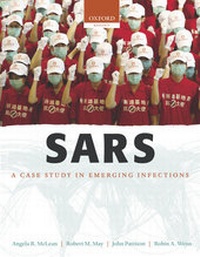
SARS
A case study in emerging infections
Published on 1. April 2005
Book
Hardback
144 pages
978-0-19-856818-6 (ISBN)
Description
The sudden appearance and rapid spread of Severe Acute Respiratory Syndrome (SARS) in 2002 served to alert the world to the fact that emerging infections are a global problem. Living in affluent societies with well developed health care systems does not necessarily protect people from the dangers posed by life-threatening infections. The SARS epidemic tested global preparedness for dealing with a new infectious agent and raised important questions: how did we do, and what did we learn? This book uses the SARS outbreak as a case study to enumerate the generic issues that must be considered when planning the control of emerging infections. Emerging infections are more than just a current biological fashion: the bitter ongoing experience of AIDS and the looming threat of pandemic influenza teach us that the control of infectious disease is a problem we have not yet solved. Scientists from a broad range of disciplines - biologists, physicians, and policy-makers - all need to prepare. But prepare for what? SARS: A Case Study in Emerging Infections provides an up-to-date and accessible overview of the tasks that must be addressed by a community that wishes to confront emerging infections. Each chapter is written by a world expert and offers an authoritative and timely overview of its subject. While focusing on SARS, the book addresses a whole range of pertinent considerations and issues, from the use of new mathematical models to account for the spread of infection across global airline networks, to a discussion of the ethics of quarantining individuals in order to protect communities. The book will be of interest to students, academics, and policy makers working in the fields of disease ecology, medicine, and public health.
Reviews / Votes
..generally well written and usually has sufficient depth to be informative. SCIENCE ...this volume will be useful to virologists and epidemiologists interested in SARS or any emerging infectious disease. The book will be invaluable for anyone who wants to know how an early 21st-century zoonotic pandemic was controlled through public health measures. It is exemplified by its readability and can be used as a guide for epidemic preparedness, as reference source for anyone interested in SARS biology and history, or as leisure reading. Deborah R Taylor, The Quarterly Review of Biology, Vol 82, June 2007 It is hard to think of a more eloquent group of people writing in this general arena... I would certainly use the book as additional reading in the course I teach...' Professor Andrew Dobson (Princeton University)More details
Language
English
Place of publication
Oxford
United Kingdom
Target group
Professional and scholarly
Illustrations
6 maps, 4 halftones and numerous line drawings
Dimensions
Height: 252 mm
Width: 194 mm
Thickness: 14 mm
Weight
487 gr
ISBN-13
978-0-19-856818-6 (9780198568186)
Copyright in bibliographic data and cover images is held by Nielsen Book Services Limited or by the publishers or by their respective licensors: all rights reserved.
Schweitzer Classification
Other editions
Additional editions

E-Book
03/2005
1st Edition
Oxford University Press
€118.94
Available for download
Book
03/2005
Oxford University Press
€68.09
Article exhausted; check different version
Persons
Robin Weiss is Professor of Viral Oncology at University College London.
Content
1. Introduction ; 2. Environmental and social influences on emerging infectious diseases: past, present, and future ; 3. Evolutionary genetics and the emergence of SARS coronavirus ; 4. Influenza as a model system for studying the cross-species transfer and evolution of the SARS coronavirus ; 5. Management and prevention of SARS in China ; 6. Confronting SARS: A view from Hong Kong ; 7. The aetiology of SARS: Koch's postulates fulfilled ; 8. Laboratory Diagnosis of SARS ; 9. Animal origins of SARS coronavirus: possible links with the international trade in small carnivores ; 10. Epidemiology, transmission dynamics and control of SARS: the 2002-2003 epidemic ; 11. Dynamics of modern epidemics ; 12. The international response to the outbreak of SARS, 2003 ; 13. The experience of the 2003 SARS outbreak as a traumatic stress among frontline healthcare workers in Toronto: lessons learned ; 14. Informed consent and public health ; 15. What have we learnt from SARS? ; References ; Index