

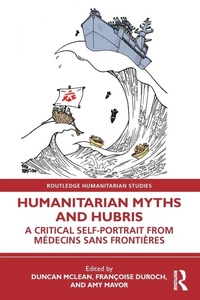
Humanitarian Myths and Hubris
A Critical Self-Portrait from Medecins Sans Frontieres
1st Edition
Will be published approx. on 22. January 2026
Book
Paperback/Softback
234 pages
978-1-032-89324-2 (ISBN)
Description
This collective work offers a critical analysis of contemporary humanitarian action, through the prism of Medecins Sans Frontieres/Doctors Without Borders (MSF).
Initially created to provide healthcare to the most vulnerable populations in crisis-stricken countries, MSF has grown from just a few dozen members in 1971 to a movement of over 67,000 people with an annual budget of over 2 billion euros. But in today's rapidly evolving global landscape, many of the founding principles and myths surrounding its creation are questioned or undermined. The post-COVID era has been marked by a reinforcement or acceleration of pre-existing trends that continue to challenge the work of humanitarian organisations: restrictive, or indeed hostile, state policies; the presence of non-state actors in counter-terrorism contexts; questionable adherence to international humanitarian law. MSF must also address several key issues, such as combating discrimination, defining its position with regard to protest movements in countries of intervention, confronting challenges related to climate change and global health security, and safeguarding patients' personal data.
Drawing on the viewpoints of practitioners, analysts, and academics, this book will be an essential read for anyone engaged in or curious about humanitarian action.
Initially created to provide healthcare to the most vulnerable populations in crisis-stricken countries, MSF has grown from just a few dozen members in 1971 to a movement of over 67,000 people with an annual budget of over 2 billion euros. But in today's rapidly evolving global landscape, many of the founding principles and myths surrounding its creation are questioned or undermined. The post-COVID era has been marked by a reinforcement or acceleration of pre-existing trends that continue to challenge the work of humanitarian organisations: restrictive, or indeed hostile, state policies; the presence of non-state actors in counter-terrorism contexts; questionable adherence to international humanitarian law. MSF must also address several key issues, such as combating discrimination, defining its position with regard to protest movements in countries of intervention, confronting challenges related to climate change and global health security, and safeguarding patients' personal data.
Drawing on the viewpoints of practitioners, analysts, and academics, this book will be an essential read for anyone engaged in or curious about humanitarian action.
Reviews / Votes
"This book offers a reflective, self-critical examination of MSF as one of the world's most iconic humanitarian organisations, which can't be more timely as the aid sector faces acute crises and must radically evolve to remain fit for purpose."Gilles Carbonnier, Professor of Development Economics, The Geneva Graduate Institute
"MSF's ability to engage in uncompromising introspection remains fascinating! A collective book that provides an insight into the organisation's ability to confront its own practices. These are relevant questions for the entire humanitarian sector as it navigates the challenges ahead."
Jean-Baptiste Richardier, President of the Board of Directors, Humanitarian Alternatives and Co-Founder of Handicap International / Humanity & Inclusion
"Humanitarian Myths and Hubris is a critical guide for the entire MSF movement at a moment when our principles, positioning, and practices are under growing strain. It is both a mirror and a map - inviting us to renew our mission with clarity, humility, and solidarity."
Wacuka Maina, The LEAF Charity
"This volume offers an insightful perspective on humanitarian action through a medical NGO's lens, critically exploring contemporary challenges. Reflecting a sustained commitment to the continued reappraisal of humanitarian aid, it is an essential read for anyone working, studying, teaching, or simply interested in the field."
Alexandre Hermet, Faculty Member, Sciences Po Toulouse
More details
Series
Language
English
Place of publication
London
United Kingdom
Publishing group
Taylor & Francis Ltd
Target group
College/higher education
Professional and scholarly
Academic, Postgraduate, Professional Practice & Development, and Undergraduate Advanced
Illustrations
2 s/w Abbildungen, 2 s/w Photographien bzw. Rasterbilder
2 Halftones, black and white; 2 Illustrations, black and white
Dimensions
Height: 234 mm
Width: 156 mm
Thickness: 14 mm
Weight
392 gr
ISBN-13
978-1-032-89324-2 (9781032893242)
Copyright in bibliographic data and cover images is held by Nielsen Book Services Limited or by the publishers or by their respective licensors: all rights reserved.
Schweitzer Classification
Other editions
Additional editions
Duncan McLean | Francoise Duroch | Amy Mavor
Humanitarian Myths and Hubris
A Critical Self-Portrait from Medecins Sans Frontieres
E-Book
01/2026
Routledge
€49.99
Available for download
Duncan McLean | Francoise Duroch | Amy Mavor
Humanitarian Myths and Hubris
A Critical Self-Portrait from Medecins Sans Frontieres
E-Book
01/2026
Routledge
€49.99
Available for download
Duncan McLean | Francoise Duroch | Amy Mavor
Humanitarian Myths and Hubris
A Critical Self-Portrait from Medecins Sans Frontieres
Book
approx. 01/2026
1st Edition
Routledge
€211.40
Not yet published
Persons
Duncan McLean is currently a Senior Researcher with MSF's Research Unit on Humanitarian Stakes and Practices (UREPH), based in Geneva. Holding a PhD in history, he has published widely on the humanitarian sector, regularly lectures at universities throughout Europe, and is on the editorial board of the Journal of Humanitarian Affairs.
Francoise Duroch began working in the humanitarian field in the early 1990s with Handicap International, then with MSF. She has spent 15 years researching gender-based violence and holds a PhD in social sciences. She is a lecturer at several universities and currently coordinates the MSF Switzerland research unit in Geneva.
Amy Mavor holds master's degrees in languages from the University of Edinburgh and translation from Universite Rennes 2, and has worked since 2018 as Publishing and Editing Officer at MSF Switzerland's research unit.
Francoise Duroch began working in the humanitarian field in the early 1990s with Handicap International, then with MSF. She has spent 15 years researching gender-based violence and holds a PhD in social sciences. She is a lecturer at several universities and currently coordinates the MSF Switzerland research unit in Geneva.
Amy Mavor holds master's degrees in languages from the University of Edinburgh and translation from Universite Rennes 2, and has worked since 2018 as Publishing and Editing Officer at MSF Switzerland's research unit.
Content
Introduction: Humanitarianism in Retreat?; PART I - ELEMENTS OF CHANGE AND CONTINUITY 1 'Good' and 'Bad' Victims? A Matter of Choice; Zoom-in: Healthcare without Borders: Navigating Securitisation and Exclusion of Migrants; 2 The Evolution of How MSF Treats People; 3 Hostility to Aid Actors: Normalising Transgression?; Zoom-in: Security Management with Locally Hired Staff: A Collaboration with Gaps?; PART II - NAVIGATING EXPECTATIONS 4 From Technique to Technicity: Evolving Aims in MSF's Medical Practice; 5 Global Health Security in Humanitarian Medicine: What Is the Greater Good?; Zoom-in: The IFRC's Community-driven Approach in DRC's Ebola Outbreak; 6 Caught in the Crossfire? International NGOs and Contemporary Forms of Protest and Resistance; Zoom-in: Protecting Humanitarian Action in an Age of Disinformation; 7 Speaking Out With, Not For: Rethinking Humanitarian Narratives; PART III - CHALLENGING ADAPTATIONS 8 Liberal vs. Critical: Diverging Paths in Humanitarian Aid and Global Health; Zoom-in: Reflecting on Diversity, Equity, and Inclusion in MSF; 9 Absorbed into the War Machine: What Is Independence When Everything Is Connected?; 10 Without Borders, Within Boundaries: Learning How to Deliver Aid in Light of the Climate Emergency; Epilogue: Negotiating Spaces, Defending Convictions