

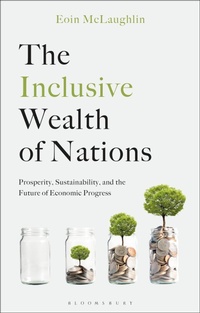
The Inclusive Wealth of Nations
Prosperity, Sustainability, and the Future of Economic Progress
Will be published approx. on 6. August 2026
Book
Hardback
416 pages
978-1-350-54415-4 (ISBN)
Description
This book argues for a reassessment of the way a nation's wealth is measured that goes beyond the simple measurement of GDP to include on all capital - produced, human, natural and social - that contribute to human well-being and national wealth in the broadest sense.
By including natural resources, ecosystems and biodiversity in the measurement of national wealth, inclusive wealth ensures that economic development is sustainable and safeguards future prosperity.
The Inclusive Wealth of Nations provides an overview of how economists have viewed economic growth from Adam Smith's early insights to the present. It carefully explains how economists responded to increased critiques of economic growth - the Limits to Growth - in the 1970s and how this laid the foundation for how economists think about sustainable development today. It analyses why economists argue that inclusive wealth should be the measurement used, and also critically evaluates practical applications of this approach.
Written in a lively and accessible way, it helps the reader understand how inclusive wealth provides a way of balancing short-term economic gains with long-term sustainability.
By including natural resources, ecosystems and biodiversity in the measurement of national wealth, inclusive wealth ensures that economic development is sustainable and safeguards future prosperity.
The Inclusive Wealth of Nations provides an overview of how economists have viewed economic growth from Adam Smith's early insights to the present. It carefully explains how economists responded to increased critiques of economic growth - the Limits to Growth - in the 1970s and how this laid the foundation for how economists think about sustainable development today. It analyses why economists argue that inclusive wealth should be the measurement used, and also critically evaluates practical applications of this approach.
Written in a lively and accessible way, it helps the reader understand how inclusive wealth provides a way of balancing short-term economic gains with long-term sustainability.
Reviews / Votes
'This is a hugely impressive work on a hugely important subject: how should an economy's performance be measured? For decades we have deployed, with no justification, on GDP and related measures. However, recent advances in theoretical reasoning have shown that the metric that should instead be used is the economy's wealth, that is, the social value of its capital assets (including natural capital). The author is among the first to prepare a full-blown account not only of the theory, but also of attempts to estimate the wealth of nations.' * Sir Partha Dasgupta, University of Cambridge, UK * 'We argue over GDP and (de)growth because we've lost a deeper historical understanding of wealth - one that saw more than income. McLaughlin returns to that tradition, not out of nostalgia, but to restore a wisdom we can no longer afford to ignore.' * Paul Sharp, University of Southern Denmark * 'Imaginative, well-written, and timely.' * Kevin O'Rourke, Sciences Po, France * 'Are people better off now than in the past - and if so, will economic progress continue? It depends on the wealth of the nation, properly defined to include its people and natural resources as well as infrastructure and machines: do we now have what we need to be productive, and can it be sustained? This book suggests not, but suggests that measuring wealth instead of GDP could change this.' * Dame Diane Coyle, University of Cambridge, UK * 'Adam Smith may not have lost much sleep 250 years ago worrying about fossil fuels and global warming - nor did he need to. But as we learn from this fluent, timely, and highly original work, Smith's framework for analysing the limits to sustainable economic growth has a very modern ring to it. In linking his insights to the concerns of environmental economists in 2026 and building on them, Eoin McLaughlin's The Inclusive Wealth of Nations contributes to both the history of economics and the economics "of what lies ahead".' * Cormac O Grada, University College Dublin, Ireland * 'The kind of book I have long wanted to be able to put into students' hands: intellectually ambitious, historically grounded, and immediately useful for teaching. It returns to Adam Smith in the only way that matters pedagogically - not as a set of slogans about pin factories and invisible hands, but as a moral philosopher concerned with the wealth of nations in the fullest sense. This is a book that will sharpen classroom discussion, travel across different teaching contexts, and reward rereading - precisely the qualities that make it an outstanding teaching text.' * Chris Colvin, Queens University Belfast, Ireland * 'Debates about progress now oscillate between optimism and alarm. Eoin McLaughlin takes a longer view, returning to Adam Smith's broader vision of political economy, one that bound markets to morals and prosperity to its natural foundations. The result is a timely and carefully argued book. At a moment when societies cannot afford to give up on growth, yet can no longer ignore its costs, McLaughlin shows how a fuller account of wealth can reconcile human flourishing with environmental limits.' * Johan Fourie, Stellenbosch University, South Africa * 'Professor McLaughlin rose to fame for revealing trends in the wealth of nations over the past 200 years. Now, in this timely work he offers the key insights into how our nations can maintain their wealth for the next 200 years.' * Matthew Agarwala, University of Sussex, UK *More details
Language
English
Place of publication
London
United Kingdom
Publishing group
Bloomsbury Publishing PLC
Target group
Professional and scholarly
College/higher education
Dimensions
Height: 234 mm
Width: 156 mm
ISBN-13
978-1-350-54415-4 (9781350544154)
Copyright in bibliographic data and cover images is held by Nielsen Book Services Limited or by the publishers or by their respective licensors: all rights reserved.
Schweitzer Classification
Person
Eoin McLaughlin is Professor of Economics in Edinburgh Business School at Heriot-Watt University, UK.
Content
Preface
1. The Inclusive Wealth of Nations
Part I History of the Theory of Economic Growth
2. Wealth of Nations: A Synopsis
3. Where is the Wealth of Nations? A Short History of the Theory of Economic Growth
Part II History of the Global Economy
4. Conflicting Futures: Development and Environment in the Twentieth Century
Part III History of Measurement
5. Measuring the Wealth of Nations: A History of National Income Accounting
6. Measuring the Inclusive Wealth of Nations: A History of Wealth Accounting
Part IV History of Economic Growth
7. A Brief History of UK Economic Growth, 1750-2020
8. Measuring the UK's Inclusive Wealth, 1750-2020
Part V Alternatives
9. Can an Inclusive Wealth Based Approach Safeguard for the Future?
Conclusion
1. The Inclusive Wealth of Nations
Part I History of the Theory of Economic Growth
2. Wealth of Nations: A Synopsis
3. Where is the Wealth of Nations? A Short History of the Theory of Economic Growth
Part II History of the Global Economy
4. Conflicting Futures: Development and Environment in the Twentieth Century
Part III History of Measurement
5. Measuring the Wealth of Nations: A History of National Income Accounting
6. Measuring the Inclusive Wealth of Nations: A History of Wealth Accounting
Part IV History of Economic Growth
7. A Brief History of UK Economic Growth, 1750-2020
8. Measuring the UK's Inclusive Wealth, 1750-2020
Part V Alternatives
9. Can an Inclusive Wealth Based Approach Safeguard for the Future?
Conclusion