

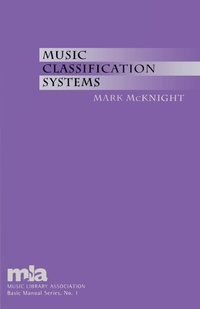
Music Classification Systems
Published on 16. April 2002
Book
Paperback/Softback
144 pages
978-0-8108-4263-2 (ISBN)
Description
Due to the distinctive nature of music as a separate "language" that non-musicians are often unable to read or understand, the cataloging and classification of music materials frequently present special challenges. In response to this often problematic situation, this volume is designed to introduce the principles of music classification to beginning music catalogers, as well as to non-specialist catalogers, and those who only occasionally deal with music materials. It will surely relieve the stress level for general catalogers by providing practical guidelines as well as clarifying and explaining the most commonly used classification systems in the United States-the Dewey Decimal Classification (DDC), the Library of Congress Classification (LCC), and the Alpha-Numeric System for Classification of Recordings (ANSCR).
Also included is a general historical overview of music classification, from early attempts to organize specific collections, to the efforts of Oscar Sonneck and others to adapt fundamental principles of classification to the distinctive characteristics of music materials; as well as a discussion of the special needs of the users of those materials.
Also included is a general historical overview of music classification, from early attempts to organize specific collections, to the efforts of Oscar Sonneck and others to adapt fundamental principles of classification to the distinctive characteristics of music materials; as well as a discussion of the special needs of the users of those materials.
Reviews / Votes
Turning to DDC, McKnight provides a well-written chapter outlining the history, advantages and pitfalls of the system....But, the heart of the manual...is the account of the LCC M (Music) schedule....McKnight picks his examples well, writes with clarity, and suggests improvements to the system... * Music Reference Services Quarterly * ...a particularly welcome addition to the limited existing literature relating to this system. McKnight writes in a clear, unfussy style, which combined with a clear structure of paragraph headings, makes his prose eminently readable....recommended as a concise introduction to music classification. * Library Review * Easy to understand and straight-forward...While this book is for the beginning and less-experienced music cataloger, even the more seasoned music cataloger should find it of interest...A welcome addition to any music cataloger's reference shelf. * Library Resources & Technical Services (LRTS) *More details
Series
Language
English
Place of publication
Lanham, MD
United States
Dimensions
Height: 216 mm
Width: 140 mm
Thickness: 10 mm
Weight
232 gr
ISBN-13
978-0-8108-4263-2 (9780810842632)
Copyright in bibliographic data and cover images is held by Nielsen Book Services Limited or by the publishers or by their respective licensors: all rights reserved.
Schweitzer Classification
Other editions
Additional editions
Mark McKnight | Linda Barnhart
Music Classification Systems
E-Book
04/2002
1st Edition
Scarecrow Press
€43.49
Available for download
Mark McKnight | Linda Barnhart
Music Classification Systems
E-Book
04/2002
1st Edition
Scarecrow Press
€43.49
Available for download
Persons
Mark McKnight is Associate Head of the Music Library at the University of North Texas and teaches courses in music cataloging for UNT's School of Library and Information Science.
Content
Chapter 1 An Introduction to Music Classification
Chapter 2 Dewey Decimal Classification (DDC)
Chapter 3 Library of Congress Classification (LCC)
Chapter 4 Alpha-Numeric System for Classification
Chapter 5 Shelf Arrangement in the Classification of Music Materials
Chapter 6 Concluding Observations
Chapter 2 Dewey Decimal Classification (DDC)
Chapter 3 Library of Congress Classification (LCC)
Chapter 4 Alpha-Numeric System for Classification
Chapter 5 Shelf Arrangement in the Classification of Music Materials
Chapter 6 Concluding Observations