

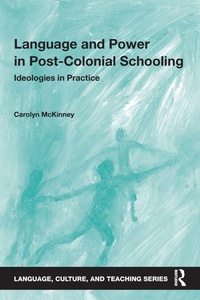
Language and Power in Post-Colonial Schooling
Ideologies in Practice
1st Edition
Published on 9. August 2016
Book
Paperback/Softback
178 pages
978-1-138-84407-0 (ISBN)
Description
Critiquing the positioning of children from non-dominant groups as linguistically deficient, this book aims to bridge the gap between theorizing of language in critical sociolinguistics and approaches to language in education. Carolyn McKinney uses the lens of linguistic ideologies-teachers' and students' beliefs about language-to shed light on the continuing problem of reproduction of linguistic inequality. Framed within global debates in sociolinguistics and applied linguistics, she examines the case of historically white schools in South Africa, a post-colonial context where political power has shifted but where the power of whiteness continues, to provide new insights into the complex relationships between language and power, and language and subjectivity. Implications for language curricula and policy in contexts of linguistic diversity are foregrounded.
Providing an accessible overview of the scholarly literature on language ideologies and language as social practice and resource in multilingual contexts, Language and Power in Post-Colonial Schooling uses the conceptual tools it presents to analyze classroom interaction and ethnographic observations from the day-to-day life in case study schools and explores implications of both the research literature and the analyses of students' and teachers' discourses and practices for language in education policy and curriculum.
Providing an accessible overview of the scholarly literature on language ideologies and language as social practice and resource in multilingual contexts, Language and Power in Post-Colonial Schooling uses the conceptual tools it presents to analyze classroom interaction and ethnographic observations from the day-to-day life in case study schools and explores implications of both the research literature and the analyses of students' and teachers' discourses and practices for language in education policy and curriculum.
More details
Series
Language
English
Place of publication
London
United Kingdom
Publishing group
Taylor & Francis Ltd
Target group
College/higher education
Professional and scholarly
Illustrations
4 s/w Abbildungen, 2 s/w Tabellen
2 Tables, black and white; 4 Illustrations, black and white
Dimensions
Height: 229 mm
Width: 152 mm
Thickness: 11 mm
Weight
295 gr
ISBN-13
978-1-138-84407-0 (9781138844070)
Copyright in bibliographic data and cover images is held by Nielsen Book Services Limited or by the publishers or by their respective licensors: all rights reserved.
Schweitzer Classification
Other editions
Additional editions
Book
08/2016
1st Edition
Routledge
€253.20
Shipment within 10-20 days
E-Book
07/2016
Routledge
€63.49
Available for download
E-Book
07/2016
Routledge
€63.49
Available for download
Person
Carolyn McKinney is Associate Professor, Language Education, School of Education, University of Cape Town, South Africa.
Content
Foreword
Hilary Janks
Preface
Chapter 1
What counts as [a] language?
Chapter 2
What counts as language in education policy and curricula?
Chapter 3
Whose language resources count in schooling?
Chapter 4
Anglonormativity: language ideologies and the reproduction of race
Chapter 5
Positioning students in an Anglonormative English class: asymmetrical relations of knowing.
Chapter 6
Hope I: Students' agency in interrupting Anglonormativity
Chapter 7
Hope II: Interrupting Anglonormativty through transformative pedagogies
Chapter 8
Conclusion: Changing what counts as legitimate language use in schooling
Hilary Janks
Preface
Chapter 1
What counts as [a] language?
Chapter 2
What counts as language in education policy and curricula?
Chapter 3
Whose language resources count in schooling?
Chapter 4
Anglonormativity: language ideologies and the reproduction of race
Chapter 5
Positioning students in an Anglonormative English class: asymmetrical relations of knowing.
Chapter 6
Hope I: Students' agency in interrupting Anglonormativity
Chapter 7
Hope II: Interrupting Anglonormativty through transformative pedagogies
Chapter 8
Conclusion: Changing what counts as legitimate language use in schooling