

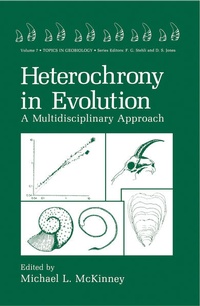
Heterochrony in Evolution
A Multidisciplinary Approach
Published on 30. September 1988
Book
Hardback
XVIII, 348 pages
978-0-306-42947-7 (ISBN)
Description
... an adult poet is simply an individual in a state of arrested development-in brief, a sort of moron. Just as all of us, in utero, pass through a stage in which we are tadpoles, ... so all of us pass through a state, in our nonage, when we are poets. A youth of seventeen who is not a poet is simply a donkey: his development has been arrested even anterior to that of the tadpole. But a man of fifty who still writes poetry is either an unfortunate who has never developed, intellectually, beyond his teens, or a conscious buffoon who pretends to be something he isn't-something far younger and juicier than he actually is. -H. 1. Mencken, High and Ghostly Matters, Prejudices: Fourth Series (1924) Where would evolution be, Without this thing, heterochrony? -M. L. McKinney (1987) One of the joys of working in a renascent field is that it is actually possible to keep up with the literature. So it is with mixed emotions that we heterochronists (even larval forms like myself) view the recent "veritable explosion of interest in heterochrony" (in Gould's words in this volume). On the positive side, it is ob viously necessary and desirable to extend and expand the inquiry; but one regrets that already we are beginning to talk past, lose track of, and even ignore each other as we carve out individual interests.
More details
Series
Edition
1988 ed.
Language
English
Place of publication
New York
United States
Publishing group
Springer Science+Business Media
Target group
Professional and scholarly
Research
Illustrations
XVIII, 348 p.
Dimensions
Height: 241 mm
Width: 160 mm
Thickness: 25 mm
Weight
723 gr
ISBN-13
978-0-306-42947-7 (9780306429477)
DOI
10.1007/978-1-4899-0795-0
Schweitzer Classification
Other editions
Additional editions
Book
06/2013
Springer
€213.99
Shipment within 15-20 days
Content
1 The Uses of Heterochrony.- I. Analysis of Heterochrony.- 2 Classifying Heterochrony: Allometry, Size, and Time.- 3 Multivariate Analysis.- 4 Shape Analysis: Ideas from the Ostracoda.- 5 Phylogenetic Analysis and the Detection of Ontogenetic Patterns.- 6 Sclerochronology and the Size versus Age Problem.- II. Heterochrony in Major Groups.- 7 Heterochrony in Plants: The Intersection of Evolution Ecology and Ontogeny.- 8 Heterochrony in Colonial Marine Animals.- 9 Heterochrony in Ammonites.- 10 Heterochrony in Gastropods: A Paleontological View.- 11 Heterochrony in Gastropods: A Neontological View.- 12 Heterochrony in Rodents.- 13 Heterochrony in Primates.- III. Cause, Abundance, and Implications of Heterochrony.- 14 Genetic Basis for Heterochronic Variation.- 15 The Abundance of Heterochrony in the Fossil Record.- 16 Heterochrony in Evolution: An Overview.