

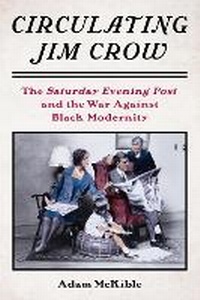
Circulating Jim Crow
The Saturday Evening Post and the War Against Black Modernity
Published on 20. February 2024
Book
Paperback/Softback
288 pages
978-0-231-21265-6 (ISBN)
Description
Winner, 2023-2024 RSAP Book Prize, Research Society for American Periodicals
Shortlisted, 2025 Modernist Studies Association Book Prize
In the early twentieth century, the Saturday Evening Post was perhaps the most popular and influential magazine in the United States, establishing literary reputations and shaping American culture. In the popular imagination, it is best remembered for Norman Rockwell's covers, which nostalgically depicted a wholesome and idyllic American way of life. But beneath those covers lurked a more troubling reality. Under the direction of its longtime editor, George Horace Lorimer, the magazine helped justify racism and white supremacy. It published works by white authors that made heavy use of paternalistic tropes and demeaning humor, portraying Jim Crow segregation and violence as simple common sense.
Circulating Jim Crow demonstrates how the Post used stereotypical dialect fiction to promulgate white supremacist ideology and dismiss Black achievements, citizenship, and humanity. Adam McKible tells the story of Lorimer's rise to prominence and examines the white authors who provided the editor and his readers with the caricatures they craved. He also explores how Black writers of the Harlem Renaissance pushed back against the Post and its commodified racism. McKible places the erstwhile household names who wrote for the magazine in conversation with figures such as Paul Laurence Dunbar, F. Scott Fitzgerald, Ann Petry, W. E. B. Du Bois, and William Faulkner. Revealing the role of the Saturday Evening Post in normalizing racism for millions of readers, this book also offers a new understanding of how Black writers challenged Jim Crow ideology.
Shortlisted, 2025 Modernist Studies Association Book Prize
In the early twentieth century, the Saturday Evening Post was perhaps the most popular and influential magazine in the United States, establishing literary reputations and shaping American culture. In the popular imagination, it is best remembered for Norman Rockwell's covers, which nostalgically depicted a wholesome and idyllic American way of life. But beneath those covers lurked a more troubling reality. Under the direction of its longtime editor, George Horace Lorimer, the magazine helped justify racism and white supremacy. It published works by white authors that made heavy use of paternalistic tropes and demeaning humor, portraying Jim Crow segregation and violence as simple common sense.
Circulating Jim Crow demonstrates how the Post used stereotypical dialect fiction to promulgate white supremacist ideology and dismiss Black achievements, citizenship, and humanity. Adam McKible tells the story of Lorimer's rise to prominence and examines the white authors who provided the editor and his readers with the caricatures they craved. He also explores how Black writers of the Harlem Renaissance pushed back against the Post and its commodified racism. McKible places the erstwhile household names who wrote for the magazine in conversation with figures such as Paul Laurence Dunbar, F. Scott Fitzgerald, Ann Petry, W. E. B. Du Bois, and William Faulkner. Revealing the role of the Saturday Evening Post in normalizing racism for millions of readers, this book also offers a new understanding of how Black writers challenged Jim Crow ideology.
Reviews / Votes
Gripping and doggedly researched, Circulating Jim Crow exposes the corrosion at the underbelly of the Saturday Evening Post. Adam McKible reveals the larger cultural and political context that made the inherently anti-Black magazine popular. Through his deft and energetic prose, McKible offers readers a fresh lens to understand the era of the New Negro Movement as a whole. -- Emily Bernard, author of <i>Black in the Body: Stories from My Grandmother's Time, My Mother's Time, and Mine</i> Through meticulous research and crisp prose, Circulating Jim Crow greatly deepens our understanding of the Saturday Evening Post, whose success in the first half of the twentieth century depended greatly on George H. Lorimer's campaign to define American identity as white supremacist and antiblack. McKible offers a crucial warning for our time. -- Darryl Dickson-Carr, author of <i>Spoofing the Modern: Satire in the Harlem Renaissance</i> McKible reveals that when not wrapping the American way in Rockwellian nostalgia, the Saturday Evening Post did its best to thwart Black modernity. Full of sobering detail and impassioned judgment, Circulating Jim Crow measures the forbidding height of the wall modern African American writing climbed and conquered. -- William J. Maxwell, author of <i>F.B. Eyes: How J. Edgar Hoover's Ghostreaders Framed African American Literature</i> A brilliant new book by a major scholar of American periodical culture, Circulating Jim Crow reveals the efforts to undermine black modernity at the heart of one of the most successful purveyors of nostalgic Americana. As voices for white supremacy again grow louder, McKible's compelling analysis of the role cultural institutions play in normalizing racism and xenophobia couldn't be timelier. -- Mark S. Morrisson, author of <i>Modernism, Science, and Technology</i> An eye-opening look at manipulative media and the way we were. * Chronogram Magazine * Detailed, informed, and scholarly . . . Recommended. * Choice Reviews * An unwavering assessment of the centrality of American racism at the beginning of the twentieth century. * e-Rea: Revue electronique d'etudes sur le monde anglophone * A brilliant, original book, which formulates a supple theoretical framework for interpreting the "shadow" cast by white supremacist cultures remade for the modern era of consumerism, airplane travel, cinema, and mass circulation periodicals. * The Space Between * What is unique about McKible's intervention is the reminder that, paradoxically, the study of mass-market magazines aimed at a white middle-class audience has much to tell us about the contexts and conditions of Black modernity and selfhood. * American Literary History * A thoroughly detailed and consistently insightful study of one of the most influential cultural sites in the US. * American Periodicals *More details
Series
Language
English
Place of publication
New York
United States
Target group
Professional and scholarly
Product notice
Paperback (trade)
Dimensions
Height: 229 mm
Width: 152 mm
ISBN-13
978-0-231-21265-6 (9780231212656)
Copyright in bibliographic data and cover images is held by Nielsen Book Services Limited or by the publishers or by their respective licensors: all rights reserved.
Schweitzer Classification
Other editions
Additional editions
E-Book
02/2024
1st Edition
Columbia University Press
€34.49
Available for download
Person
Adam McKible is associate professor of English at John Jay College of Criminal Justice. He is author of The Space and Place of Modernism: The Russian Revolution, Little Magazines, and New York (2002), editor of Edward Christopher Williams's When Washington Was in Vogue (2004), and coeditor of Little Magazines and Modernism: New Approaches (2007).
Content
Acknowledgments
Introduction
1. George Horace Lorimer and Rising Jim Crow
2. Literary Aspiration and Intimate Minstrelsy
3. Irvin S. Cobb: Making the New Negro Old Again
4. Hugh Wiley, Edward Christopher Williams, and Black Doughboys
5. Octavus Roy Cohen, the Midnight Motion Picture Company, and the Shadows of Jim Crow
6. The End of the Lorimer Era
Epilogue
Notes
Bibliography
Index
Introduction
1. George Horace Lorimer and Rising Jim Crow
2. Literary Aspiration and Intimate Minstrelsy
3. Irvin S. Cobb: Making the New Negro Old Again
4. Hugh Wiley, Edward Christopher Williams, and Black Doughboys
5. Octavus Roy Cohen, the Midnight Motion Picture Company, and the Shadows of Jim Crow
6. The End of the Lorimer Era
Epilogue
Notes
Bibliography
Index