

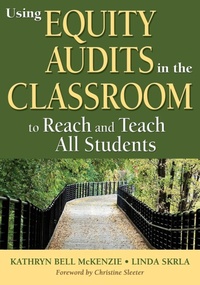
Using Equity Audits in the Classroom to Reach and Teach All Students
1st Edition
Published on 7. September 2011
Book
Paperback/Softback
128 pages
978-1-4129-8677-9 (ISBN)
Description
Raise your equity awareness quotient
In this time of changing demographics and increased diversity, many teachers find that existing strategies to promote equity are only successful with some of the students in their classes. This book provides teachers with new strategies and tools that will work for all children, including those with diverse needs. The authors outline a wide range of methods to help teachers:
Assess their competency in teaching all students
Embrace self-reflection and be open to change
Evaluate and assess student achievement
Develop high-quality teaching skills and an equity consciousness that leads to success with all students
Every chapter of this easy-to-read and content-rich text contains a wealth of assessment tools and discussion tools that guide educators to greater equity and excellence. Teachers will find practical strategies for raising student achievement and closing the achievement gap.
In this time of changing demographics and increased diversity, many teachers find that existing strategies to promote equity are only successful with some of the students in their classes. This book provides teachers with new strategies and tools that will work for all children, including those with diverse needs. The authors outline a wide range of methods to help teachers:
Assess their competency in teaching all students
Embrace self-reflection and be open to change
Evaluate and assess student achievement
Develop high-quality teaching skills and an equity consciousness that leads to success with all students
Every chapter of this easy-to-read and content-rich text contains a wealth of assessment tools and discussion tools that guide educators to greater equity and excellence. Teachers will find practical strategies for raising student achievement and closing the achievement gap.
Reviews / Votes
"Equity audits are critical to improving the services we provide in today's diverse classroom. It is crucial that teachers and administrators see the inequities in the system and establish the protocols necessary to level the field." -- Maria J. Carrillo, Science Teacher "It is essential, but woefully insufficient, to desire excellence and equity. We need detailed, evidence-based, practical maps and guides. This powerful, useful book will chart our path beyond current inequities toward the assurance of quality teaching and learning for all." -- Joseph F. Johnson, Jr., Executive DirectorMore details
Edition
First Edition
Language
English
Place of publication
Thousand Oaks
United States
Publishing group
SAGE Publications Inc
Target group
Professional and scholarly
Dimensions
Height: 254 mm
Width: 178 mm
Thickness: 7 mm
Weight
260 gr
ISBN-13
978-1-4129-8677-9 (9781412986779)
Copyright in bibliographic data and cover images is held by Nielsen Book Services Limited or by the publishers or by their respective licensors: all rights reserved.
Schweitzer Classification
Persons
Kathryn Bell McKenzie is professor emerita of Advanced Studies in Education at California State University, Stanislaus and associate professor emerita of Educational Administration and Human Resource Development at Texas A&M University. At California State, Kathryn was director of the EdD program in Educational Leadership and at Texas A&M, she was coordinator for the PhD in K-12 Educational Leadership.Prior to becoming a professor,Kathryn was a public school educator serving as a teacher, curriculum specialist, assistant principal,and principal for nearly twenty-five years. She was also the deputy director of the Austin Independent School District Leadership Academy. She has an international reputation with both P-12 and university educators who have used her work on equity traps and equity audits to improve educational practices that advance equity and excellence. She has numerous journal publications and books and is an educational consultant,writer, and speaker. Linda Skrla is Professor of Educational Administration at Texas A&M University. Prior to joining the Texas A&M faculty in 1997, Linda worked as a middle school and high school teacher and as a campus and district administrator in public schools. Her research focuses on educational equity issues in school leadership, including accountability policy, high success school districts, and women superintendents. Linda is Vice President of Division A of the American Educational Research Association (AERA) and Editor of Educational Administration Quarterly. She has published extensively in academic journals and has co-authored and co-edited five other books, the most recent of which is Using Equity Audits to Create Equitable and Excellent Schools (Corwin Press, 2009).
Content
Foreword
Acknowledgments
About the Authors
1. Introduction
A Brief Overview of Our Work on Equity Audits
Previews of Chapters 2-9
Chapter Conclusion
Section I. Conceptual and Historical Frameworks
2. Equitable and Excellent Teaching
Equity Consciousness Preassessment
Equity Consciousness Defined
Research on Equity Consciousness
Research on High-Quality Teaching Skills
Chapter Conclusion
Discussion Questions and Activities
3. Qualities of Equitable and Excellent Classrooms
An Example of an Equitable and Excellent School: Tice Elementary
Classroom Equity Assessment
Chapter Conclusion
Discussion Questions and Activities
4. Auditing for Equity and Excellence
Equity Audits in International Settings
Equity Audits in U.S. Education
Refining Equity Audits Into a Usable Tool
Chapter Conclusion
Discussion Questions and Activities
Section II. Equity Auditing in the Classroom
5. Auditing for Teaching and Learning
Active Cognitive Engagement
What Our Critics Might Say
Zone of Self-Efficacy
An Auditing Tool: Teaching and Learning Tours
Chapter Conclusion
Discussion Questions and Activities
6. Auditing for Discipline
Research on Discipline
Reasons for Discipline Disproportionality
Auditing Tools for Examining Classroom Disciplinary Practices
Chapter Conclusion
Discussion Questions and Activities
7. Auditing for Parental Involvement
What Research Says About Parental Involvement
Classroom Parental Involvement Inventory
Chapter Conclusion
Discussion Questions and Activities
8. Auditing for Programmatic Equity
Advanced Placement
Gifted and Talented Programs
Special Education
Chapter Conclusion
Discussion Questions and Activities
9. Conclusion
References
Index
Acknowledgments
About the Authors
1. Introduction
A Brief Overview of Our Work on Equity Audits
Previews of Chapters 2-9
Chapter Conclusion
Section I. Conceptual and Historical Frameworks
2. Equitable and Excellent Teaching
Equity Consciousness Preassessment
Equity Consciousness Defined
Research on Equity Consciousness
Research on High-Quality Teaching Skills
Chapter Conclusion
Discussion Questions and Activities
3. Qualities of Equitable and Excellent Classrooms
An Example of an Equitable and Excellent School: Tice Elementary
Classroom Equity Assessment
Chapter Conclusion
Discussion Questions and Activities
4. Auditing for Equity and Excellence
Equity Audits in International Settings
Equity Audits in U.S. Education
Refining Equity Audits Into a Usable Tool
Chapter Conclusion
Discussion Questions and Activities
Section II. Equity Auditing in the Classroom
5. Auditing for Teaching and Learning
Active Cognitive Engagement
What Our Critics Might Say
Zone of Self-Efficacy
An Auditing Tool: Teaching and Learning Tours
Chapter Conclusion
Discussion Questions and Activities
6. Auditing for Discipline
Research on Discipline
Reasons for Discipline Disproportionality
Auditing Tools for Examining Classroom Disciplinary Practices
Chapter Conclusion
Discussion Questions and Activities
7. Auditing for Parental Involvement
What Research Says About Parental Involvement
Classroom Parental Involvement Inventory
Chapter Conclusion
Discussion Questions and Activities
8. Auditing for Programmatic Equity
Advanced Placement
Gifted and Talented Programs
Special Education
Chapter Conclusion
Discussion Questions and Activities
9. Conclusion
References
Index