

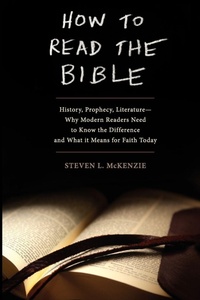
How to Read the Bible
History, Prophecy, Literature--Why Modern Readers Need to Know the Difference and What It Means for Faith Today
Published on 30. April 2009
Book
Paperback/Softback
224 pages
978-0-19-538330-0 (ISBN)
Description
More people read the Bible than any other book and, as Steven McKenzie shows in this provocative volume, most of us misread it. McKenzie argues that to comprehend the Bible we must grasp the intentions of the biblical authors themselves--what sort of texts they thought they were writing and how they would have been understood by their contemporaries. McKenzie examines several genres that are typically misunderstood, offering careful readings of specific texts to show how the confusion arises, and how knowing the genre produces a correct reading. The book of Jonah, for example, offers many clues that it is meant as a humorous satire, not a straight-faced historical account of a man who was swallowed by a fish. Likewise, the very names "Adam" (man) and "Eve" (life) tell us that these are not historical characters, but figures who symbolize human origins. For anyone who takes reading the Bible seriously and who wants to get it right, this book will be enlightening.
Reviews / Votes
"Thoughtfully considered and ably written, this book is highly recommended for all libraries."--Library Journal
"Steven L. McKenzie offers a fresh take on the ancient texts of the Bible and allows us to see the familiar biblical landscape in wholly new and illuminating ways. How to Read the Bible is authoritative and provocative, often witty and always insightful and illuminating, an essential tool for modern readers of the Jewish and Christian scriptures."
--Jonathan Kirsch, author of God Against the Gods: The History of the War Between Monotheism and Polytheism and The Harlot by the Side of the Road: Forbidden Tales of the Bible
"In order to determine what the Bible means, we must first determine the intentions of its authors, intentions expressed in the literary genres they used. In his examination of several genres used in the Bible, McKenzie demonstrates through detailed analysis how the identification of genre is as necessary for the understanding of biblical literature as it is of any literature. An important and insightful book."
--Michael D. Coogan, editor of The New Oxford Annotated Bible, Third Edition, and The Oxford History of the Biblical World
"Thoughtfully considered and ably written, this book is highly recommended for all libraries."--Library Journal
"Steven L. McKenzie offers a fresh take on the ancient texts of the Bible and allows us to see the familiar biblical landscape in wholly new and illuminating ways. How to Read the Bible is authoritative and provocative, often witty and always insightful and illuminating, an essential tool for modern readers of the Jewish and Christian scriptures." --Jonathan Kirsch, author of God Against the Gods: The History of the War Between Monotheism and
Polytheism and The Harlot by the Side of the Road: Forbidden Tales of the Bible
"In order to determine what the Bible means, we must first determine the intentions of its authors, intentions expressed in the literary genres they used. In his examination of several genres used in the Bible, McKenzie demonstrates through detailed analysis how the identification of genre is as necessary for the understanding of biblical literature as it is of any literature. An important and insightful book."--Michael D. Coogan, editor of The New Oxford
Annotated Bible, Third Edition, and The Oxford History of the Biblical World
"How to Read the Bible is a role model of its kind. Steven L. McKenzie, a rising star in our field, has 'squared the circle' and delivered a book that blends serious up-to-date scholarship with a simple, straightforward style aimed at an intelligent but non-scholarly audience. At the same time, I would add a hint to scholars: We could read the book to advantage and pick up pointers on the latest wrinkles in our field of study, along with ways and means
to improve our own presentation. Approaching the Hebrew Bible (Old Testament) in terms of its types or categories of literature, the author explains and illustrates from the text of the Bible. While the book
is an introductory survey, he samples the literature successfully and treats in detail selected stories and representative passages from the historical, prophetic, and wisdom books of the Old Testament." --David Noel Freedman, author of The Nine Commandments: Uncovering the Hidden Pattern of Crime and
"Thoughtfully considered and ably written, this book is highly recommended for all libraries."--Library Journal
"Steven L. McKenzie offers a fresh take on the ancient texts of the Bible and allows us to see the familiar biblical landscape in wholly new and illuminating ways. How to Read the Bible is authoritative and provocative, often witty and always insightful and illuminating, an essential tool for modern readers of the Jewish and Christian scriptures." --Jonathan Kirsch, author of God Against the Gods: The History of the War Between Monotheism and
Polytheism and The Harlot by the Side of the Road: Forbidden Tales of the Bible
"In order to determine what the Bible means, we must first determine the intentions of its authors, intentions expressed in the literary genres they used. In his examination of several genres used in the Bible, McKenzie demonstrates through detailed analysis how the identification of genre is as necessary for the understanding of biblical literature as it is of any literature. An important and insightful book."--Michael D. Coogan, editor of The New Oxford
Annotated Bible, Third Edition, and The Oxford History of the Biblical World
"How to Read the Bible is a role model of its kind. Steven L. McKenzie, a rising star in our field, has 'squared the circle' and delivered a book that blends serious up-to-date scholarship with a simple, straightforward style aimed at an intelligent but non-scholarly audience. At the same time, I would add a hint to scholars: We could read the book to advantage and pick up pointers on the latest wrinkles in our field of study, along with ways and means
to improve our own presentation. Approaching the Hebrew Bible (Old Testament) in terms of its types or categories of literature, the author explains and illustrates from the text of the Bible. While the book
is an introductory survey, he samples the literature successfully and treats in detail selected stories and representative passages from the historical, prophetic, and wisdom books of the Old Testament." --David Noel Freedman, author of The Nine Commandments: Uncovering the Hidden Pattern of Crime and
More details
Language
English
Place of publication
New York
United States
Target group
Professional and scholarly
Dimensions
Height: 229 mm
Width: 152 mm
Thickness: 14 mm
Weight
371 gr
ISBN-13
978-0-19-538330-0 (9780195383300)
Copyright in bibliographic data and cover images is held by Nielsen Book Services Limited or by the publishers or by their respective licensors: all rights reserved.
Schweitzer Classification
Other editions
Additional editions
Steven L. McKenzie
How to Read the Bible
History, Prophecy, Literature--Why Modern Readers Need to Know the Difference and What It Means for Faith Today
E-Book
04/2009
1st Edition
OUP eBook
€10.99
Available for download
Steven L. McKenzie
How to Read the Bible
History, Prophecy, Literature--Why Modern Readers Need to Know the Difference, and What It Means for Faith Today
Book
01/2006
Oxford University Press Inc
€64.90
Shipment within 15-20 days
Steven L. McKenzie
How to Read the Bible
History, Prophecy, Literature--Why Modern Readers Need to Know the Difference and What It Means for Faith Today
E-Book
09/2005
1st Edition
OUP USA
€10.99
Available for download
Person
Steven McKenzie is Professor of Hebrew Bible at Rhodes College, in Memphis, Tennessee.
Content
Introduction ; JONAH AND GENRE ; Chapter One ; NOT EXACTLY AS IT HAPPENED ; Historiography in the Bible ; Chapter Two ; FORTHTELLING, NOT FORETELLING ; Biblical Prophecy ; Chapter Three ; LIFE'S REAL QUESTIONS ; Wisdom Literature in the Bible ; Chapter Four ; NOT THE END OF THE WORLD AS WE KNOW IT ; Apocalyptic Literature in the Bible ; Chapter Five ; ISSUES IN THE CHURCHES ; The Letters of the New Testament ; Notes ; Bibliography ; Index