

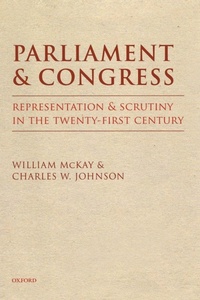
Parliament and Congress
Representation and Scrutiny in the Twenty-first Century
Published on 3. June 2010
Book
Hardback
614 pages
978-0-19-927362-1 (ISBN)
Description
The constitutional background of both legislatures and their procedures are described and where possible compared. Currently unsolved problems often have much in common, in vexed areas such as ethics requirements or how procedural rules permit minorities fair access to legislative time before majorities prevail. British successes include the enhanced authority and effectiveness of select committees and the acquisition of more debating time by the creation of a parallel Chamber. Unsolved problems at Westminster begin with the powers and status of the Lords, and go on through the search for more effective review of EU activities, adapting parliamentary scrutiny to more sophisticated government financial information, and making better use of legislative time without diminishing back-bench rights.
The accelerated pace and extent of procedural changes in Congress is problematic. Constant pursuit of campaign funds, increased party exploitation of Members' ethical shortcomings, and partisan reapportionments, have diminished collegiality and compromise. Business is conducted with greater predictability, with fewer quorum calls, postponement and clustering of votes, and by utilization of ad hoc special orders, often in derogation of openness and minority rights in the House. Minority complaints have been frequent and occasionally extreme. Conversely constant filibuster threats in the Senate have enhanced minority party power there. An 'inverse ratio' between the greater complexity, importance, and urgency of pending legislation on the one hand, and diminution of deliberative capacity, fairness. and transparency on the other, has been repeatedly demonstrated, especially at the stage of final compromises between the Houses.
The accelerated pace and extent of procedural changes in Congress is problematic. Constant pursuit of campaign funds, increased party exploitation of Members' ethical shortcomings, and partisan reapportionments, have diminished collegiality and compromise. Business is conducted with greater predictability, with fewer quorum calls, postponement and clustering of votes, and by utilization of ad hoc special orders, often in derogation of openness and minority rights in the House. Minority complaints have been frequent and occasionally extreme. Conversely constant filibuster threats in the Senate have enhanced minority party power there. An 'inverse ratio' between the greater complexity, importance, and urgency of pending legislation on the one hand, and diminution of deliberative capacity, fairness. and transparency on the other, has been repeatedly demonstrated, especially at the stage of final compromises between the Houses.
Reviews / Votes
The strengths of this new work are many ... notable and praiseworthy for its clarity and honesty. * The Capitol Dome, US Capitol Historical Society * In this compendium the authors build upon and extend previous comparative studies of Parliament and Congress, taking into account the most recent evolution of parliamentary practice in London and Washington... [This] is a book that every student of Parliament or Congress should keep close at hand. * APSA Legislative Studies Section Newsletter *More details
Language
English
Place of publication
Oxford
United Kingdom
Target group
College/higher education
Professional and scholarly
Dimensions
Height: 260 mm
Width: 183 mm
Thickness: 37 mm
Weight
1333 gr
ISBN-13
978-0-19-927362-1 (9780199273621)
Copyright in bibliographic data and cover images is held by Nielsen Book Services Limited or by the publishers or by their respective licensors: all rights reserved.
Schweitzer Classification
Other editions
Additional editions
William McKay | Charles W. Johnson
Parliament and Congress
Representation and Scrutiny in the Twenty-First Century
Book
08/2012
1st Edition
Oxford University Press
€74.28
Shipment within 15-20 days
William Mckay And Charles W. Johnson
Parliament and Congress
Representation and Scrutiny in the Twenty-First Century
E-Book
06/2010
1st Edition
Oxford University Press
€318.98
Available for download
Persons
William McKay; MA University of Edinburgh 1961. Served in the department of the Clerk of the House of Commons 1962-1994. Clerk Assistant of the House of Commons, 1994-1997. Clerk of the House and Chief Executive of the House Service, 1998-2002. Interim-Clerk designate to the Scottish Assembly 1979. For several years conseiller presidentiel to the president of the WEU Assembly, meeting periodically in Paris. Honorary Professor in the School of Law, University of Aberdeen 2003-07. Observer, Council of the Law Society of Scotland, 2006-present.
Charles Johnson; BA Amherst College, 1960; JD, University of Virginia Law School 1963. Member of District of Columbia Bar, 1965; U.S. Supreme Court Bar, 1968. Assistant Parliamentarian, U.S. House of Representatives 1964-1974; Deputy Parliamentarian 1975-1994; Parliamentarian 1994-2004. U.S. House Compilation of Precedents consultant, 2004-present. Adjunct Professor, University of Virginia Law School, 2005; Lecturer at several colleges and law schools.
Charles Johnson; BA Amherst College, 1960; JD, University of Virginia Law School 1963. Member of District of Columbia Bar, 1965; U.S. Supreme Court Bar, 1968. Assistant Parliamentarian, U.S. House of Representatives 1964-1974; Deputy Parliamentarian 1975-1994; Parliamentarian 1994-2004. U.S. House Compilation of Precedents consultant, 2004-present. Adjunct Professor, University of Virginia Law School, 2005; Lecturer at several colleges and law schools.
Content
Preface ; 1. Introduction ; 2. Basic Constitutional Distinctions ; 3. The Four Houses ; 4. Representatives, Members, Lords and Senators ; 5. Procedural Basics ; 6. Power of the Purse ; 7. Scrutiny and Oversight ; 8. Committees ; 9. Legislation ; 10. Privilege and Contempt ; 11. Ethics and Standards ; 12. Conclusion ; Annex of Tables ; Index