

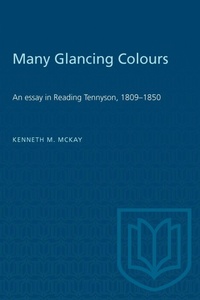
Many Glancing Colours
An Essay in Reading Tennyson, 1809-1850
Published on 15. December 1988
Book
Paperback/Softback
304 pages
978-1-4875-7874-9 (ISBN)
Description
'Poetry,' wrote Tennyson 'is like shot-silk with many glancing colours.' Taking this statement as a key to Tennyson's art and meaning, Kenneth McKay explores in detail the maturing poems from Tennyson's earliest efforts as a boy under his father's eye at Somersby, through 'Timbuctoo' and 'The Lover's Tale,' through the great poems published between 1830 and 1847, to their culmination in 'In Memoriam,' that complex, various, and subtle expression of Tennyson's achieved maturity. Rooted in close analyses of individual poems, Many Glancing Colours becomes a study of the development and character of Tennyson's liberal artistic imagination.
Though closely aligned with Coleridge's idea of 'multeity in unity,' Tennyson's sense of poetry as shot-silk is different, MacKay suggests, chiefly by its resistance to and subversion of a faith in the efficacy of the rational, ordering consciousness. Tennyson rejected Coleridge's Germany idealism, recognizing in the words of Arthur Hallam, that 'Pain is the deepest thing we have in our nature, and union through pain has always seemed more real and more holy than any other.' With this, he saw, again with Hallam, that 'the Godhead of the Son has not been a fixed, invariable thing from the beginning: he is more God now than he was once; and will be perfectly united to God hereafter.'
From this position, McKay argues, Tennyson wrote his great poems between 1830 and 1850, apprehending reality in a body of work which is distinct in a voice, technique, and imaginative grasp. First in 'Mariana' (1830) and then in the major poems which follow, Tennyson projects a world in which meaning and love come only as one submits, beyond any hope for or presumption of knowledge, to suffering and ignorance as the very condition of both vision and life. A poetry of shot-silk, in its intelligence, range, variety, and ambiguity, became Tennyson's natural instrument, one fundamental to his liberal artistic imagination and a study of which makes for a new understanding of the development and character of the Victorian period generally.
Though closely aligned with Coleridge's idea of 'multeity in unity,' Tennyson's sense of poetry as shot-silk is different, MacKay suggests, chiefly by its resistance to and subversion of a faith in the efficacy of the rational, ordering consciousness. Tennyson rejected Coleridge's Germany idealism, recognizing in the words of Arthur Hallam, that 'Pain is the deepest thing we have in our nature, and union through pain has always seemed more real and more holy than any other.' With this, he saw, again with Hallam, that 'the Godhead of the Son has not been a fixed, invariable thing from the beginning: he is more God now than he was once; and will be perfectly united to God hereafter.'
From this position, McKay argues, Tennyson wrote his great poems between 1830 and 1850, apprehending reality in a body of work which is distinct in a voice, technique, and imaginative grasp. First in 'Mariana' (1830) and then in the major poems which follow, Tennyson projects a world in which meaning and love come only as one submits, beyond any hope for or presumption of knowledge, to suffering and ignorance as the very condition of both vision and life. A poetry of shot-silk, in its intelligence, range, variety, and ambiguity, became Tennyson's natural instrument, one fundamental to his liberal artistic imagination and a study of which makes for a new understanding of the development and character of the Victorian period generally.
More details
Series
Language
English
Place of publication
Toronto
Canada
Target group
College/higher education
Professional and scholarly
Product notice
Paperback (trade)
Dimensions
Height: 234 mm
Width: 156 mm
Thickness: 16 mm
Weight
426 gr
ISBN-13
978-1-4875-7874-9 (9781487578749)
Copyright in bibliographic data and cover images is held by Nielsen Book Services Limited or by the publishers or by their respective licensors: all rights reserved.
Schweitzer Classification
Person
KENNETH M. MCKAY is professor of English at Brock University.