

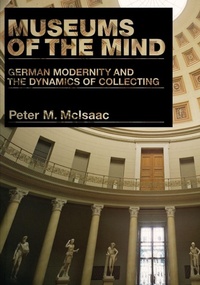
Museums of the Mind
German Modernity and the Dynamics of Collecting
Will be published approx. on 15. January 2013
Book
Paperback/Softback
336 pages
978-0-271-05870-2 (ISBN)
Description
Museums of the Mind is the first book to explore the evolving relationship of collecting and the German literary imagination since the invention of the public museum. This study shows that in addition to redefining categories of art, history, and identity in modernity, the museum transforms the relationship between material objects and imaginative narratives. Using new categories, Peter McIsaac constructs a critical genealogy using key texts by Johann Goethe, Adalbert Stifter, Wilhelm Raabe, Rainer Maria Rilke, Ingeborg Bachmann, Siegfried Lenz, W. G. Sebald, and Durs Gruenbein and the material record of Germanophone museums.
McIsaac rethinks how fundamental cultural "truths" define what it means to belong to acculturated communities, showing that the activation of meaning in museums depends foremost on what people bring, in their minds, to those real and imagined environments, resulting in what McIsaac calls museums of the mind. This notion elucidates the vital shifts wrought by museum culture over the past two centuries and illuminates how museums, literature, and digital media shape thought and behavior today.
McIsaac rethinks how fundamental cultural "truths" define what it means to belong to acculturated communities, showing that the activation of meaning in museums depends foremost on what people bring, in their minds, to those real and imagined environments, resulting in what McIsaac calls museums of the mind. This notion elucidates the vital shifts wrought by museum culture over the past two centuries and illuminates how museums, literature, and digital media shape thought and behavior today.
Reviews / Votes
"It is the principal merit of this study to have highlighted the connections that bind the process of internalisation of memory in German literature with the tangible nature of museums as both objective and imaginative structures."-Daria Santini Oxford Art Journal
More details
Language
English
Place of publication
Pennsylvania
United States
Target group
College/higher education
Product notice
Paperback (trade)
Illustrations
38 Halftones, black and white
Dimensions
Height: 254 mm
Width: 178 mm
Thickness: 18 mm
Weight
637 gr
ISBN-13
978-0-271-05870-2 (9780271058702)
Copyright in bibliographic data and cover images is held by Nielsen Book Services Limited or by the publishers or by their respective licensors: all rights reserved.
Schweitzer Classification
Person
Peter M. McIsaac is Assistant Professor of German at York University, Toronto. He is the author of numerous articles on German literature and culture and museum studies.
Content
Contents
Illustrations
Acknowledgments
Part 1: Historical and Theoretical Coordinates of Museal and Literary Discourses
1. The Museum Function, Inventoried Consciousness, and German-Speaking Literature
2. Inventoried Consciousness Today: Durs Gruenbein and W. G. Sebald
Part 2: The Rise of the Public Museum and Bildung
3. Ottilie Under Glass: Collecting as Disciplinary Regime in Goethe's Wahlverwandtschaften
4. The Museum of Bildung: Collecting in Stifter's Nachsommer
Part 3: Acculturation, Commodification, and the Nation
5. Archaeology, Exhibition, and Tourism: Raabe's "Keltische Knochen"
6. Flaneur Optical, Collector Tactile: Rilke's Neue Gedichte as Imaginary Museum Landscape
Part 4: Narrative Interventions in the Museal Abuse of Culture
7. "Quiet Violence": The Army Museum in Ingeborg Bachmann's Malina
8. (Re)collecting the Twentieth Century: Siegfried Lenz's Heimatmuseum
Conclusion
Notes
Works Cited
Index
Illustrations
Acknowledgments
Part 1: Historical and Theoretical Coordinates of Museal and Literary Discourses
1. The Museum Function, Inventoried Consciousness, and German-Speaking Literature
2. Inventoried Consciousness Today: Durs Gruenbein and W. G. Sebald
Part 2: The Rise of the Public Museum and Bildung
3. Ottilie Under Glass: Collecting as Disciplinary Regime in Goethe's Wahlverwandtschaften
4. The Museum of Bildung: Collecting in Stifter's Nachsommer
Part 3: Acculturation, Commodification, and the Nation
5. Archaeology, Exhibition, and Tourism: Raabe's "Keltische Knochen"
6. Flaneur Optical, Collector Tactile: Rilke's Neue Gedichte as Imaginary Museum Landscape
Part 4: Narrative Interventions in the Museal Abuse of Culture
7. "Quiet Violence": The Army Museum in Ingeborg Bachmann's Malina
8. (Re)collecting the Twentieth Century: Siegfried Lenz's Heimatmuseum
Conclusion
Notes
Works Cited
Index