

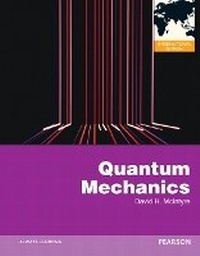
Quantum Mechanics
International Edition
Published on 22. February 2012
Book
Paperback/Softback
592 pages
978-0-321-79852-7 (ISBN)
Description
This innovative new text presents quantum mechanics in a manner that directly reflects the methods used in modern physics research-making the material more approachable and preparing students more thoroughly for real research. Most texts in this area start with a bit of history and then move directly to wave-particle problems with accompanying heavy mathematical analysis; Quantum Mechanics provides a foundation in experimental phenomena and uses a more approachable, less intimidating, more powerful mathematical matrix model. Beginning with the Stern-Gerlach experiments and the discussion of spin measurements, and using bra-ket notation, the authors introduce an important notational system that is used throughout quantum mechanics. This non-traditional presentation is designed to enhance students' understanding and strengthen their intuitive grasp of the subject.
More details
Language
English
Place of publication
United States
Publishing group
Pearson Education (US)
Target group
College/higher education
Dimensions
Height: 233 mm
Width: 185 mm
Thickness: 30 mm
Weight
930 gr
ISBN-13
978-0-321-79852-7 (9780321798527)
Copyright in bibliographic data is held by Nielsen Book Services Limited or its licensors: all rights reserved.
Schweitzer Classification
Other editions
New editions
David McIntyre | Corinne Manogue | Janet Tate
Quantum Mechanics: Pearson New International Edition
Book
07/2013
Pearson Education Limited
€90.67
Article exhausted; check different version
Persons
David H. McIntyre received a B.S. degree in physics from the University of Arizona and M.S. and Ph.D. degrees in physics from Stanford University. He has been on the physics faculty at Oregon State University since 1989 and is one of the original developers of the Paradigms in Physics program. His other teaching interests include computational physics, computer interfacing, and optical physics. His laboratory research interests are in laser spectroscopy and optical physics.
Corinne A. Manogue received an A.B. degree in mathematics and physics from Mount Holyoke Collegeand a Ph.D. degree in physics from the University of Texas at Austin. She has been on the physics faculty at Oregon State University since 1988 and is the Director and one of the original developers of the Paradigms in Physics program. She is a Fellow of the American Physical Society and was awarded the Excellence in Undergraduate Physics Teaching Award from the American Association of Physics Teachers in 2008. She is coauthoring a textbook onThe Geometry of Vector Calculus. Her theoretical research interests use the octonions to parameterize higher dimensional theories of particle physics.
Janet Tate received a B.Sc. degree in physics and chemistry from the University of Natal and M.S. and Ph.D. degrees in physics from Stanford University. She has been on the physics faculty at Oregon State University since 1989 and is one of the original developers of the Paradigms in Physics program. She is particularly interested in helping students to improve their critical thinking skills, especially through experimental work and writing. Her laboratory research interests are in experimental condensed matter physics.
Corinne A. Manogue received an A.B. degree in mathematics and physics from Mount Holyoke Collegeand a Ph.D. degree in physics from the University of Texas at Austin. She has been on the physics faculty at Oregon State University since 1988 and is the Director and one of the original developers of the Paradigms in Physics program. She is a Fellow of the American Physical Society and was awarded the Excellence in Undergraduate Physics Teaching Award from the American Association of Physics Teachers in 2008. She is coauthoring a textbook onThe Geometry of Vector Calculus. Her theoretical research interests use the octonions to parameterize higher dimensional theories of particle physics.
Janet Tate received a B.Sc. degree in physics and chemistry from the University of Natal and M.S. and Ph.D. degrees in physics from Stanford University. She has been on the physics faculty at Oregon State University since 1989 and is one of the original developers of the Paradigms in Physics program. She is particularly interested in helping students to improve their critical thinking skills, especially through experimental work and writing. Her laboratory research interests are in experimental condensed matter physics.
Content
1. Stern-Gerlach Experiments
2. Operators And Measurement
3. Schroedinger Time Evolution
4. Quantum Spookiness
5. Quantized Energies: Particle in a Box
6. Unbound States
7. Angular Momentum
8. Hydrogen Atom
9. Harmonic Oscillator
10. Perturbation Theory
11. Hyperfine Structure and the Addition of Angular Momentum
12. Perturbation of Hydrogen
13. Identical Particles
14. Time dependent perturbation theory
15. Periodic Systems
16. Modern Applications
Appendices
2. Operators And Measurement
3. Schroedinger Time Evolution
4. Quantum Spookiness
5. Quantized Energies: Particle in a Box
6. Unbound States
7. Angular Momentum
8. Hydrogen Atom
9. Harmonic Oscillator
10. Perturbation Theory
11. Hyperfine Structure and the Addition of Angular Momentum
12. Perturbation of Hydrogen
13. Identical Particles
14. Time dependent perturbation theory
15. Periodic Systems
16. Modern Applications
Appendices