

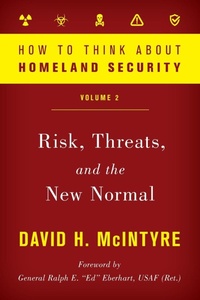
How to Think about Homeland Security: Risk, Threats, and the New Normal
Volume 2
Published on 14. October 2019
Book
Hardback
250 pages
978-1-5381-2576-2 (ISBN)
Description
Risk, Threats and the New Normal explains the new political and technological developments that created new domestic national security threats against the nation and the people of the United States. The book traces the development of and competition between national preparedness (focused on people and property), and civil defense / security (focused on the defense of systems and infrastructure) since the latter days of World War I. Extensive policy research demonstrates a shift in federal (and hence state and local) focus over the last decade from WMD based Threats at the National Security Level (TNSL) back to more traditional hazards and disasters. A framework is offered to analyze and evaluate TNSL dangers to national power; it is applied to a case study involving a nuclear attack. Recommendations are offered to mitigate or prevent the potentially catastrophic aftermath. In Vol 3 this analysis will be extended to other TNSL events (chemical, biological, radiological, etc.) and the actors who must prepare for them.
Reviews / Votes
A retired colonel in the US Army, McIntyre (now, Bush School of Government and Public Service, Texas A&M Univ.) wrote How to Think about Homeland Security to educate future homeland security professionals on how terrorists wielding new and lethal technologies could decimate the US. His intent is not to break new ground; rather, it is to introduce those willing to indulge this grisly mindset to the concepts and vocabulary of risk and threat assessment. The first of the set's two volumes is subtitled "The Imperfect Intersection of National Security and Public Safety." The chapters in volume 2 introduce basic concepts (part 1); provide a clear but terse summary of the strategy of successive presidents to guard against doomsday (part 2); and present new threats that terrorists can use to disrupt or destroy the basic infrastructure of US society (part 3).Summing Up: Recommended. . . Upper-division undergraduates, graduate students, students in technical programs, professionals. * Choice Reviews *
More details
Series
Language
English
Place of publication
United States
Publishing group
Bloomsbury Publishing Plc
Target group
College/higher education
US School Grade: From College Freshman to College Graduate Student
Illustrations
8 tables; 9 charts; 12 textboxes
Dimensions
Height: 260 mm
Width: 183 mm
Thickness: 18 mm
Weight
672 gr
ISBN-13
978-1-5381-2576-2 (9781538125762)
Copyright in bibliographic data and cover images is held by Nielsen Book Services Limited or by the publishers or by their respective licensors: all rights reserved.
Schweitzer Classification
Other editions
Additional editions
E-Book
10/2019
1st Edition
Rowman & Littlefield Publishers
€26.99
Available for download
E-Book
10/2019
1st Edition
Bloomsbury eBooks US
€26.99
Available for download
Person
Dr. David H. McIntyre has been writing, teaching, and presenting on National Security and Homeland Security issues for 30 years. He is currently a lecturer at the Bush School of Government and Public Service at Texas A&M University. Before that he was Deputy Director of the ANSER Institute for Homeland Security in Washington, DC. Colonel McIntyre (USA, Retired) began those duties after a 30 year career in the United States Army, where he served in airborne and armored cavalry units, wrote and taught strategy, and retired as the Dean of Faculty and Academics at the National War College.
Content
List of Figures, Tables, and Textboxes
Foreword by General Ralph Eberhart
Acknowledgments
About This Series
Introducing the Concept of Frameworks: Thinking About Thinking About Homeland Security
Part I: Thinking About Risk
Threat, Preparedness and Defense: A History of Adapting to a New NormalFrom Countering Terrorism to a Preparedness System: Rethinking Homeland SecurityThe DHS Risk Management Process Improving the Utility, and Reducing the Risk, of Risk Following the Clues: The Shifting Focus of Risk ManagementA Brother by Another Mother: Risk Management for Critical Infrastructure
Part II: Thinking About Threats
Not All MOMs Are Created Equal: The TNSL Test The Special Danger of Terrorism at the National Security Level The Nature, Character and Conduct of War The Dangerous Enigma of Terrorism Terrorism as Criminal War
Part III: Thinking About the New Normal
A Framework for Thinking About Threats and the New Normal Shall we Play a Game? (Preparedness and a Nuclear MOM) From Preparedness to National Defense (Nuclear TNSL MOM)TNSL MOMs, Bad DADs, and a Newer New Normal
Index
About the Author
Foreword by General Ralph Eberhart
Acknowledgments
About This Series
Introducing the Concept of Frameworks: Thinking About Thinking About Homeland Security
Part I: Thinking About Risk
Threat, Preparedness and Defense: A History of Adapting to a New NormalFrom Countering Terrorism to a Preparedness System: Rethinking Homeland SecurityThe DHS Risk Management Process Improving the Utility, and Reducing the Risk, of Risk Following the Clues: The Shifting Focus of Risk ManagementA Brother by Another Mother: Risk Management for Critical Infrastructure
Part II: Thinking About Threats
Not All MOMs Are Created Equal: The TNSL Test The Special Danger of Terrorism at the National Security Level The Nature, Character and Conduct of War The Dangerous Enigma of Terrorism Terrorism as Criminal War
Part III: Thinking About the New Normal
A Framework for Thinking About Threats and the New Normal Shall we Play a Game? (Preparedness and a Nuclear MOM) From Preparedness to National Defense (Nuclear TNSL MOM)TNSL MOMs, Bad DADs, and a Newer New Normal
Index
About the Author