

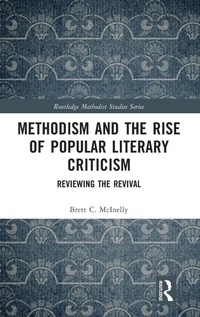
Methodism and the Rise of Popular Literary Criticism
Reviewing the Revival
1st Edition
Published on 1. June 2023
Book
Hardback
226 pages
978-1-032-45686-7 (ISBN)
Description
This book examines how Methodism and popular review criticism intersected with and informed each other in the eighteenth century. Methodism emerged at a time when the idea of a 'public square' was taking shape, a process facilitated by the periodical press. Perhaps more so than any previous religious movement, Methodism, and the publications associated with it, received greater scrutiny largely because of periodical literature and the emergence of popular review criticism. The book considers in particular how works addressing Methodism were discussed and critiqued in the era's two leading literary periodicals - The Monthly Review and The Critical Review. Focusing on the period between 1749 and 1789, the study encompasses the formative years of popular review criticism and some of the more dramatic moments in the textual culture of early Methodism. The author illustrates some of the specific ways these review journals diverged in their critical approaches and sensibilities as well as their politics and religious opinions. The Monthly's and the Critical's responses to the Methodists' own publishing efforts as well as the anti-Methodist critique are shown to be both multifaceted and complex. The book critically reflects on the pretended neutrality, reasonableness, and objectivity of reviewers, who at times found themselves negotiating between the desire to regulate literary tastes and the impulse to undermine the Methodist revival. It will be relevant to scholars of religion, history and literary studies with an interest in Methodism, print culture, and the eighteenth century.
Reviews / Votes
"To find myself reviewing a book about book reviews is ironic to say the least. Thankfully, this review - unlike many of those explored in this book - is an overwhelmingly positive one, devoid of the 'hostile attitudes' encountered by early Methodist authors [...]. By showing that anti-Methodist literature reached a much broader audience than previously thought, this book makes an invaluable contribution to the study of eighteenth-century Methodism. Crucially, by showing that reviewers often voiced their own opinions relating to matters of doctrine, McInelly has enhanced our understanding of the important - but largely neglected - role played by the laity in eighteenth-century theological controversies." - Simon Lewis in Proceedings of the Wesley Historical SocietyMore details
Series
Language
English
Place of publication
London
United Kingdom
Publishing group
Taylor & Francis Ltd
Target group
College/higher education
Academic and Postgraduate
Illustrations
1 s/w Tabelle
1 Tables, black and white
Dimensions
Height: 240 mm
Width: 161 mm
Thickness: 17 mm
Weight
523 gr
ISBN-13
978-1-032-45686-7 (9781032456867)
Copyright in bibliographic data and cover images is held by Nielsen Book Services Limited or by the publishers or by their respective licensors: all rights reserved.
Schweitzer Classification
Other editions
Additional editions
Book
11/2024
1st Edition
Routledge
€63.20
Shipment within 10-20 days
E-Book
06/2023
1st Edition
Routledge
€55.49
Available for download
E-Book
06/2023
1st Edition
Routledge
€55.49
Available for download
Person
Brett McInelly is a Professor in the English Department at Brigham Young University, USA. His publications include Textual Warfare and the Making of Methodism (2014).
Content
Introduction
1 Popular Review Criticism, Methodism, and the Public Sphere
2 Reviewing Methodism in Devotional and Polemical Literature
3 Reviewing Whitefield and Wesley
4 Anti-Methodism and Belletristic Critique
5 Reviewing the Oxford Expulsion and the Minutes Controversy
6 The Legacy of the Monthly and the Critical Reviews
Epilogue
1 Popular Review Criticism, Methodism, and the Public Sphere
2 Reviewing Methodism in Devotional and Polemical Literature
3 Reviewing Whitefield and Wesley
4 Anti-Methodism and Belletristic Critique
5 Reviewing the Oxford Expulsion and the Minutes Controversy
6 The Legacy of the Monthly and the Critical Reviews
Epilogue