

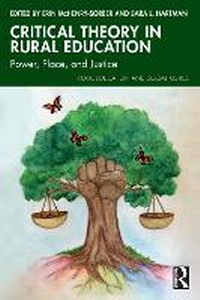
Critical Theory in Rural Education
Power, Place, and Justice
1st Edition
Will be published approx. on 15. October 2026
Book
Paperback/Softback
192 pages
978-1-041-21436-6 (ISBN)
Description
Critical Theory in Rural Education provides scholars and practitioners with the theoretical tools needed to interrogate and dismantle inequities that disproportionately impact rural schools and communities. Rural educators have long been confronted with policies and rhetoric that seek to restrict discussions of race, gender, history, and social injustice. This volume highlights critical frameworks that challenge deficit ideologies and offer intersectional, asset-driven approaches to research, policy, and practice. Organized into three sections-Place: Perspectives and Opportunities; Power: Race, Coloniality, and History; and Justice: Boundaries, Borders, and Identities-this book offers actionable insights and theoretical foundations for those committed to advancing justice in rural education. Embracing a range of perspectives, from racialized educator experiences, queer literacies, and decolonial Indigenous praxis to geography, policy analysis, and career-connected learning, this collection serves as a vital resource for those seeking to resist oppression and foster transformative change in rural schools and communities.
Reviews / Votes
"Reading Gaventa's Power and Powerlessness changed my life-academically, professionally, personally. While I had read and thought about power and justice broadly, I had never before engaged with how that dynamic manifested in my own place (rural eastern Kentucky). Hartman and McHenry-Sorber stand on Gaventa's shoulders, re-engaging that same intersection as it manifests in contemporary (and, notably, post-2016) rural contexts-a whole new world in many ways. Moreover-and very importantly-the editors intentionally bring diverse rural voices and spaces to the table in this volume, and in so doing they extend and deepen the exploration of how power and justice shape and are shaped by rural contexts. This is an important work that we need now more than ever."Jerry Johnson, Phoebe Moore Dail Distinguished Professor in Rural Education, Director, Rural Education Institute, College of Education, East Carolina University
"In a time when rural educators are navigating complex policy pressures and competing community expectations, this collection brings grounded scholarship and practical insight that helps leaders protect learning, dignity, and opportunity for rural students."
Melissa Sadorf, Executive Director, National Rural Education Association
"As someone who spent eight years leading the National Rural Education Association, I have witnessed firsthand how rural schools and communities navigate the complex intersection of place, power, and justice-often while being overlooked or misunderstood by policymakers and researchers alike. Critical Theory in Rural Education: Place, Power, and Justice arrives at a critical moment when rural educators face unprecedented attacks on their professional autonomy, and when the diversity and complexity of rural America demand nuanced, place-based scholarship. This volume not only documents these challenges but also provides essential theoretical frameworks and practical insights for educators, researchers, and policymakers committed to equity and justice in rural contexts. The editors and contributors have assembled a remarkable collection that honors the sophistication of rural education scholarship while centering the voices and experiences too often marginalized in policy debates. For anyone seeking to understand-or to resist-the forces that perpetuate educational inequity in rural America, this book is indispensable. It is both a timely intervention and a lasting contribution to the field."
Dr. Allen Pratt, Former Executive Director, National Rural Education Association
"This much-needed, critical book centers the intersection of place, power, and justice in rural education. The editors and authors offer rich theoretical, practical, and methodological contributions that call readers to examine, resist, and transform inequitable practices, policies, and structures that create disadvantage across and within rural communities. This timely book disrupts monolithic portrayals of rural communities, providing nuanced perspectives about rural schools and communities."
Dr. Darris Means, President-Elect Designate, National Rural Education Association, Professor of Educational Leadership and Dean's Fellow for Rural Education, Clemson University
"One way to think about policies is as sets of decisions made by people to guide actions-a framing which emphasizes that policies and the practices they lead to can be changed. For too long, policies have been made to the detriment of-and without consideration for-the concerns of rural people and the assets and needs of rural places. This important volume provides a set of perspectives, with concrete examples, about how critical theory can help us to better understand the ways that policies and practices interact with place to promote (and hinder) justice for the diverse people who live and learn in rural places. Importantly, Critical Theory in Rural Education also provides tools and models for how we might work together to bring about greater justice for rural students, teachers, and communities."
Devon Brenner, Director of the Rural Education Research and Initiatives Lab, Mississippi State University and Immediate Past President, National Rural Education Association
"I can't think of a more pressing time to advance the conversation about rural education at the intersection of power and justice. Against a history of reductive narratives about rural people and places, this book calls for complexity and amplifies diverse methodological perspectives. Contributors explore questions of privilege and social peripheries while engaging, extending, and mobilizing critical theories that invite readers to consider the crossroads metaphor as both analytic lens and invitation-urging scholars to adopt approaches that resist hegemonic systems for all rural communities. Ultimately, this book calls on readers to advance the field of rural education research by complicating it."
Amy Price Azano, Professor of Rural Education, Director, Virginia Tech Center for Rural Education, Rural Education and Social Justice Series Editor "Reading Gaventa's Power and Powerlessness changed my life-academically, professionally, personally. While I had read and thought about power and justice broadly, I had never before engaged with how that dynamic manifested in my own place (rural eastern Kentucky). Hartman and McHenry-Sorber stand on Gaventa's shoulders, re-engaging that same intersection as it manifests in contemporary (and, notably, post-2016) rural contexts-a whole new world in many ways. Moreover-and very importantly-the editors intentionally bring diverse rural voices and spaces to the table in this volume, and in so doing they extend and deepen the exploration of how power and justice shape and are shaped by rural contexts. This is an important work that we need now more than ever."
Jerry Johnson, Phoebe Moore Dail Distinguished Professor in Rural Education, Director, Rural Education Institute, College of Education, East Carolina University
"In a time when rural educators are navigating complex policy pressures and competing community expectations, this collection brings grounded scholarship and practical insight that helps leaders protect learning, dignity, and opportunity for rural students."
Melissa Sadorf, Executive Director, National Rural Education Association
"As someone who spent eight years leading the National Rural Education Association, I have witnessed firsthand how rural schools and communities navigate the complex intersection of place, power, and justice-often while being overlooked or misunderstood by policymakers and researchers alike. Critical Theory in Rural Education: Place, Power, and Justice arrives at a critical moment when rural educators face unprecedented attacks on their professional autonomy, and when the diversity and complexity of rural America demand nuanced, place-based scholarship. This volume not only documents these challenges but also provides essential theoretical frameworks and practical insights for educators, researchers, and policymakers committed to equity and justice in rural contexts. The editors and contributors have assembled a remarkable collection that honors the sophistication of rural education scholarship while centering the voices and experiences too often marginalized in policy debates. For anyone seeking to understand-or to resist-the forces that perpetuate educational inequity in rural America, this book is indispensable. It is both a timely intervention and a lasting contribution to the field."
Dr. Allen Pratt, Former Executive Director, National Rural Education Association
"This much-needed, critical book centers the intersection of place, power, and justice in rural education. The editors and authors offer rich theoretical, practical, and methodological contributions that call readers to examine, resist, and transform inequitable practices, policies, and structures that create disadvantage across and within rural communities. This timely book disrupts monolithic portrayals of rural communities, providing nuanced perspectives about rural schools and communities."
Dr. Darris Means, President-Elect Designate, National Rural Education Association, Professor of Educational Leadership and Dean's Fellow for Rural Education, Clemson University
"One way to think about policies is as sets of decisions made by people to guide actions-a framing which emphasizes that policies and the practices they lead to can be changed. For too long, policies have been made to the detriment of-and without consideration for-the concerns of rural people and the assets and needs of rural places. This important volume provides a set of perspectives, with concrete examples, about how critical theory can help us to better understand the ways that policies and practices interact with place to promote (and hinder) justice for the diverse people who live and learn in rural places. Importantly, Critical Theory in Rural Education also provides tools and models for how we might work together to bring about greater justice for rural students, teachers, and communities."
Devon Brenner, Director of the Rural Education Research and Initiatives Lab, Mississippi State University and Immediate Past President, National Rural Education Association
"I can't think of a more pressing time to advance the conversation about rural education at the intersection of power and justice. Against a history of reductive narratives about rural people and places, this book calls for complexity and amplifies diverse methodological perspectives. Contributors explore questions of privilege and social peripheries while engaging, extending, and mobilizing critical theories that invite readers to consider the crossroads metaphor as both analytic lens and invitation-urging scholars to adopt approaches that resist hegemonic systems for all rural communities. Ultimately, this book calls on readers to advance the field of rural education research by complicating it."
Amy Price Azano, Professor of Rural Education, Director, Virginia Tech Center for Rural Education, Rural Education and Social Justice Series Editor
More details
Series
Language
English
Place of publication
London
United Kingdom
Publishing group
Taylor & Francis Ltd
Target group
College/higher education
Postgraduate and Undergraduate Advanced
Illustrations
6 s/w Tabellen
6 Tables, black and white
Dimensions
Height: 229 mm
Width: 152 mm
ISBN-13
978-1-041-21436-6 (9781041214366)
Copyright in bibliographic data and cover images is held by Nielsen Book Services Limited or by the publishers or by their respective licensors: all rights reserved.
Schweitzer Classification
Other editions
Additional editions
Book
approx. 10/2026
1st Edition
Routledge
€191.50
Not yet published
Persons
Erin McHenry-Sorber is the Alice Trotter Muffly Endowed Professor in the School of Education and Counseling, College of Applied Human Sciences at West Virginia University.
Sara L. Hartman is a Professor in the Department of Teacher Education in The Gladys W. and David H. Patton College of Education and an Associate Dean of Faculty Affairs in University College at Ohio University.
Sara L. Hartman is a Professor in the Department of Teacher Education in The Gladys W. and David H. Patton College of Education and an Associate Dean of Faculty Affairs in University College at Ohio University.
Content
1. Introduction: Rural Education at the Intersection of Power and Justice SECTION 1: Place: Perspectives and Opportunities 2. RuralEdCrit: Toward a Critical Theory of Rural Education 3. Finding Commonalities, Illuminating Nuances: Using Purposeful Maximal Sampling in Critical Rural Education Research 4. 'A lot of working parts': Appalachian Educators Take Agency through Community and A Career Connected Learning 5. A Rural Critical Policy Analysis of Missouri Educator Preparation and Certification Regulations 6. Letting the Land Lead: Socioecological Leadership Practice Amid Policy Challenges 7. Rewriting the Narrative: Reshaping Rurality in English Language Arts Pedagogy SECTION 2: Power: Race, Coloniality, and History 8. At the Educational Crossroads of Critical Race and Critical Rural Theories 9. Teaching in the Afterlife of Rural Schooling: A Black Practitioner's Reflection on Race, Power, and Pedagogical Integrity 10. Complicating Rural: A Critical Discourse Analysis of State Social Studies Standards 11. From the Margins to Leadership: Double Consciousness as Method and Identity in Rural Education 12. Decoloniality in South Dakota Indigenous Education: Practices of Delinking and Refusal in Colonial Context SECTION 3: Justice: Boundaries, Borders, and Identities 13. What is rural education anyway? Reshaping notions of rural education in the United States through the lens of spatial imaginaries 14. Be(com)ing Slantwise: Queering Rural Literacies for More Rural Trans- and Queer-Affirming Futures 15. Borderlands and Nepantla State: Latina Identity in a Predominantly White Institution in Appalachia 16. When Monolingual Frameworks Fail: Border Thinking and Linguistic Identity in Rural Schools 17. Reflections on Research: Using Critical, Asset-Based Frameworks to Study Rural College Students 18. Entre Dos Tierras, We Found Ourselves 19. In Closing: Reflections and Future Directions