

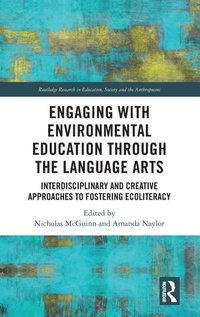
Engaging with Environmental Education through the Language Arts
Interdisciplinary and Creative Approaches to Fostering Ecoliteracy
1st Edition
Published on 4. November 2024
Book
Hardback
256 pages
978-1-032-61555-4 (ISBN)
Description
This creative volume demonstrates the urgent importance of engaging students cognitively and affectively with the climate crisis and environmental education, underpinning the vital role the language arts play in expanding this engagement for a better future.
Moving beyond the basic modalities of English, chapters written by an internationally diverse group of contributors advocate for the integration of language arts with environmental education through broad representation of creative subdisciplines: drama, visual literacy, philosophy, poetry, student voice and more. These subdisciplines are explored to suggest the context in which environmental degradation, forest ecologies, carbon literacy and indigenous knowledges are taught, further helping students to develop a comprehensive view of how they can effect change. Ultimately, the book makes a compelling argument by emphasising the significance of interdisciplinary learning in fostering a holistic understanding of environmental issues.
This volume will appeal to scholars, researchers and postgraduate students in the field of environmental and sustainability education, English and literacy/language arts and teacher education more broadly. Undergraduate students, policymakers, environmental educators and curriculum designers may also benefit from this volume.
Moving beyond the basic modalities of English, chapters written by an internationally diverse group of contributors advocate for the integration of language arts with environmental education through broad representation of creative subdisciplines: drama, visual literacy, philosophy, poetry, student voice and more. These subdisciplines are explored to suggest the context in which environmental degradation, forest ecologies, carbon literacy and indigenous knowledges are taught, further helping students to develop a comprehensive view of how they can effect change. Ultimately, the book makes a compelling argument by emphasising the significance of interdisciplinary learning in fostering a holistic understanding of environmental issues.
This volume will appeal to scholars, researchers and postgraduate students in the field of environmental and sustainability education, English and literacy/language arts and teacher education more broadly. Undergraduate students, policymakers, environmental educators and curriculum designers may also benefit from this volume.
More details
Series
Language
English
Place of publication
London
United Kingdom
Publishing group
Taylor & Francis Ltd
Target group
College/higher education
Professional and scholarly
Academic and Postgraduate
Illustrations
17 s/w Photographien bzw. Rasterbilder, 18 s/w Abbildungen, 1 s/w Zeichnung, 3 s/w Tabellen
3 Tables, black and white; 1 Line drawings, black and white; 17 Halftones, black and white; 18 Illustrations, black and white
Dimensions
Height: 240 mm
Width: 161 mm
Thickness: 19 mm
Weight
570 gr
ISBN-13
978-1-032-61555-4 (9781032615554)
Copyright in bibliographic data and cover images is held by Nielsen Book Services Limited or by the publishers or by their respective licensors: all rights reserved.
Schweitzer Classification
Other editions
Additional editions
Nicholas McGuinn | Amanda Naylor
Engaging with Environmental Education through the Language Arts
Interdisciplinary and Creative Approaches to Fostering Ecoliteracy
Book
05/2026
1st Edition
Routledge
€58.50
Shipment within 10-20 days
Nicholas McGuinn | Amanda Naylor
Engaging with Environmental Education through the Language Arts
Interdisciplinary and Creative Approaches to Fostering Ecoliteracy
E-Book
11/2024
1st Edition
Routledge
€60.49
Available for download
Nicholas McGuinn | Amanda Naylor
Engaging with Environmental Education through the Language Arts
Interdisciplinary and Creative Approaches to Fostering Ecoliteracy
E-Book
11/2024
1st Edition
Routledge
€60.49
Available for download
Persons
Nicholas McGuinn is an Honorary Fellow in the Department of Education, University of York, UK.
Amanda Naylor is Senior Lecturer in English and Education, University of York, UK.
Amanda Naylor is Senior Lecturer in English and Education, University of York, UK.
Content
Introduction
Part 1: Opening up the Debate
Chapter 1 Environmental texts in the classroom: The centrality of ecocritical reading
Chapter 2 Fostering Environmental Justice, Climate Justice, and Collective Action through Children's and Young Adult Literature
Chapter 3 Humanising Science through the Arts
Chapter 4 Imagining the Environment in a Different, More Hopeful Language: (Foreign) Language Teaching with Environmental Issues and Sustainability
Part 2: Thinking about Voice
Chapter 5 Voicing More-Than-Human Vulnerability: A Lyric Approach to Fostering Biodiversity Loss Literacy
Chapter 6 Philosophical Dialogue in Ecoliteracy Education: Words for Change
Part 3: Creating and Responding to Texts
Chapter 7 "Reading-With" to Build Meaningful Connections with Animate Place-based Literacies
Chapter 8 Environmental education in international contexts: exploring issues through literature
Chapter 9 Pre-Service English Teachers engage with the natural world through poetry: A cubed template to document the plains of the unknown world
Chapter 10 What can storytelling and drama offer to students' ecological understanding and citizenship? Being trees
Chapter 11 Socio-Environmental (In)Justice In Forest Stewardship: a multi-perspective materials assemblage for English as a Foreign Language teacher education in Chile
Part 4: Engaging with Visual and Social Media
Chapter 12 The Visual Image and Imagination of Alternative Futures: Nuance, Ambiguity, and Hope
Chapter 13 Engaging young people with ecocritical analysis of language in the media
Conclusion
Part 1: Opening up the Debate
Chapter 1 Environmental texts in the classroom: The centrality of ecocritical reading
Chapter 2 Fostering Environmental Justice, Climate Justice, and Collective Action through Children's and Young Adult Literature
Chapter 3 Humanising Science through the Arts
Chapter 4 Imagining the Environment in a Different, More Hopeful Language: (Foreign) Language Teaching with Environmental Issues and Sustainability
Part 2: Thinking about Voice
Chapter 5 Voicing More-Than-Human Vulnerability: A Lyric Approach to Fostering Biodiversity Loss Literacy
Chapter 6 Philosophical Dialogue in Ecoliteracy Education: Words for Change
Part 3: Creating and Responding to Texts
Chapter 7 "Reading-With" to Build Meaningful Connections with Animate Place-based Literacies
Chapter 8 Environmental education in international contexts: exploring issues through literature
Chapter 9 Pre-Service English Teachers engage with the natural world through poetry: A cubed template to document the plains of the unknown world
Chapter 10 What can storytelling and drama offer to students' ecological understanding and citizenship? Being trees
Chapter 11 Socio-Environmental (In)Justice In Forest Stewardship: a multi-perspective materials assemblage for English as a Foreign Language teacher education in Chile
Part 4: Engaging with Visual and Social Media
Chapter 12 The Visual Image and Imagination of Alternative Futures: Nuance, Ambiguity, and Hope
Chapter 13 Engaging young people with ecocritical analysis of language in the media
Conclusion