

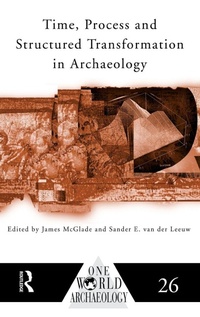
Time, Process and Structured Transformation in Archaeology
Published on 2. January 1997
Book
Hardback
508 pages
978-0-415-11788-3 (ISBN)
Description
In a discipline which essentially studies how modern man came to be, it is remarkable that there are hardly any conceptual tools to describe change. This is due to the history of the western intellectual and scientific tradition, which for a long time favoured mechanics over dynamics, and the study of stability over that of change. Change was primarily deemed due to external events (in archaeology mainly climatic or 'environmental').
Revolutionary innovations in the natural and life sciences, often (erroneously) referred to as 'chaos theory', suggest that there are ways to overcome this problem. A wide range of processes can be described in terms of dynamic systems, and modern computing methods enable us to investigate many of their properties. This volume presents a cogent argument for the use of such approaches, and a discussion of a number of its aspects by a range of scientists from the humanities, social and natural sciences, and archaeology.
Revolutionary innovations in the natural and life sciences, often (erroneously) referred to as 'chaos theory', suggest that there are ways to overcome this problem. A wide range of processes can be described in terms of dynamic systems, and modern computing methods enable us to investigate many of their properties. This volume presents a cogent argument for the use of such approaches, and a discussion of a number of its aspects by a range of scientists from the humanities, social and natural sciences, and archaeology.
Reviews / Votes
'From modelling mammoth hunting and extinctions, the spread of European disease to and across the Americas and the transfer of information in genes, this is state-of-the-art archaeology.' - New ScientistMore details
Series
Language
English
Place of publication
London
United Kingdom
Publishing group
Taylor & Francis Ltd
Target group
College/higher education
Postgraduate
Dimensions
Height: 240 mm
Width: 161 mm
Thickness: 32 mm
Weight
922 gr
ISBN-13
978-0-415-11788-3 (9780415117883)
Copyright in bibliographic data and cover images is held by Nielsen Book Services Limited or by the publishers or by their respective licensors: all rights reserved.
Schweitzer Classification
Other editions
Additional editions
James McGlade | Sander E. Van Der Leeuw
Time, Process and Structured Transformation in Archaeology
E-Book
10/2013
1st Edition
Routledge
€64.49
Available for download
James McGlade | Sander E. Van Der Leeuw
Time, Process and Structured Transformation in Archaeology
E-Book
10/2013
1st Edition
Routledge
€64.49
Available for download
James McGlade | Sander E. Van Der Leeuw
Time, Process and Structured Transformation in Archaeology
Book
06/2010
1st Edition
Routledge
€73.20
Shipment within 15-20 days
Persons
James McGlade, Sander E. van der Leeuw
Content
Preface 1 Introduction: Archaeology and non-linear dynamics -new approaches to long-term change Part I Dynamical approaches to social processes 2 Models of creativity: towards a new science of history 3 The dynamics of peer polities 4 City-size dynamics in urban systems 5 Expectations and social outcomes Part II Models for archaeology 6 Archaeological interpretation and non-linear dynamic modelling: between metaphor and simulation 7 Simulating mammoth hunting and extinctions: implications for North America 8 Clusters of death, pockets of survival: dynamic modelling and GIS 9 Fractal environmental changes and the evolution of culture 10 Why does cultural evolution proceed at a faster rate than biological evolution? 11 Distributed artificial intelligence and emergent social complexity 12 The limits of social control: coherence and chaos in a prestige-goods economy 13 Structural change and bifurcation in urban evolution: a non-linear dynamical perspective Part III Issues in modelling 14 Are our modelling paradigms non-generic? 15 On wholeness, reflexive complexity, hierarchies, structures and system dynamics 16 Towards an 'appropriate metrology' of human action in archaeology 17 Dynamic modelling and new social theory of the mid- to long term