

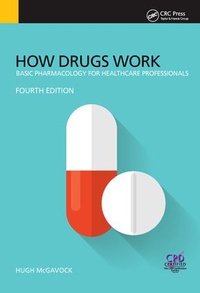
How Drugs Work
Basic Pharmacology for Health Professionals, Fourth Edition
4th Edition
Published on 2. August 2017
Book
Hardback
214 pages
978-1-138-42930-7 (ISBN)
Description
This book provides complex information into what is essential for the prescriber, without sacrificing scientific accuracy. It provides readers with an understanding of how drugs work sufficient to make their prescribing and medication reviewing safer and more effective.
More details
Edition
4th edition
Language
English
Place of publication
London
United Kingdom
Publishing group
Taylor & Francis Ltd
Target group
Professional and scholarly
Professional Reference
Dimensions
Height: 246 mm
Width: 171 mm
Weight
560 gr
ISBN-13
978-1-138-42930-7 (9781138429307)
Copyright in bibliographic data and cover images is held by Nielsen Book Services Limited or by the publishers or by their respective licensors: all rights reserved.
Schweitzer Classification
Other editions
Additional editions
E-Book
10/2017
4th Edition
CRC Press
€53.99
Available for download
E-Book
10/2017
4th Edition
CRC Press
€53.99
Available for download
Book
09/2015
4th Edition
Radcliffe Publishing Ltd
€51.00
Shipment within 3-4 weeks
Person
Hugh McGavock
Content
1. Getting a drug into the body: Absorption 2. Getting a drug to its site of action: Distribution 3. Inactivating drugs: Phase 1 drug metabolism 4. Phase 2 drug metabolism and methods of excretion 5. The concept of a drug's half-life (GBP1/2): An estimate of the rate of elimination of different drugs 6. Receptor function and intercellular signalling 7. The central role of receptors in drug action 8. Drugs that block enzymes: Understanding NSAID therapy in inflammation 9. The principal targets for drug action 10. Calcium ion for the prescriber Drugs and the Central Nervous System 11. Introduction to drugs in the central nervous system 12. CNS drugs whose action is (a) understood, (b) unknown/speculative 13. The actions of CNS drugs used to treat anxiety, insomnia and life-threatening status epilepticus 14. Drugs used to treat Parkinsonism 15. Pain and analgesics 16. How anti-emetic drugs work 17. Antipsychotic drugs 18. Antidepressant drugs 19. Anti-epileptic drugs 20. Drugs of abuse: Hallucinogens and CNS stimulants 21. Alzheimer's disease Drug Topics of Special Importance 22. How the many antidiabetic drugs work 23. Treating severe chronic inflammation 24. The scientific basis of prescribing for the elderly 25. Antibacterial action and bacterial resistance 26. How to prevent adverse drug interactions - ADIs 27. How to predict and avoid adverse drug reactions to single drugs -ADRs 28. Why consider a practice formulary? 29. Getting new drugs to market: Licensing medicines for human 30. The problem of patients' noncompliance with their medication - 'non-concordance'