

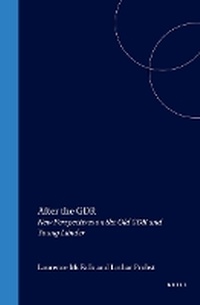
After the GDR
New Perspectives on the Old GDR and Young Laender
Published on 1. January 2001
Book
Paperback/Softback
314 pages
978-90-420-1326-1 (ISBN)
Description
This volume represents the efforts of fifteen scholars from Europe and North America to work through the complex and sometimes compromising past and the current struggles that together define eastern German identity, society, and politics ten years after unification. Their papers offer an exemplary illustration of the variety of disciplinary methods and new source materials on which established and younger scholars can draw today to further differentiated understanding of the old GDR and the young Laender. In a volume that will interest students of German history, cultural studies and comparative politics, the authors show how utopian ideals quickly degenerated into a dictatorship that provoked the everyday resistance at all levels of society that ultimately brought the regime to its demise. They also suggest how the GDR might live on in memory to shape the emerging varieties of postcommunist politics in the young states of the Federal Republic and how the GDR experience might inspire new practices and concepts for German society as a whole. Most importantly, the papers here testify to the multidisciplinary vitality of a field whose original object of enquiry disappeared over a decade ago.
Reviews / Votes
"A wide range of subjects are tackled and a good balance is struck between contributions...it is a volume which does indeed, ..., 'testify to the multidisciplinary vitality of a field whose original object of enquiry disappeared a decade ago'." - in: Journal of European Area Studies, Vol. 10, No. 1 (2002)"This is a very useful book..." - in: Modern Language Review, 98.1 (2003), pp. 246-248
More details
Series
Language
English
German
Place of publication
Leiden
Netherlands
Publishing group
Brill
Target group
College/higher education
Professional and scholarly
Dimensions
Height: 240 mm
Width: 170 mm
Weight
653 gr
ISBN-13
978-90-420-1326-1 (9789042013261)
Copyright in bibliographic data and cover images is held by Nielsen Book Services Limited or by the publishers or by their respective licensors: all rights reserved.
Schweitzer Classification
Other editions
Additional editions
Book
01/2001
Rodopi
€80.66
Article exhausted; check different version
Content
Laurence McFALLS: Introduction. I. The Betrayal of the Intellectuals? Wolfgang EMMERICH: Deutsche Intellektuelle: was nun? Zum Funktionswandel der (ostdeutschen) literarischen Intelligenz in und seit der Wende. Marie-Elisabeth RAEKEL: Der Nationalsozialismus im kulturpolitischen Diskurs der SED, 1946-56. II. Dictatorship, Resistance and Autonomy in the GDR. Gerhard WETTIG: Autonomy and Dependence: The East German Regime's Relationship with the USSR, 1945-49. Gary BRUCE: The Revolutionary Potential of GDR Society in the 1950s. Jeffrey KOPSTEIN: Does Everyday Resistance Matter? Lessons from the Two German Dictatorships. Randall BYTWERK: The Pleasures of Unanimity in the GDR. David P. HARDING: The Demoralization of the East German Officer Corps and the Prussian Military Tradition. III. Modes of Memory. Karen KRAMER: Imag(in)ing the GDR: Gender in Projected Memory. Bernd LINDNER: Medien der Zeitgeschichte: Die Aufarbeitung der DDR-Geschichte am Beispiel des Herbstes '89. Roswitha SKARE: "Real Life within the False One": Manifestations of East German Identity in Post-Reunification Texts. IV. Politics and Political Culture in the New Laender. Lothar PROBST: Resistance against Modernization? East German Attitudes and Identity in the Transition from Community to Society. Catherine PERRON: Eastern German and Czech Democratization from the Perspective of Local Politics. Meredith HEISER-DURON: PDS Success in the East German States, 1998-99: "Colorful Calling Card from the Forgotten Communist Past?". Jennifer YODER: The Regionalization of Political Culture and Identity in Eastern Germany: A Study of State Parliamentarians in Three Laender. Astrid SEGERT: Allokationsprozesse deutscher Eliten. Diskussion der Kolonialisierungsthese. About the Authors.