

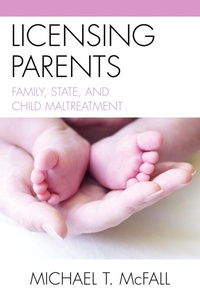
Licensing Parents
Family, State, and Child Maltreatment
Published on 8. July 2010
Book
Paperback/Softback
248 pages
978-0-7391-2914-2 (ISBN)
Description
In Licensing Parents, Michael McFall argues that political structures, economics, education, racism, and sexism are secondary in importance to the inequality caused by families, and that the family plays the primary role in a child's acquisition of a sense of justice. He demonstrates that examination of the family is necessary in political philosophy and that informal structures (families) and considerations (character formation) must be taken seriously. McFall advocates a threshold that should be accepted by all political philosophers: children should not be severely abused or neglected because child maltreatment often causes deep and irreparable individual and societal harm. The implications of this threshold are revolutionary, but this is not recognized fully because no philosophical book has systematically considered the ethical or political ramifications of child maltreatment.
By exposing a tension between the rights of children and adults, McFall reveals pervasive ageism; parental rights usually trump children's rights, and this is often justified because children are not fully autonomous. Yet parental rights should not always trump children's rights. Ethics and political philosophy are not only about rights, but also about duties-especially when considering potential parents who are unable or unwilling to provide minimally decent nurturance. While contemporary political philosophy focuses on adult rights, McFall examines systems whereby the interests and rights of children and parents are better balanced. This entails exploring when parental rights are defeasible and defending the ethics of licensing parents, whereby some people are precluded from rearing children. He argues that, if a sense of justice is largely developed in childhood, parents directly influence the character of future generations of adults in political society. A completely stable and well-ordered society needs stable and psychologically healthy citizens in addition to just laws, and McFall demonstrates how parental love
By exposing a tension between the rights of children and adults, McFall reveals pervasive ageism; parental rights usually trump children's rights, and this is often justified because children are not fully autonomous. Yet parental rights should not always trump children's rights. Ethics and political philosophy are not only about rights, but also about duties-especially when considering potential parents who are unable or unwilling to provide minimally decent nurturance. While contemporary political philosophy focuses on adult rights, McFall examines systems whereby the interests and rights of children and parents are better balanced. This entails exploring when parental rights are defeasible and defending the ethics of licensing parents, whereby some people are precluded from rearing children. He argues that, if a sense of justice is largely developed in childhood, parents directly influence the character of future generations of adults in political society. A completely stable and well-ordered society needs stable and psychologically healthy citizens in addition to just laws, and McFall demonstrates how parental love
Reviews / Votes
Licensing Parents: Family, State, and Child Maltreatment presents an eloquent and passionate argument, advanced with purity of heart, for undergirding the family in order that the most precious of all, namely children, will have from the very start of their lives the most majestic affirmation that is humanly possible. -- Laurence Thomas, Syracuse UniversityMore details
Language
English
Place of publication
United States
Publishing group
Bloomsbury Publishing Plc
Target group
Professional and scholarly
Dimensions
Height: 229 mm
Width: 152 mm
Thickness: 15 mm
Weight
412 gr
ISBN-13
978-0-7391-2914-2 (9780739129142)
Copyright in bibliographic data and cover images is held by Nielsen Book Services Limited or by the publishers or by their respective licensors: all rights reserved.
Schweitzer Classification
Other editions
Additional editions
E-Book
01/2009
1st Edition
Lexington Books
€65.09
Available for download
E-Book
01/2009
1st Edition
Lexington Books
€48.49
Available for download
Persons
Michael T. McFall is a postdoctoral teaching fellow in the Introduction to Humanities Department at Stanford University.
Content
Chapter 1 Introduction
Chapter 2 Chapter 1: A Sense of Justice and Political Stability
Chapter 3 Chapter 2: Non-Rawlsian ISJs and Self-Respect
Chapter 4 Chapter 3: Family Egalitarianism
Chapter 5 Chapter 4: What is a Family?
Chapter 6 Chapter 5: Licensing Parents
Chapter 7 Chapter 6: Rights and Duties
Chapter 8 Chapter 7: The Constitution, Due Process, and Prior Restraint
Chapter 9 Chapter 8: Unintended Consequences, Trust, Stability, Evil, and Utopia
Chapter 10 Epilogue
Chapter 2 Chapter 1: A Sense of Justice and Political Stability
Chapter 3 Chapter 2: Non-Rawlsian ISJs and Self-Respect
Chapter 4 Chapter 3: Family Egalitarianism
Chapter 5 Chapter 4: What is a Family?
Chapter 6 Chapter 5: Licensing Parents
Chapter 7 Chapter 6: Rights and Duties
Chapter 8 Chapter 7: The Constitution, Due Process, and Prior Restraint
Chapter 9 Chapter 8: Unintended Consequences, Trust, Stability, Evil, and Utopia
Chapter 10 Epilogue