

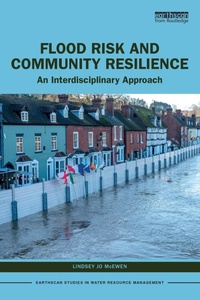
Flood Risk and Community Resilience
An Interdisciplinary Approach
1st Edition
Published on 27. February 2024
Book
Paperback/Softback
22 pages
978-1-138-95447-2 (ISBN)
Description
This book details the impact of flooding on our environment, and the ways in which communities, and those that work with them, can act to manage the associated risks.
Flooding is an increasingly significant environmental hazard which inflicts major costs to the economies and livelihoods of developed countries. This book explores how local communities can identify, manage, and adapt to the ever-increasing damage flooding causes. Focusing on the future role of local communities, the benefits and challenges of their involvement, and the potential areas of transformation, this book provides insights into the efficacy of interdisciplinary and transdisciplinary working. Alongside research into similar environmental hazards, this book also draws upon the author's own knowledge of flood risk management in distinctive non-contiguous interdisciplinary settings. The chapters draw together a different and distinctive set of interdisciplinary themes in flood risk management and social resilience. In doing so, it strives to communicate the different ways of thinking that can usefully contribute to flood risk management.
This book would be ideal for those researching flood risk management, alongside scholars and non-scholars alike who are interested in finding ways of adapting to environmental hazards working with local communities.
Flooding is an increasingly significant environmental hazard which inflicts major costs to the economies and livelihoods of developed countries. This book explores how local communities can identify, manage, and adapt to the ever-increasing damage flooding causes. Focusing on the future role of local communities, the benefits and challenges of their involvement, and the potential areas of transformation, this book provides insights into the efficacy of interdisciplinary and transdisciplinary working. Alongside research into similar environmental hazards, this book also draws upon the author's own knowledge of flood risk management in distinctive non-contiguous interdisciplinary settings. The chapters draw together a different and distinctive set of interdisciplinary themes in flood risk management and social resilience. In doing so, it strives to communicate the different ways of thinking that can usefully contribute to flood risk management.
This book would be ideal for those researching flood risk management, alongside scholars and non-scholars alike who are interested in finding ways of adapting to environmental hazards working with local communities.
More details
Series
Language
English
Place of publication
London
United Kingdom
Publishing group
Taylor & Francis Ltd
Target group
College/higher education
Professional and scholarly
Postgraduate, Professional, and Undergraduate
Illustrations
48 s/w Tabellen, 42 s/w Zeichnungen, 23 s/w Photographien bzw. Rasterbilder, 65 s/w Abbildungen
48 Tables, black and white; 42 Line drawings, black and white; 23 Halftones, black and white; 65 Illustrations, black and white
Dimensions
Height: 234 mm
Width: 156 mm
Thickness: 20 mm
Weight
570 gr
ISBN-13
978-1-138-95447-2 (9781138954472)
Copyright in bibliographic data and cover images is held by Nielsen Book Services Limited or by the publishers or by their respective licensors: all rights reserved.
Schweitzer Classification
Other editions
Additional editions
E-Book
03/2024
1st Edition
Routledge
€55.49
Available for download
E-Book
03/2024
1st Edition
Routledge
€55.49
Available for download
Book
02/2024
1st Edition
Routledge
€207.30
Shipment within 10-20 days
Person
Lindsey Jo McEwen is Professor of Environmental Management and Director of the Centre for Water, Communities and Resilience at the University of the West of England, Bristol, UK.
Content
Chapter 1 Interdisciplinary explorations in communities and their resilience to changing flood risk: an introduction
Chapter 2 Different flood types and diverse communities: interactions, impacts and management at local level
Chapter 3 Flood hazard perception, awareness, and action: from individual to community?
Chapter 4 Different flood knowledges: conflict or integration?
Chapter 5 Linking flood heritage and local community resilience
Chapter 6 Communicating flood science for community resilience
Chapter 7 Flood management strategies and their relation to community awareness and action
Chapter 8 Community participation and agency in local flood risk management
Chapter 9 Community learning for flood resilience: strategies and pitfalls
Chapter 10 Community resilience to flood risk: futures, challenges and opportunities
Chapter 2 Different flood types and diverse communities: interactions, impacts and management at local level
Chapter 3 Flood hazard perception, awareness, and action: from individual to community?
Chapter 4 Different flood knowledges: conflict or integration?
Chapter 5 Linking flood heritage and local community resilience
Chapter 6 Communicating flood science for community resilience
Chapter 7 Flood management strategies and their relation to community awareness and action
Chapter 8 Community participation and agency in local flood risk management
Chapter 9 Community learning for flood resilience: strategies and pitfalls
Chapter 10 Community resilience to flood risk: futures, challenges and opportunities