

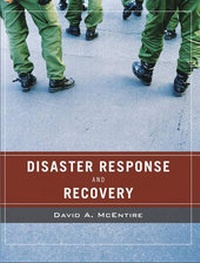
Disaster Response and Recovery
Strategies and Tactics for Resilience
Published on 18. August 2006
Book
Paperback/Softback
504 pages
978-0-471-78974-1 (ISBN)
Description
Providing readers with a well-rounded understanding of disaster responses, this book first explores the various types of disasters that may occur. It then uncovers the myriad of actors that are involved in emergency management as well as the diverse theoretical frameworks from which post-disaster activities may be approached. Readers will gain a better understanding of the typical challenges to be expected during response efforts as well as the tools and techniques that will enhance the ability to protect lives, reduce property damage and minimize disruption.
More details
Language
English
Place of publication
New York
United States
Target group
Professional and scholarly
Illustrations
Illustrations
Dimensions
Height: 232 mm
Width: 189 mm
Thickness: 28 mm
Weight
764 gr
ISBN-13
978-0-471-78974-1 (9780471789741)
Copyright in bibliographic data and cover images is held by Nielsen Book Services Limited or by the publishers or by their respective licensors: all rights reserved.
Other editions
New editions
Book
10/2014
2nd Edition
Wiley
Unfortunately, price unknown
Article exhausted; check for reprint
Person
David McEntire is an assistant professor of emergency administration and planning at the University of North Texas. His expertise includes: Disaster Prepardness Planning and reponse, Emergency Management, Terror Response, Disasters in Developing Nations, Disasters, Disaster Relief.
Content
Introduction. 1. Knowing What to Expect: Hazards and Disasters. 2. Understanding the Actors: Role and Responsibilities of Disaster Participants. 3. Anticipating Human Behavior in Disasters: Myths, Exaggerations and Realities. 4. Approaching Response and Recovery Operations: Alternative Management Theories. 5. Responding with Initial Measures: Hazard Detection, Warning, Evacuation, and Sheltering. 6. Caring for the Injured, Dead and Distraught: Overcoming Physical and Emotional Impacts. 7. Managing Public Relations, Donations and Volunteers: Expected Challenges and Benefits. 8. Moving Beyond Immediate Needs: Damage Assessment, Disaster Declarations and Debris Removal. 9. Promoting Recovery and Mitigation: Disaster Assistance and Vulnerability Reduction. 10. Overcoming Typical Challenges: Other Anticipated Problems After Disaster. 11. Harnessing Technology and Organization: Tools for Local, State and Federal Governments. 12. Dealing with Future Disasters: Prior Lessons, New Threats and Rising Vulnerability. 13. Promoting Disaster Resilience: Preparedness, Improvisation, Professionalism and Leadership. Bibliography. Glossary. Index.