

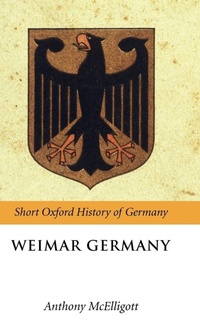
Weimar Germany
Published on 19. March 2009
Book
Hardback
344 pages
978-0-19-928006-3 (ISBN)
Description
The Weimar Republic was born out of Germany's defeat in the First World War and ended with the coming to power of Hitler and his Nazi Party in 1933. In many ways, it is a wonder that Weimar lasted as long as it did. Besieged from the outset by hostile forces, the young republic was threatened by revolution from the left and coups d'etats from the right. Plagued early on by a wave of high-profile political assassinations and a period of devastating hyper-inflation, its later years were dominated by the onset of the Great Depression. And yet, for a period from the mid-1920s it looked as if the Weimar system would not only survive but even flourish, with the return of economic stability and the gradual reintegration of the country into the international community.
With contributions from an international team of ten experts, this volume in the Short Oxford History of Germany series offers an ideal introduction to Weimar Germany, challenging the reader to rethink preconceived ideas of the republic and throwing new light on important areas, such as military ideas for reshaping society after the First World War, constitutional and social reform, Jewish life, gender, and culture.
With contributions from an international team of ten experts, this volume in the Short Oxford History of Germany series offers an ideal introduction to Weimar Germany, challenging the reader to rethink preconceived ideas of the republic and throwing new light on important areas, such as military ideas for reshaping society after the First World War, constitutional and social reform, Jewish life, gender, and culture.
Reviews / Votes
highly recommended as an introduction to the topic * Andreas Wirsching, German Historical Institute London Bulletin * provides an excellent introudction to new work and new approaches to the Weimar Republic ... this is a stimulating and accessibly volume which will inform and enliven dicussion of the Republic and its problems in an admirable way. * Jonathan Wright, English Historical Review * Like the other short histories of Germany, this is an excellently accessible work that nevertheless introduces students to up-to-date scholarly debates. * Jeff Bowersox, University of Worcester *More details
Series
Language
English
Place of publication
Oxford
United Kingdom
Target group
College/higher education
Illustrations
1 map
Dimensions
Height: 222 mm
Width: 145 mm
Thickness: 24 mm
Weight
617 gr
ISBN-13
978-0-19-928006-3 (9780199280063)
Copyright in bibliographic data and cover images is held by Nielsen Book Services Limited or by the publishers or by their respective licensors: all rights reserved.
Schweitzer Classification
Other editions
Additional editions
Anthony McElligott
Weimar Germany
Book
03/2009
Oxford University Press
€57.00
Shipment within 15-20 days
Person
Anthony McElligott is professor of history at the University of Limerick, where he is also the Director of the Centre for Historical Research. He is a founding co-editor of Cultural and Social History: The Journal of the Social History Society. He has published widely on the Weimar Republic and the Third Reich, notably Contested City: Municipal Politics and the Rise of Nazism in Altona 1917-1937 (1998), The German Urban Experience 1900-1945, Modernity and Crisis (2001), and with Tim Kirk, 'Working Towards The Fuehrer': Essays in Honour of Sir Ian Kershaw (2003). He is currently completing a major new study of the Weimar republic, Rethinking The Weimar Republic: Authority and Authoritarianism 1916-1936.
Content
Introduction ; 1. Political Culture ; 2. Foreign Policy ; 3. The Reichswehr and the Weimar Republic ; 4. The Weimar Economy ; 5. The 'Urban Republic' ; 6. Women and the Politics of Gender ; 7. The Weimar Welfare System ; 8. 'Neues Wohnen': Housing and Reform ; 9. Weimar Jewry ; 10. High Brow and Low Brow Culture ; Further Reading ; Chronology