

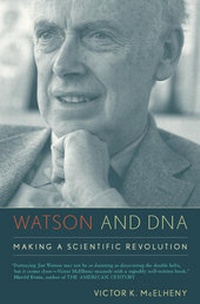
Watson and DNA
Making a Scientific Revolution
1st Edition
Published on 23. September 2003
Book
Paperback/Softback
380 pages
978-0-470-85430-3 (ISBN)
Description
An account of one of the biggest scientific breakthroughs of the past century.
In 1950 a young American zoologist, James Watson, came to Cambridge to work on molecular biology. From 1950-1953 he worked with Francis Crick, during which time they solved the structure of DNA - seen as one of the biggest scientific breakthroughs of the past century - and for which they were awarded a shared Nobel Prize in 1962. Watson returned to the US where he became Professor of Molecular Biology at Harvard and subsequently Director of the Cold Spring Harbour Laboratory. He was appointed Head of the US Human Genome Project in 1988, and was pivotal to guiding the project through the controversy surrounding genetic research. His collaboration with The Wellcome Trust helped to establish the Sanger Centre as the focus for the UK sequencing effort of the human genome.
Giving a balanced view of Watson's whole life and work, this biography traces the stages of this discovery, the setbacks, false starts and breakthroughs, putting Watson and Crick within the context of the other work being done at the time. It also looks at Watson's whole career including his later genome work and his early life.
Victor K. McElheny is a prominent science writer who has been writing about the revolution in molecular biology and biotechnology for over three decades. His interest in James D. Watson spans the years from his first meeting with Watson in 1962 to the present day. He is a Harvard graduate who also headed the Knight Science Journalism Fellowships at the Massachusetts Institute of Technology. His work has been featured by The New York Times, The Boston Globe, Science and the BBC.
* There has been considerable criticism lately (particularly in a biography of Rosalind Franklin by Brenda Maddox) that James D. Watson's own account of his work, The Double Helix, presented an exceptionally biased view of events. This biography is based on interviews with all his contemporaries to present a more balanced view.
* A biography of a extremely talented man - he gained his PhD at the remarkably young age of 22 - who has made a major contribution towards the shaping of the future world
* Explains how the structure of DNA was discovered
* Gives an insight into the workings of the world of science and scientists
* 2003 is 50 years since the discovery of DNA, which will undoubtly ensure coverage of the progress to date in this field, and there is also a five-part series currently in production on James Watson and featuring the author of this book, which is due to be screened in Spring 2003 on Channel 4.
In 1950 a young American zoologist, James Watson, came to Cambridge to work on molecular biology. From 1950-1953 he worked with Francis Crick, during which time they solved the structure of DNA - seen as one of the biggest scientific breakthroughs of the past century - and for which they were awarded a shared Nobel Prize in 1962. Watson returned to the US where he became Professor of Molecular Biology at Harvard and subsequently Director of the Cold Spring Harbour Laboratory. He was appointed Head of the US Human Genome Project in 1988, and was pivotal to guiding the project through the controversy surrounding genetic research. His collaboration with The Wellcome Trust helped to establish the Sanger Centre as the focus for the UK sequencing effort of the human genome.
Giving a balanced view of Watson's whole life and work, this biography traces the stages of this discovery, the setbacks, false starts and breakthroughs, putting Watson and Crick within the context of the other work being done at the time. It also looks at Watson's whole career including his later genome work and his early life.
Victor K. McElheny is a prominent science writer who has been writing about the revolution in molecular biology and biotechnology for over three decades. His interest in James D. Watson spans the years from his first meeting with Watson in 1962 to the present day. He is a Harvard graduate who also headed the Knight Science Journalism Fellowships at the Massachusetts Institute of Technology. His work has been featured by The New York Times, The Boston Globe, Science and the BBC.
* There has been considerable criticism lately (particularly in a biography of Rosalind Franklin by Brenda Maddox) that James D. Watson's own account of his work, The Double Helix, presented an exceptionally biased view of events. This biography is based on interviews with all his contemporaries to present a more balanced view.
* A biography of a extremely talented man - he gained his PhD at the remarkably young age of 22 - who has made a major contribution towards the shaping of the future world
* Explains how the structure of DNA was discovered
* Gives an insight into the workings of the world of science and scientists
* 2003 is 50 years since the discovery of DNA, which will undoubtly ensure coverage of the progress to date in this field, and there is also a five-part series currently in production on James Watson and featuring the author of this book, which is due to be screened in Spring 2003 on Channel 4.
Reviews / Votes
"!a vivid portrait of a man who himself is an institution!the book contains many insightful comments and quotations!" (Nature, 23 January 2003) "!packed with factual information, anecdotes and gossip about those involved!this book will be a riveting read!" (New Scientist, 15 March 2003) "!to molecular biologists and history of science aficionados, this biography will be both a great pleasure and a great resource!" (Spectator, 8 March 2003) "... McElheny presents the science in this amazing story with effortless lucidity...McElheny has done a good job, producing a warts--and--all portrait..." (The Guardian, 15 March 2003) "!rich in detail, McElheny has done his homework. As a consequence he gives the most insightful account!" (Yorkshire Post Magazine, 27 September 2003) "...McElheny has researched the story of Watsona s extraordinary life diligently...and recounted it fairly and with occasional panache..." (The Sunday Telegraph23 March 2003 "!an excellent third--person account in Victor McElenhy's Watson and DNA for its invaluable array of objective character perspectives!" (The Sunday Times, 23 March 2003) a ... brings a clear eye to the hard--to--explain combination of Watsona s abrasive personality and unremitting achievement.a (Manchester Guardian Weekly, 2 April 2003) a ... challenges the simplicity of both the science and the person in ways that make both more real.a (Focus, May 2003) "!a marvellous insight!a fine biography, many years in the making and containing plenty of new material!" (Chemistry in Britain, April 2003) "!McElhwny provides a very full account of Watson's life and scientific contributions!" (Times Higher Educational Supplement, 25 April 2003) "! for those with a predilection for the minutiae of this historical event, McElheny is your only man!" (Irish Times (Dublin), 19 April 2003) "Watson has told his own story, piecemeal, in several books: this one by a veteran newspaperman does it well, and warmly, in one narrative!" (Lancet, 19 April 2003) No 6 in Bestsellers Cambridge list (New Scientist, 26 April 2003) "!there is plenty more in this book to keep you turning the pages!" (British Society for Cell Biology Newsletter, Summer 2003) "!This book puts the discovery of the double helix into context and explains how the effects of the discovery will resonate for many years!" (www.relaxwithabook.com 13June 2003) "!there is plenty more in this book to keep you turning the pages!" (British Society for Developmental Biology Newsletter, Summer 2003) '!informative, entertaining, and well--written.' (The Biochemist, 10 July 2003) "!rich in detail, McElheny has done his homework. As a consequence he gives the most insightful account!" (Yorkshire Post Magazine, 27 September 2003) "!without bombarding the non--scientific minded reader with jargon, McElheny makes his subject universally appealing!" (Western Daily Press, 18 October 2003)More details
Content
Preface.
Acknowledgments.
Prologue: 19 October 1962.
1. Books and Birds: "Growing Up" in Chicago.
2. Target, The Gene: Bloomington and "Paradise"
3. Stumbling on Gold: Two Smart Alecks in Cambridge.
4. A Beautiful Molecule: Being Believed.
5. Now What? Thrashing Around.
6. Harvard: "Few Dared Call Him to Account".
7. Minifesto and Marriage.
8. "Fresh, Arrogant, Catty, Bratty, and Funny".
9. A Passion for Building: Cold Spring Harbor.
10. "Higher" Cells: Science at Cold Spring Harbor.
11. "Odd Man Out": Recombinant DNA.
12. Genome: "It Is So Obvious".
Epilogue: "I'am an Optimist".
James Dewey Watson: A Brief Chronology.
Interviews by the Author.
Notes.
Index.
About the Author.
Acknowledgments.
Prologue: 19 October 1962.
1. Books and Birds: "Growing Up" in Chicago.
2. Target, The Gene: Bloomington and "Paradise"
3. Stumbling on Gold: Two Smart Alecks in Cambridge.
4. A Beautiful Molecule: Being Believed.
5. Now What? Thrashing Around.
6. Harvard: "Few Dared Call Him to Account".
7. Minifesto and Marriage.
8. "Fresh, Arrogant, Catty, Bratty, and Funny".
9. A Passion for Building: Cold Spring Harbor.
10. "Higher" Cells: Science at Cold Spring Harbor.
11. "Odd Man Out": Recombinant DNA.
12. Genome: "It Is So Obvious".
Epilogue: "I'am an Optimist".
James Dewey Watson: A Brief Chronology.
Interviews by the Author.
Notes.
Index.
About the Author.