

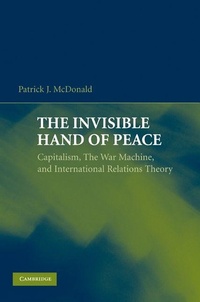
The Invisible Hand of Peace
Capitalism, the War Machine, and International Relations Theory
Published on 2. March 2009
Book
Paperback/Softback
354 pages
978-0-521-74412-6 (ISBN)
Description
The Invisible Hand of Peace shows that the domestic institutions associated with capitalism, namely private property and competitive market structures, have promoted peace between states over the past two centuries. It employs a wide range of historical and statistical evidence to illustrate both the broad applicability of these claims and their capacity to generate new explanations of critical historical events, such as the emergence of the Anglo-American friendship at the end of the nineteenth century, the outbreak of World War I, and the evolution of the recent conflict across the Taiwan Strait. By showing that this capitalist peace has historically been stronger than the peace among democratic states, these findings also suggest that contemporary American foreign policy should be geared toward promoting economic liberalization rather than democracy in the post-9/11 world.
Reviews / Votes
'Thoroughly researched, cogently argued, and clearly written, McDonald's The Invisible Hand of Peace draws out the essential contribution that capitalism, private property, and free trade make to the liberal peace. McDonald insightfully combines political theory, quantitative analysis, and case studies in a way that illuminates both international history and contemporary policy debates.' Michael W. Doyle, Columbia University 'The liberal argument that international commerce reduces the chance of military conflict among trading partners has long been controversial among scholars and policy makers. McDonald's argument that the pacifying effect of trade depends on the presence of liberal rules governing trade within each state helps to sort out when trade helps preserve peace and when it does not. His combination of quantitative analysis and careful examination of the well-known historical cases that have fuelled the controversy over trade and conflict makes his book especially convincing.' Benjamin O. Fordham, State University of New York, Binghamton 'Patrick McDonald argues forcefully that Adam Smith's invisible hand promotes not only wealth but international peace as well. Going beyond commercial liberalism, McDonald demonstrates that private property and competitive markets constrain the political rent-seeking of leaders and make them more responsive to popular demands. Deftly using both data analysis and historical materials, he advances a challenging new domestic political economy explanation of the erroneously labeled democratic peace.' David A. Lake, University of California, San DiegoMore details
Language
English
Place of publication
Cambridge
United Kingdom
Target group
Professional and scholarly
College/higher education
Product notice
Paperback (trade)
Illustrations
17 Tables, unspecified; 1 Line drawings, unspecified
Dimensions
Height: 229 mm
Width: 152 mm
Thickness: 21 mm
Weight
575 gr
ISBN-13
978-0-521-74412-6 (9780521744126)
Copyright in bibliographic data and cover images is held by Nielsen Book Services Limited or by the publishers or by their respective licensors: all rights reserved.
Schweitzer Classification
Other editions
Additional editions
Patrick J. McDonald
The Invisible Hand of Peace
Capitalism, the War Machine, and International Relations Theory
E-Book
04/2009
1st Edition
Cambridge University Press
€26.49
Available for download
Person
Patrick J. McDonald is an Assistant Professor in the Department of Government at the University of Texas, Austin. He received a Ph.D. in political science from the Ohio State University in 2002. He then served as a Postdoctoral Fellow at the Christopher H. Browne Center for International Politics at the University of Pennsylvania until 2004. Professor McDonald's research has been published in the American Journal of Political Science, International Studies Quarterly, the Journal of Conflict Resolution, the Washington Quarterly, and World Politics.
Content
1. American grand strategy and the liberal peace; 2. Liberal international relations theory on war; 3. Releasing the invisible hand; 4. Liberal economic institutions and peace in the twentieth century; 5. Free trade and peace in the first era of globalization; 6. From rivalry to friendship; 7. The Achilles' heel of liberal international relations theory?; 8. Peace across the Taiwan Strait?; 9. The invisible hand or the ballot box?; 10. Capitalism and America's peaceful market power.