

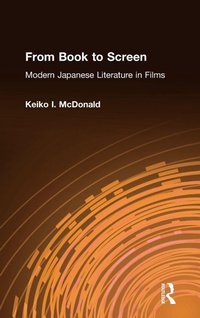
From Book to Screen
Modern Japanese Literature in Films
1st Edition
Published on 31. May 1999
Book
Hardback
344 pages
978-0-7656-0387-6 (ISBN)
Description
Of all the world s cinemas, Japan's is perhaps unique in its closeness to the nation's literature, past and contemporary. The Western world became aware of this when Akira Kurosawa's Rashomon was awarded the Grand Prize at the Venice film festival in 1951 and the Oscar for best foreign film in 1952. More recent examples include Shohei Imamura's Eel, which won the Palm d'Or (Best Picture) at Cannes in 1997.From Book to Screen breaks new ground by exploring important connections between Japan's modern literary tradition and its national cinema. The first part offers an historical and cultural overview of the working relationship that developed between pure literature and film. It deals with three important periods in which filmmakers relied most heavily on literary works for enriching and developing cinematic art. The second part provides detailed analyses of a dozen literary works and their screen adoptions.
More details
Language
English
Place of publication
London
United Kingdom
Publishing group
Taylor & Francis Ltd
Target group
College/higher education
Professional and scholarly
Illustrations
photographs, bibliography, index
Dimensions
Height: 235 mm
Width: 157 mm
Thickness: 23 mm
Weight
650 gr
ISBN-13
978-0-7656-0387-6 (9780765603876)
Copyright in bibliographic data and cover images is held by Nielsen Book Services Limited or by the publishers or by their respective licensors: all rights reserved.
Schweitzer Classification
Other editions
Additional editions
E-Book
09/2016
Routledge
€64.49
Available for download
E-Book
09/2016
Routledge
€64.49
Available for download
Book
12/1999
1st Edition
Routledge
€72.10
Shipment within 15-20 days
Person
Keiko I. McDonald
Content
Introduction PART I. Shifts in Creative Emphasis 1. The Camera Looks at Melodrama: 1908-1920 2. Literature More Pure Than Popular: 1935-1941 3. More Freedoms, More Troubles: 1951-1959 PART II Writing as Directed: A Re-creative Enterprise 4. A Lyrical Novella Revamped: Gosho's Izu Dancer(1933) 5. Freedom to Stray from the Straight and Narrow: Mizoguchi's Lady Musashino(1951) 6. Religion and Politics: Kumai's The Sea and Poison (1986) 7. The Modern Outcast State: Ichikawa's The Broken Commandment(1962) 8. Cuts in Plot and Characters: Higashi's A River with No Bridge(1992) 9. More of a lust-So Story: Shimazu's The Story of Shunkin (1935) 10. Differently True: Toyoda's A Strange Tale of Tom Bast Of the River(1960) 11. Living the Postwar Life: Naruse's Older BrotheI; Younger Sister(1953) 12. The Pain of Emancipation: Shinoda's Maihime(1989) 13. Back to the Mirror of the Past: Morita's Sorekara (1985) 14. Stylistic Experiment: Teshigahara's The Face of Another(1966) 15. Rehearsing Death: Takabayashi's The Temple of the Golden PaviIion (1976)