

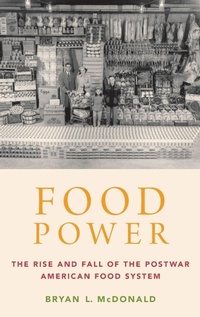
Food Power
The Rise and Fall of the Postwar American Food System
Published on 29. December 2016
Book
Hardback
264 pages
978-0-19-060068-6 (ISBN)
Description
In Food Power, Bryan L. McDonald brings together the history of food, agriculture, and foreign policy to explore the use of food to promote American national security and national interests during the first three decades of the Cold War. In the years after World War II, Americans struggled to understand how an unprecedented abundance of food could be used to best advance American goals and values. Was food a weapon, a commodity to be valued and exchanged through markets, or a substance to be provided to those in need? The use of food as an element of national power is often referred to as "food power." McDonald traces different visions of food power and shows how food was an essential part of America's postwar modernization strategy -- its vision of what it meant to be a stable, secure, and technologically advanced nation.
Debates during the postwar years about how food power could help the United States achieve goals such as stability, prosperity, and security were part of a larger conversation about the role of food in the security of states, communities, and individuals. America helped build a new, postwar food system based on the steadying influence of American agricultural surpluses that helped maintain stable prices and food availability. This system averted a global-scale food crisis for almost three decades. The end of this food system in the early 1970s ushered in a much more unstable period in global food relations. Food Power argues that efforts to both interpret America's role in the world during the mid-twentieth century and to address contemporary food problems can be strengthened by understanding more fully the ways postwar American policymakers and experts sought to shape the politics of security and prosperity by linking people and places around the world through food.
Debates during the postwar years about how food power could help the United States achieve goals such as stability, prosperity, and security were part of a larger conversation about the role of food in the security of states, communities, and individuals. America helped build a new, postwar food system based on the steadying influence of American agricultural surpluses that helped maintain stable prices and food availability. This system averted a global-scale food crisis for almost three decades. The end of this food system in the early 1970s ushered in a much more unstable period in global food relations. Food Power argues that efforts to both interpret America's role in the world during the mid-twentieth century and to address contemporary food problems can be strengthened by understanding more fully the ways postwar American policymakers and experts sought to shape the politics of security and prosperity by linking people and places around the world through food.
Reviews / Votes
Food Power is a valuable contribution to the conversation about our food network and reminds future scholarship of the lingering importance of government policy in a system dominated by a multitude of corporate hubs and nodes. * Jayson Otto, Agricultural History * Food Power is an interesting book that very usefully illuminates the relationship between American food and American power in the postwar period. * Helen Zoe Veit, Journal of American History * Food Power: The Rise and Fall of the Postwar American Food System takes this superfluity of food as its central concern, tracking the political dynamic by which surplus food was either a problem to be eliminated or a boon to international diplomatic strategies ... It is a fascinating story that brings together a number of historical strands, including the effect of science and technology on both farming and food production, the role of World War II in creating an unprecedented food system, the challenges of electoral politics, and the various kinds of political philosophy and strategies that different secretaries of agriculture followed in wrestling with these problems ... McDonald's book is important and accessible, and it sheds new light on the challenges governments face in balancing production, consumption, and political survival. * Deborah Fitzgerald, American Historical Review *More details
Language
English
Place of publication
New York
United States
Target group
College/higher education
Professional and scholarly
Dimensions
Height: 240 mm
Width: 161 mm
Thickness: 19 mm
Weight
564 gr
ISBN-13
978-0-19-060068-6 (9780190600686)
Copyright in bibliographic data and cover images is held by Nielsen Book Services Limited or by the publishers or by their respective licensors: all rights reserved.
Schweitzer Classification
Other editions
Additional editions
E-Book
11/2016
1st Edition
OUP eBook
€21.99
Available for download
E-Book
11/2016
1st Edition
OUP eBook
€27.49
Available for download
Person
Bryan McDonald is Assistant Professor of History at Pennsylvania State University.
Content
Acknowledgments
Introduction: Food Power, the Food Network, and American Security
Chapter 1: Freedom from Want: Creating a Postwar Food System
Chapter 2: Fixed Stomachs and Convenience Foods: Abundance and Food in the 1950s
Chapter 3: Freedom to Farm: Prosperity, Security, and "the Farm Problem" in the 1950s
Chapter 4: What to Eat After an Atomic Bomb: Deploying Food Power Defensively
Chapter 5: Food for Peace and the War on Hunger: Food Power in the 1960s
Chapter 6: The World Food Crisis and the End of the Postwar Food System
Conclusion: The Past, Present, and Future of World Food Problems
Notes
Index
Introduction: Food Power, the Food Network, and American Security
Chapter 1: Freedom from Want: Creating a Postwar Food System
Chapter 2: Fixed Stomachs and Convenience Foods: Abundance and Food in the 1950s
Chapter 3: Freedom to Farm: Prosperity, Security, and "the Farm Problem" in the 1950s
Chapter 4: What to Eat After an Atomic Bomb: Deploying Food Power Defensively
Chapter 5: Food for Peace and the War on Hunger: Food Power in the 1960s
Chapter 6: The World Food Crisis and the End of the Postwar Food System
Conclusion: The Past, Present, and Future of World Food Problems
Notes
Index