

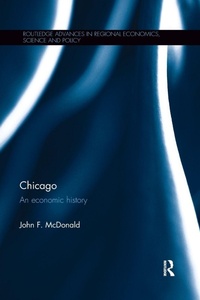
Chicago
An economic history
1st Edition
Published on 12. December 2019
Book
Paperback/Softback
264 pages
978-0-367-87366-0 (ISBN)
Description
Chicago went from nothing in 1830 to become the second-largest city in the nation in 1900, while the Midwest developed to become one of the world's foremost urban areas. This book is an economic history of the Chicago metropolitan area from the 1820s to the present. It examines the city in its Midwestern region and compares it to the other major cities of the North. This book uses theories of the economics of location and other economic models to explain much of Chicago's history.
Chicago maintained its status as the second-largest city through the first decades of the 20th century, but rapid growth shifted to the Sunbelt following World War II. Since the 1950s the city's history can be divided into four distinct periods; growth with suburbanization (1950-1970), absence of growth, continued suburbanization, and central city crisis (1970-1990), rebound in the 1990s, and financial crisis and deep recession after 2000. Through it all Chicago has maintained its position as the economic capital of the Midwest. The book is a synthesis of available literature and public data, and stands as an example of using economics to understand much of the history of Chicago.
This book is intended for the college classroom, urban scholars, and for those interested in the history of one of world's foremost urban areas.
Chicago maintained its status as the second-largest city through the first decades of the 20th century, but rapid growth shifted to the Sunbelt following World War II. Since the 1950s the city's history can be divided into four distinct periods; growth with suburbanization (1950-1970), absence of growth, continued suburbanization, and central city crisis (1970-1990), rebound in the 1990s, and financial crisis and deep recession after 2000. Through it all Chicago has maintained its position as the economic capital of the Midwest. The book is a synthesis of available literature and public data, and stands as an example of using economics to understand much of the history of Chicago.
This book is intended for the college classroom, urban scholars, and for those interested in the history of one of world's foremost urban areas.
Reviews / Votes
"Though much of the text is devoted to dry statistical analysis, the author's account is leavened by personal reflections drawn from his professional experience and a family history entwined with Chicago's development since the late 19th century. The result is an engaging depiction of Chicago's rise to prominence as a national transportation hub and manufacturing powerhouse. Populated by waves of immigrants and African American migrants, it was the American "Second City" during the mid-20th century. The last half of the book contends with Chicago's more problematic recent evolution as population stagnated and the city's manufacturing economy fell into terminal decline. Despite the city's economic turnaround in the 1990s, the Great Recession and its aftermath leave the author uncertain about Chicago's future"R. S. Hewett, Drake University, CHOICE
More details
Series
Language
English
Place of publication
London
United Kingdom
Publishing group
Taylor & Francis Ltd
Target group
College/higher education
Postgraduate
Dimensions
Height: 234 mm
Width: 156 mm
Thickness: 14 mm
Weight
409 gr
ISBN-13
978-0-367-87366-0 (9780367873660)
Copyright in bibliographic data and cover images is held by Nielsen Book Services Limited or by the publishers or by their respective licensors: all rights reserved.
Schweitzer Classification
Other editions
Additional editions
Book
08/2015
1st Edition
Routledge
€186.30
Shipment within 10-20 days
Person
John F. McDonald is Emeritus Professor of Economics, University of Illinois at Chicago, and Gerald W. Fogelson Distinguished Chair in Real Estate Emeritus, Roosevelt University, USA
Content
1. Some Useful Economic Models in Prose 2. Chicago and the Development of the Old Northwest 3. The Second City: 1900-1930 4. Depression and War 5. Chicago in 1950, and a Look Ahead 6. Postwar Growth and Suburbanization: 1950-1970 7. The Decades of Urban Crisis 8. The Old Century Ends on a High Note, and a New Century Begins