

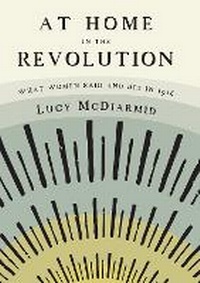
At Home in the Revolution
what women said and did in 1916
Published on 18. November 2015
Book
Paperback/Softback
300 pages
978-1-908996-74-9 (ISBN)
Description
On Monday morning 24 April 1916, Catherine Byrne jumped through a window on the side of the GPO on O'Connell Street to join the Irish revolution; Mairead Ni Cheallaigh served breakfast to Patrick and Willie Pearse, their last home-cooked meal, and then went out to set up an emergency hospital with members of Cumann na mBan; Maire Nic Shiubhlaigh persuaded Thomas MacDonagh to let her into the garrison at Jacob's Biscuit Factory; and Elsie Mahaffy, daughter of the Provost of Trinity, was in her bedroom 'completing her toilet' when her sister came in to tell her that 'the Sinn Feiners had risen.'
At Home in the Revolution derives its material from women's own accounts of the Easter Rising, interpreted broadly to include also the Howth gun-running and events that took place over the summer of 1916 in Ireland. These eye-witness narratives -- diaries, letters, memoirs, autobiographies, and official witness statements -- were written by nationalists and unionists, Catholics and Protestants, women who felt completely at home in the garrisons, cooking for the men and treating their wounds, and women who stayed at home during the Rising. The book's focus is on the kind of episode usually ignored by traditional historians: cooking with bayonets, arguing with priests, resisting sexual harassment, soothing a female prostitute, doing sixteen-hand reels in Kilmainham Gaol, or disagreeing with Prime Minister Asquith about the effect of the Rising on Dublin's architecture. The women's 'small behaviours', to use Erving Goffman's term, reveal social change in process, not the official history of manifestos and legislation, but the unofficial history of access to a door or a leap through a window; they show how issues of gender were negotiated in a time of revolution.
At Home in the Revolution derives its material from women's own accounts of the Easter Rising, interpreted broadly to include also the Howth gun-running and events that took place over the summer of 1916 in Ireland. These eye-witness narratives -- diaries, letters, memoirs, autobiographies, and official witness statements -- were written by nationalists and unionists, Catholics and Protestants, women who felt completely at home in the garrisons, cooking for the men and treating their wounds, and women who stayed at home during the Rising. The book's focus is on the kind of episode usually ignored by traditional historians: cooking with bayonets, arguing with priests, resisting sexual harassment, soothing a female prostitute, doing sixteen-hand reels in Kilmainham Gaol, or disagreeing with Prime Minister Asquith about the effect of the Rising on Dublin's architecture. The women's 'small behaviours', to use Erving Goffman's term, reveal social change in process, not the official history of manifestos and legislation, but the unofficial history of access to a door or a leap through a window; they show how issues of gender were negotiated in a time of revolution.
Reviews / Votes
'Few books published for the centenary of 1916 will be as original, as entertaining, as thoroughly researched or as well written as this analysis of women's words, ideas and actions during the Easter Rising and the Howth gun-running that preceded it'. -- Angela Bourke * At Home in the Revolution review: the Rising's clan na gals * 'In the torrent of history books published to mark the 1916 centenary, a small number will stand out as worthy of repeated reprint. Lucy McDiarmid's At Home In The Revolution is one of those books. Its concept is innovative, its substance is enlightening and surprising, and its style and production are a joy to read and hold'. -- Eoin O Broin * Seeing the Rising from a female perspective * 'The book is at once a political study of shifting gender relations as well as a thoroughly researched, vivid, emotional, and often comic look at forgotten stories of the Rising that will entertain as much as it will enlighten'. -- Adam Farley 'This work is an exemplar of how to do and write women's history. Although bookshelves may be groaning with the weight of 1916-themed books this is one book no one interested in the 1916 Rising can be without'. -- Mary McAuliffe 'There's a particular pleasure in the well-told anecdote. But in historical scholarship, "well-told" also involves finding the larger meaning of the individual episode. At this, Lucy McDiarmid [...] clearly excels'. -- James Clyde Sellman * Shelf Life *More details
Language
English
Place of publication
Dublin
Ireland
Target group
Professional and scholarly
Dimensions
Height: 24 mm
Width: 16 mm
Weight
450 gr
ISBN-13
978-1-908996-74-9 (9781908996749)
Copyright in bibliographic data and cover images is held by Nielsen Book Services Limited or by the publishers or by their respective licensors: all rights reserved.
Schweitzer Classification
Other editions
Additional editions
E-Book
11/2015
Royal Irish Academy
€24.49
Available for download
E-Book
11/2015
Royal Irish Academy
€24.49
Available for download
Person
Lucy McDiarmid's scholarly interest in cultural politics, especially quirky, colourful, suggestive episodes, is exemplified by The Irish Art of Controversy (2005) and Poets and the Peacock Dinner: the literary history of a meal (2014). She is a past president of the American Conference for Irish Studies and a former fellow of the Guggenheim Foundation and of the Cullman Center for Scholars and Writers at the New York Public Library.