

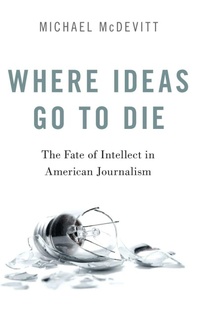
Where Ideas Go to Die
The Fate of Intellect in American Journalism
Published on 29. June 2020
Book
Hardback
268 pages
978-0-19-086995-3 (ISBN)
Description
Ideas die at the hands of journalists. This is the controversial thesis offered by Michael McDevitt in a sweeping examination of anti-intellectualism in American journalism. A murky presence, anti-intellectualism is not acknowledged by reporters and editors. It is not easily measured by scholars, as it entails opportunities not taken, context not provided, ideas not examined. Where Ideas Go to Die will be the first book to document how journalism polices intellect at a time when thoughtful examination of our society's news media is arguably more important than ever.
Through analysis of media encounters with dissent since 9/11, McDevitt argues that journalism engages in a form of social control, routinely suppressing ideas that might offend audiences. McDevitt is not arguing that journalists are consciously or purposely controlling ideas, but rather that resentment of intellectuals and suspicion of intellect are latent in journalism and that such sentiment manifests in the stories journalists choose to tell, or not to tell. In their commodification of knowledge, journalists will, for example, "clarify" ideas to distill deviance; dismiss nuance as untranslatable; and funnel productive ideas into static, partisan binaries. Anti-intellectualism is not unique to American media. Yet, McDevitt argues that it is intertwined with the nation's cultural history, and consequently baked into the professional training that occurs in classrooms and newsrooms. He offers both a critique of our nation's media system and a way forward, to a media landscape in which journalists recognize the prevalence of anti-intellectualism and take steps to avoid it, and in which journalism is considered an intellectual profession.
Through analysis of media encounters with dissent since 9/11, McDevitt argues that journalism engages in a form of social control, routinely suppressing ideas that might offend audiences. McDevitt is not arguing that journalists are consciously or purposely controlling ideas, but rather that resentment of intellectuals and suspicion of intellect are latent in journalism and that such sentiment manifests in the stories journalists choose to tell, or not to tell. In their commodification of knowledge, journalists will, for example, "clarify" ideas to distill deviance; dismiss nuance as untranslatable; and funnel productive ideas into static, partisan binaries. Anti-intellectualism is not unique to American media. Yet, McDevitt argues that it is intertwined with the nation's cultural history, and consequently baked into the professional training that occurs in classrooms and newsrooms. He offers both a critique of our nation's media system and a way forward, to a media landscape in which journalists recognize the prevalence of anti-intellectualism and take steps to avoid it, and in which journalism is considered an intellectual profession.
Reviews / Votes
One of the book's chief strengths is the way its substantive chapters take a multimodal approach to interrogating how anti-intellectualism manifests in journalistic text, practice, and education. ... One leaves this book with a deeper understanding of how an obligation to preserving enduring normative standards can leave practitioners, educators, and advocates alike blind to all the ways journalism's institutional arrangements are built on a compromise with more unsavory realities. * Mass Communication and Society * In this provocative and timely book, McDevitt guides us through the many ways that journalism is not a neutral conduit but an active shaper of what ideas make it into the public arena. There are no conspiracy theories here. Instead, we see how journalistic ideologies and practices converge to constrain what can be thought at any time. * Matt Carlson, University of Minnesota * McDevitt offers an insightful and provocative study of the anti-intellectualism that characterizes so much of mainstream journalism in the United States. Not an indictment of journalists but a critique of journalism, McDevitt focuses on taken-for granted newsroom norms and the consequences of their ideological underpinnings. This book adds a new and important chapter to the history of the culture of modern American journalism. * Theodore L. Glasser, Stanford University * This book is an eye-opener. If you've thought of journalism as being a knowledge profession, this book will lead you to think again. McDevitt systematically unveils the anti-intellect strain that cuts through American journalism and journalism education. Readable and illuminating, the book is a must read for everyone in the journalism field, and for those who care about the quality of the information on which our democracy depends. * Thomas E. Patterson, Harvard University * McDevitt provides a fresh and timely perspective on journalism's current predicament, arguing that the press must free itself from the forces of anti-intellectualism if it is to resist the post-truth illiberal assault. The populist wave attacks elite-based expertise, but being historically dubious of expertise has left journalism ill-equipped to push back. Without its own intellectual autonomy, the press risks both catering to a public running on emotion or passively accommodating the currupting power of special interests. * Stephen D. Reese, University of Texas at Austin * a welcome critique of the behind-the-scenes of journalistic practice, rhetoric, and control * Robert E. Gutsche, Jr., Lancaster University, Journalism and Mass Communication Quarterly *More details
Language
English
Place of publication
New York
United States
Target group
Professional and scholarly
Dimensions
Height: 240 mm
Width: 161 mm
Thickness: 19 mm
Weight
575 gr
ISBN-13
978-0-19-086995-3 (9780190869953)
Copyright in bibliographic data and cover images is held by Nielsen Book Services Limited or by the publishers or by their respective licensors: all rights reserved.
Schweitzer Classification
Other editions
Additional editions

Book
06/2020
Oxford University Press Inc
€41.50
Shipment within 15-20 days

E-Book
05/2020
OUP eBook
€13.49
Available for download

E-Book
05/2020
OUP eBook
€17.49
Available for download
Person
Michael McDevitt is Professor of Journalism and Media Studies in the College of Media, Communication and Information at the University of Colorado. He previously worked as a reporter and editorial writer for newspapers in the San Francisco Bay Area.
Content
Preface
Introduction
1 Journalism and Intellect: A Vexed Relationship
Part I: News Media and Democratic Decline
2 Peopling of the Journalistic Imagination: Four Kinds of Anti-intellectualism
3 Eclipse of Reflexivity in the Rise of Trump
Part II: Social Control of Intellect
4 The Academic-Media Nexus
5 Policing of Intellectual Transgressions: News as a Recursive Regime
6 Social Drama at Macro and Micro Levels: The Fractal Control of Dissent
7 Deviant in Residence: Idea Rendering and Repair in the Parochial Press
Part III: Education and Reform
8 Closing of the Journalism Mind: Anti-intellectualism among College Students
9 In My Buggy: How Dangerous Professors Seed Intellect in a Hybrid Field
10 What Intellectual Journalism Would Look Like
Appendix
Introduction
1 Journalism and Intellect: A Vexed Relationship
Part I: News Media and Democratic Decline
2 Peopling of the Journalistic Imagination: Four Kinds of Anti-intellectualism
3 Eclipse of Reflexivity in the Rise of Trump
Part II: Social Control of Intellect
4 The Academic-Media Nexus
5 Policing of Intellectual Transgressions: News as a Recursive Regime
6 Social Drama at Macro and Micro Levels: The Fractal Control of Dissent
7 Deviant in Residence: Idea Rendering and Repair in the Parochial Press
Part III: Education and Reform
8 Closing of the Journalism Mind: Anti-intellectualism among College Students
9 In My Buggy: How Dangerous Professors Seed Intellect in a Hybrid Field
10 What Intellectual Journalism Would Look Like
Appendix