

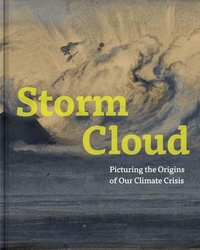
Storm Cloud
Picturing the Origins of Our Climate Crisis
Published on 7. January 2025
Book
Hardback
176 pages
978-0-300-27614-5 (ISBN)
Description
A revealing exploration of how prescient nineteenth-century artists, writers, and scientists began to sound the alarm on climate crisis
Against a backdrop of industrialization and scientific development that reshaped humanity's relationship to the planet, nineteenth-century artists and writers began to express a novel perception of humanity's place in, and impact on, the natural world. This essential volume traces, in art and literature, the growing understanding of the industrial world's effect on the environment. It features works from both sides of the Atlantic, including paintings, photographs, scientific illustrations, and books by Mary Hunter Austin, Frederic Edwin Church, Thomas Cole, John Constable, Henry David Thoreau, and Carleton Watkins. These are discussed by experts, including artists, art and literary historians, scientists, environmental activists, and representatives of Indigenous knowledge.
Examining a nascent environmental awareness through the intersection of art and science, contributors highlight this intertwined historical dialogue and what it can tell us about today's climate crisis. The title references lectures by the Victorian writer John Ruskin, in which he described how decades of observing the English skies led him to conclude that his own age had created a disturbing "storm-cloud"-smog caused by burning coal. Though he wouldn't have understood it in this way, his lectures became one of the earliest published considerations of human-caused climate change.
Published in association with the Huntington Library, Art Museum, and Botanical Gardens
Exhibition Schedule:
The Huntington Library, Art Museum, and Botanical Gardens
(September 14, 2024-January 6, 2025)
Against a backdrop of industrialization and scientific development that reshaped humanity's relationship to the planet, nineteenth-century artists and writers began to express a novel perception of humanity's place in, and impact on, the natural world. This essential volume traces, in art and literature, the growing understanding of the industrial world's effect on the environment. It features works from both sides of the Atlantic, including paintings, photographs, scientific illustrations, and books by Mary Hunter Austin, Frederic Edwin Church, Thomas Cole, John Constable, Henry David Thoreau, and Carleton Watkins. These are discussed by experts, including artists, art and literary historians, scientists, environmental activists, and representatives of Indigenous knowledge.
Examining a nascent environmental awareness through the intersection of art and science, contributors highlight this intertwined historical dialogue and what it can tell us about today's climate crisis. The title references lectures by the Victorian writer John Ruskin, in which he described how decades of observing the English skies led him to conclude that his own age had created a disturbing "storm-cloud"-smog caused by burning coal. Though he wouldn't have understood it in this way, his lectures became one of the earliest published considerations of human-caused climate change.
Published in association with the Huntington Library, Art Museum, and Botanical Gardens
Exhibition Schedule:
The Huntington Library, Art Museum, and Botanical Gardens
(September 14, 2024-January 6, 2025)
Reviews / Votes
"A superb catalog."-Holland Cotter, New York TimesMore details
Language
English
Place of publication
United States
Target group
College/higher education
Product notice
Cloth over boards
Illustrations
96 color illus.
Dimensions
Height: 286 mm
Width: 229 mm
Thickness: 15 mm
Weight
928 gr
ISBN-13
978-0-300-27614-5 (9780300276145)
Copyright in bibliographic data and cover images is held by Nielsen Book Services Limited or by the publishers or by their respective licensors: all rights reserved.
Schweitzer Classification
Persons
Melinda McCurdy is curator of British art and Karla Nielsen is curator of literary collections, both at the Huntington Library, Art Museum, and Botanical Gardens.