

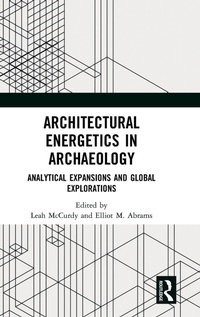
Architectural Energetics in Archaeology
Analytical Expansions and Global Explorations
1st Edition
Published on 4. March 2019
Book
Hardback
300 pages
978-1-138-08856-6 (ISBN)
Description
Archaeologists and the public at large have long been fascinated by monumental architecture built by past societies. Whether considering the earthworks in the Ohio Valley or the grandest pyramids in Egypt and Mexico, people have been curious as to how pre-modern societies with limited technology were capable of constructing monuments of such outstanding scale and quality. Architectural energetics is a methodology within archaeology that generates estimates of the amount of labor and time allocated to construct these past monuments. This methodology allows for detailed analyses of architecture and especially the analysis of the social power underlying such projects.
Architectural Energetics in Archaeology assembles an international array of scholars who have analyzed architecture from archaeological and historic societies using architectural energetics. It is the first such volume of its kind. In addition to applying architectural energetics to a global range of architectural works, it outlines in detail the estimates of costs that can be used in future architectural analyses.
This volume will serve archaeology and classics researchers, and lecturers teaching undergraduate and graduate courses related to social power and architecture. It also will interest architects examining past construction and engineering projects.
Architectural Energetics in Archaeology assembles an international array of scholars who have analyzed architecture from archaeological and historic societies using architectural energetics. It is the first such volume of its kind. In addition to applying architectural energetics to a global range of architectural works, it outlines in detail the estimates of costs that can be used in future architectural analyses.
This volume will serve archaeology and classics researchers, and lecturers teaching undergraduate and graduate courses related to social power and architecture. It also will interest architects examining past construction and engineering projects.
More details
Language
English
Place of publication
London
United Kingdom
Publishing group
Taylor & Francis Ltd
Target group
College/higher education
Illustrations
18 s/w Photographien bzw. Rasterbilder, 66 s/w Zeichnungen, 54 s/w Tabellen
54 Tables, black and white; 66 Line drawings, black and white; 18 Halftones, black and white
Dimensions
Height: 240 mm
Width: 161 mm
Thickness: 22 mm
Weight
652 gr
ISBN-13
978-1-138-08856-6 (9781138088566)
Copyright in bibliographic data and cover images is held by Nielsen Book Services Limited or by the publishers or by their respective licensors: all rights reserved.
Schweitzer Classification
Other editions
Additional editions
Leah McCurdy | Elliot M. Abrams
Architectural Energetics in Archaeology
Analytical Expansions and Global Explorations
Book
09/2020
1st Edition
Routledge
€53.31
Shipment within 15-20 days
Leah McCurdy | Elliot M. Abrams
Architectural Energetics in Archaeology
Analytical Expansions and Global Explorations
E-Book
01/2019
1st Edition
Routledge
€60.49
Available for download
Leah McCurdy | Elliot M. Abrams
Architectural Energetics in Archaeology
Analytical Expansions and Global Explorations
E-Book
01/2019
1st Edition
Routledge
€60.49
Available for download
Persons
Leah McCurdy is a Senior Lecturer in the Department of Art & Art History at the University of Texas at Arlington (UTA) and a Research Associate with The University of Texas at San Antonio (UTSA). Leah earned her PhD from UTSA in 2016 with her dissertation focused on the application of energetics and labor analysis to the ancient Maya site of Xunantunich, Belize. Leah has been excavating at Xunantunich since 2008 to collect data relevant to her research interests in ancient construction practices, cooperative labor, the intersections of monumentality and community, as well as the meaning of the ancient built environment.
Elliot M. Abrams is Emeritus Professor of Anthropology at Ohio University. He refined and promoted the methodology of architectural energetics in How the Maya Built Their World (1994). In addition to his archaeological research in Mesoamerica, he has conducted excavations in the Ohio Valley for over three decades. He coedited (with AnnCorinne Freter) The Emergence of the Moundbuilders: The Archaeology of Tribal Societies in Southeastern Ohio (2005), which outlines the formation of sedentary tribal communities. He also studies environmental change, economic institutions, and social power through the lens of anthropological archaeology.
Elliot M. Abrams is Emeritus Professor of Anthropology at Ohio University. He refined and promoted the methodology of architectural energetics in How the Maya Built Their World (1994). In addition to his archaeological research in Mesoamerica, he has conducted excavations in the Ohio Valley for over three decades. He coedited (with AnnCorinne Freter) The Emergence of the Moundbuilders: The Archaeology of Tribal Societies in Southeastern Ohio (2005), which outlines the formation of sedentary tribal communities. He also studies environmental change, economic institutions, and social power through the lens of anthropological archaeology.
Content
1: Massive Assumptions and Moundbuilders: The History, Method, and Relevance of Architectural Energetics
Elliot M. Abrams and Leah McCurdy
2: Built Environments and Social Organizations: A Comparative View from Asia
Nam C. Kim and Jina Heo
3: Pharaonic Power and Architectural Labor Investment at the Karnak Temple Complex
Megan Drennan and Michael J. Kolb
4: An Energetics Approach to the Construction of the Heuneburg: Thoughts on Celtic Labor Cost Choices
Francois Remise
5: To House and Defend: The Application of Architectural Energetics to Southeast Archaic Greek Sicily
Jerrad Lancaster
6: Labor Mobilization and Medieval Castle Construction in at Salemi, Western Sicily
Michael J. Kolb, Scott Detrich Kirk, and William M. Balco
7: Labor Recruitment among Tribal Societies: An Architectural Energetic Analysis of Serpent Mound, Ohio
Jamie L. Davis, Jarrod Burks, and Elliot M. Abrams
8: The Energetics of Earthen Landscape Modification: An Assessment of an Emerging Mississippian Polity
Cameron H. Lacquement
9: Dual Labor Organization Models for the Construction of Monumental Architecture in a Corporate Society
Anthony James DeLuca
10: Peopling Monuments: Virtual Energetics and Labor Impact Analysis of Monumental Construction at Xunantunich, Belize
Leah McCurdy
11: A Construction Management Approach to Building the Monumental Adobe Ciudadelas at Chan Chan, Peru
Richard L. Smailes
12: Towards a Multiscalar Comparative Approach to Power Relations: Political Dimensions of Urban Construction at Teotihuacan and Copan
Tatsuya Murakami
13: The Future of Architectural Energetics in 2D and 3D
Leah McCurdy and Elliot M. Abrams
Elliot M. Abrams and Leah McCurdy
2: Built Environments and Social Organizations: A Comparative View from Asia
Nam C. Kim and Jina Heo
3: Pharaonic Power and Architectural Labor Investment at the Karnak Temple Complex
Megan Drennan and Michael J. Kolb
4: An Energetics Approach to the Construction of the Heuneburg: Thoughts on Celtic Labor Cost Choices
Francois Remise
5: To House and Defend: The Application of Architectural Energetics to Southeast Archaic Greek Sicily
Jerrad Lancaster
6: Labor Mobilization and Medieval Castle Construction in at Salemi, Western Sicily
Michael J. Kolb, Scott Detrich Kirk, and William M. Balco
7: Labor Recruitment among Tribal Societies: An Architectural Energetic Analysis of Serpent Mound, Ohio
Jamie L. Davis, Jarrod Burks, and Elliot M. Abrams
8: The Energetics of Earthen Landscape Modification: An Assessment of an Emerging Mississippian Polity
Cameron H. Lacquement
9: Dual Labor Organization Models for the Construction of Monumental Architecture in a Corporate Society
Anthony James DeLuca
10: Peopling Monuments: Virtual Energetics and Labor Impact Analysis of Monumental Construction at Xunantunich, Belize
Leah McCurdy
11: A Construction Management Approach to Building the Monumental Adobe Ciudadelas at Chan Chan, Peru
Richard L. Smailes
12: Towards a Multiscalar Comparative Approach to Power Relations: Political Dimensions of Urban Construction at Teotihuacan and Copan
Tatsuya Murakami
13: The Future of Architectural Energetics in 2D and 3D
Leah McCurdy and Elliot M. Abrams