

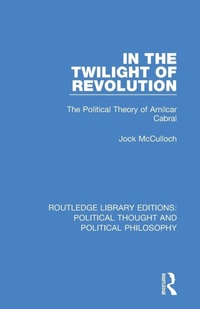
In the Twilight of Revolution
The Political Theory of Amilcar Cabral
1st Edition
Published on 1. December 2021
Book
Paperback/Softback
170 pages
978-0-367-24775-1 (ISBN)
Description
First published in 1983. Amilcar Cabral was one of Africa's leading revolutionary figures. Universally recognised as the founding father at the independent state of Guine-Bissau, he was also the first truly important political thinker to have emerged from Africa's two decades of revolution. This book was the first publication to present a critical analysis of his standing as a political theorist.
Born in 1925 in the then Portuguese colony of Guine, Cabral devoted his life to the liberation of his people from colonialism and was instrumental in founding the PAIGC, the African Party for the Independence of Guine and Cape Verde. He was assassinated early in 1973, but the PAIGC continued his task and Guine-Bissau gained independence in September 1973. Guine's revolution came late, but it was a genuine revolution and, like all revolutions, was accompanied by a theory of its own. That theory is found in the writings of Cabral. In this study Jack McCulloch explains that, because of the conjunction of a number of historical factors, the revolution in Guine assumed an importance for out of proportion to the size or economic significance of the country, and shows that consequently Cabral's theory has come to have an historical significance of its own.
This account of Cabral's political theory demonstrates clearly that the effect of Cabral's career was to help bring down the last of the great colonial empires in Africa and, in the realm of theory, to dismantle the central shibboleths of African socialism.
Born in 1925 in the then Portuguese colony of Guine, Cabral devoted his life to the liberation of his people from colonialism and was instrumental in founding the PAIGC, the African Party for the Independence of Guine and Cape Verde. He was assassinated early in 1973, but the PAIGC continued his task and Guine-Bissau gained independence in September 1973. Guine's revolution came late, but it was a genuine revolution and, like all revolutions, was accompanied by a theory of its own. That theory is found in the writings of Cabral. In this study Jack McCulloch explains that, because of the conjunction of a number of historical factors, the revolution in Guine assumed an importance for out of proportion to the size or economic significance of the country, and shows that consequently Cabral's theory has come to have an historical significance of its own.
This account of Cabral's political theory demonstrates clearly that the effect of Cabral's career was to help bring down the last of the great colonial empires in Africa and, in the realm of theory, to dismantle the central shibboleths of African socialism.
More details
Series
Language
English
Place of publication
London
United Kingdom
Publishing group
Taylor & Francis Ltd
Target group
College/higher education
General, Postgraduate, and Undergraduate
Dimensions
Height: 216 mm
Width: 140 mm
Thickness: 9 mm
Weight
223 gr
ISBN-13
978-0-367-24775-1 (9780367247751)
Copyright in bibliographic data and cover images is held by Nielsen Book Services Limited or by the publishers or by their respective licensors: all rights reserved.
Schweitzer Classification
Other editions
Additional editions
Book
12/2019
1st Edition
Routledge
€144.90
Shipment within 15-20 days
E-Book
11/2019
1st Edition
Routledge
€45.99
Available for download
Person
Jock McCulloch
Content
1. Introduction 2. The Struggle of Guine 3. The Agronomic Writings 4. The Class Analysis of African Society 5. Culture and Personality 6. The State 7. The Forces of Production 8. Imperialism 9. Conclusion; Notes; Bibliography; Index