

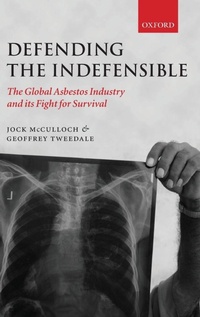
Defending the Indefensible
The Global Asbestos Industry and its Fight for Survival
Published on 24. July 2008
Book
Hardback
338 pages
978-0-19-953485-2 (ISBN)
Description
In the early twentieth century, asbestos had a reputation as a lifesaver. In 1960, however, it became known that even relatively brief exposure to asbestos can cause mesothelioma, a virulent and lethal cancer.
Yet the bulk of the world's asbestos was mined after 1960. Asbestos usage in many countries continued unabated.
This is the first global history of how the asbestos industry and its allies in government, insurance, and medicine defended the product throughout the twentieth century. It explains how mining and manufacture could continue despite overwhelming medical evidence as to the risks. The argument advanced in this book is that asbestos has proved so enduring because the industry was able to mount a successful defense strategy for the mineral - a strategy that still operates in some parts of the world. This defence involved the shaping of the public debate by censoring, and sometimes corrupting, scientific research, nurturing scientific uncertainty, and using allies in government, insurance, and medicine.
The book also discusses the problems of asbestos in the environment, compensating victims, and the continued use of asbestos in the developing world. Its global focus shows how asbestos can be seen as a model for many occupational diseases - indeed for a whole range of hazards produced by industrial societies. The book is based on a wealth of documentary material gained from legal discovery, supplemented by evidence from the authors' visits and researches in the US, the UK, Canada, Kazakhstan, Zimbabwe, Australia, Swaziland, and South Africa.
Yet the bulk of the world's asbestos was mined after 1960. Asbestos usage in many countries continued unabated.
This is the first global history of how the asbestos industry and its allies in government, insurance, and medicine defended the product throughout the twentieth century. It explains how mining and manufacture could continue despite overwhelming medical evidence as to the risks. The argument advanced in this book is that asbestos has proved so enduring because the industry was able to mount a successful defense strategy for the mineral - a strategy that still operates in some parts of the world. This defence involved the shaping of the public debate by censoring, and sometimes corrupting, scientific research, nurturing scientific uncertainty, and using allies in government, insurance, and medicine.
The book also discusses the problems of asbestos in the environment, compensating victims, and the continued use of asbestos in the developing world. Its global focus shows how asbestos can be seen as a model for many occupational diseases - indeed for a whole range of hazards produced by industrial societies. The book is based on a wealth of documentary material gained from legal discovery, supplemented by evidence from the authors' visits and researches in the US, the UK, Canada, Kazakhstan, Zimbabwe, Australia, Swaziland, and South Africa.
Reviews / Votes
...Fascinating and thoughtful study of the asbestos industry...I found McCulloch and Tweedale's account a valuable addition to an already large literature. By globalizing the asbestos story, the authors reveal the tactics that have protected the industry for decades from sustained, intense criticism, and they clarify the challenges that remain in defending the victims whose lives have been irreparably damaged and in protecting us all from the threat of future injuries by this industry. * Marc J. Stern, Business History * Given all that has been written and said about asbestos over the past 30 years is there anything else worth knowing? Do we really need another book on asbestos? After reading Defending the Indefensible the emphatic answer I reached was yes. This book is a tour-de-force of informed and concerned scholarship. * Labour History * [A] compelling book. * The Lancet, Volume 373, Issue 9660 * An important and particularly essential addition to the existing literature on asbestos; its history, usage and controversial values of benefit and disaster...Splendidly presented and annotated... This is a brilliant text which answers many startling new questions and asks a good many more. * RoSPA Occupational Safety and Health Journal *More details
Language
English
Place of publication
Oxford
United Kingdom
Target group
Professional and scholarly
Illustrations
Figures and tables
Dimensions
Height: 240 mm
Width: 161 mm
Thickness: 23 mm
Weight
672 gr
ISBN-13
978-0-19-953485-2 (9780199534852)
Copyright in bibliographic data and cover images is held by Nielsen Book Services Limited or by the publishers or by their respective licensors: all rights reserved.
Schweitzer Classification
Persons
Jock McCulloch and Geoffrey Tweedale are historians with long-term research interests in health, corporate history, and mining. They have published widely on the history of industrial hazards. They have written three books on the asbestos industry covering manufacture and mining in the UK, South Africa, and Australia.
Content
1. Introduction ; 2. Making the World Safe ; 3. Building the Defences ; 4. The Challenge of Mesothelioma and Irving J. Selikoff ; 5. The Chrysotile Defence ; 6. Hiding the Elephant of Compensation ; 7. Don't Disturb the Dog: Asbestos in the Environment ; 8. Pushing Asbestos in the Developing World ; 9. Defending Asbestos: 21st Century Perspectives ; Sources and Acknowledgements