

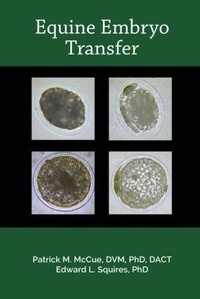
Equine Embryo Transfer
1st Edition
Published on 18. February 2015
Book
Paperback/Softback
184 pages
978-1-59161-047-2 (ISBN)
Description
This book briefly reviews the history of equine embryo transfer, covering in clinically practical terms the techniques, equipment, and management protocols currently in use. Embryo transfer has become a big business, especially for breeding racing stock (horses and camels), and is therefore a very important aspect of equine practice. Ed Squires and Pat McCue have been involved with the development of embryo collection and transfer procedures since the early 60s and have both contributed important techniques and innovations to the process through their research and clinical experience. This book captures the clinical experience, so far, and applies it directly to equine practice. The book is of great value to general equine practitioners for reference, equine reproduction specialists, animal science at the graduate level (equine track), and breeders.
Reviews / Votes
"... a well-written book. It covers everything involved in equine embryo transfer work from start to finish. The book is written in a manner that will provide valuable information to anyone interested in learning embryo transfer or someone who is already doing some embryo transfer but would like more information. ... I particularly liked the pictures and charts, because they nicely complimented and augmented the text. This book also contains a lot of descriptive statistics for a large number of embryo transfers. It is a good value and will be a nice addition to the library of anyone interested in equine embryo transfer."-Shawn Jensen, DVM, Bluff Country Equine, Winona, Minnesota, USA, from Vet Med Today: Book Reviews, JAVMA, Vol 247, No. 6, September 15, 2015
More details
Language
English
Place of publication
Jackson
United States
Target group
College/higher education
Professional and scholarly
Academic and Postgraduate
Illustrations
132 farbige Abbildungen
132 Illustrations, color
Dimensions
Height: 228 mm
Width: 149 mm
Thickness: 12 mm
Weight
364 gr
ISBN-13
978-1-59161-047-2 (9781591610472)
Copyright in bibliographic data and cover images is held by Nielsen Book Services Limited or by the publishers or by their respective licensors: all rights reserved.
Schweitzer Classification
Other editions
Additional editions
Patrick M. McCue | Edward L. Squires
Equine Embryo Transfer
E-Book
02/2015
Teton NewMedia
€81.99
Available for download
Persons
Patrick M. McCue, Edward L. Squires
Content
Contents 1. Introduction General Introduction (i.e. what is ET) Advantages and uses of embryo transfer Changes in the ET Industry Breed regulations (include a Table of most major breeds; ET, frozen embryos, etc.) Per cycle ET Success = Embryo Collection Rate (50-60%) x Embryo Transfer Pregnancy Rate (70-80%)Goals of the Manual 2. History of equine embryo transfer Livestock Horses Domestic horses as surrogates for endangered equids(?) 3. Reproductive Anatomy and Physiology of the MareAnatomy of the mare Physiology of the estrous cycle Physiology of early embryonic development and early pregnancy 4. Management of the donor mare Selection of the donor Evaluation of the donor (BSE)Management and Day of breeding (fresh, cooled, frozen semen) Palpation/ultrasound examinations relative to flush; daily vs every 6-8 hrs for frozen semen; BID if goal is to collect a small embryo at day 6.5 for cryopreservation Induction of ovulation (hCG and deslorelin) Donor mare management (PMIE, fluid, etc.)Estrous cycle control (Lights, P&E, PGF, hCG, Deslorelin, Regumate) Allow a mare to carry to term by approximately 10 years of age Allowing mare to carry own every 3-4 years Effect of repeated flushing on uterine health and embryo recovery # flushes per year recommendedFertility of mares after flushing (i.e. same season)Problem mares (i.e. PMIE, etc.) Maiden mares (young vs older)Post partum mares (i.e. flushing on foal heat) 5. SuperovulationHistoryTechniques EFSH Optimal follicle size at onset Problems - same stallion vs. goal of different stallions Not every mare responds to FSHPAF's and HAF's 6. Embryo Collection Equipment (Box Table) Facilities (stocks vs stall, etc.) Procedure; (incl. clean out and wash up) Ultrasound prior to flush in problem