

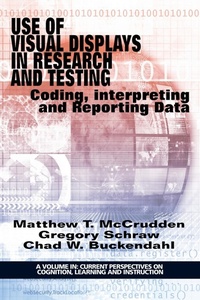
Use of Visual Displays in Research and Testing
Coding, Interpreting, and Reporting Data
Published on 7. May 2015
Book
Paperback/Softback
346 pages
978-1-68123-101-3 (ISBN)
Description
Visual displays play a crucial role in knowledge generation and communication. The purpose of the volume is to provide researchers with a framework that helps them use visual displays to organize and interpret data; and to communicate their findings in a comprehensible way within different research (e.g., quantitative, mixed methods) and testing traditions that improves the presentation and understanding of findings. Further, this book includes contributions from leading scholars in testing and quantitative, qualitative, and mixed methods research, and results reporting. The volume's focal question is: What are the best principles and practices for the use of visual displays in the research and testing process, which broadly includes the analysis, organization, interpretation, and communication of data?
The volume is organized into four sections. Section I provides a rationale for this volume; namely, that including visual displays in research and testing can enhance comprehension and processing efficiency. Section II includes addresses theoretical frameworks and universal design principles for visual displays. Section III examines the use of visual displays in quantitative, qualitative, and mixed methods research. Section IV focuses on using visual displays to report testing and assessment data.
The volume is organized into four sections. Section I provides a rationale for this volume; namely, that including visual displays in research and testing can enhance comprehension and processing efficiency. Section II includes addresses theoretical frameworks and universal design principles for visual displays. Section III examines the use of visual displays in quantitative, qualitative, and mixed methods research. Section IV focuses on using visual displays to report testing and assessment data.
More details
Series
Language
English
Place of publication
Charlotte
United States
Publishing group
Emerald Publishing Inc
Target group
Professional and scholarly
Dimensions
Height: 234 mm
Width: 156 mm
Thickness: 19 mm
Weight
526 gr
ISBN-13
978-1-68123-101-3 (9781681231013)
Copyright in bibliographic data and cover images is held by Nielsen Book Services Limited or by the publishers or by their respective licensors: all rights reserved.
Schweitzer Classification
Other editions
Additional editions
Matthew T. McCrudden
Use of Visual Displays in Research and Testing
Coding, Interpreting, and Reporting Data
E-Book
01/2015
1st Edition
Information Age Publishing
from
€62.33
Available for download
Persons
Matthew T. McCrudden, Victoria University of Wellington, USA
Gregory Schraw, University of Nevada - Las Vegas, USA
Chad Buckendahl, Alpine Testing
Gregory Schraw, University of Nevada - Las Vegas, USA
Chad Buckendahl, Alpine Testing
Content
Section I: Introduction.
Chapter 1. Visual Displays in Research and Testing: Theoretical and Practical Considerations, Matthew T. McCrudden, Gregory Schraw, and Chad W. Buckendahl.
Section II: Theoretical Frameworks and Design Principles.
Chapter 2. Design Principles for Visual Displays: Past, Present, and Future, Antonio P. Gutierrez, Gregory Schraw, and Andreas Stefik.
Chapter 3. Guidelines for Making Graphs Easy to Perceive, Easy to Understand, and Information Rich, David M. Lane.
Chapter 4. Examining the Type, Frequency, and Interpretative Complexity of Visual Displays Appearing in the Journal of Educational Psychology, 2010-2014, Gregory Schraw and Antonio P. Gutierrez.
Section III: Visual Displays in Quantitative, Qualitative, and Mixed Methods Research.
Chapter 5. Promoting the Use of Path Diagrams in Quantitative Research, Dena A. Pastor and Sara J. Finney.
Chapter 6. Using Joint Displays and MAXQDA Software to Represent the Results of Mixed Methods Research, Tim Guetterman, John W. Creswell, and Udo Kuckartz.
Chapter 7. The Use of Visual Displays in Mixed Methods Research: Strategies for Effectively Integrating the Quantitative and Qualitative Components of a Study, Vicki L. Plano Clark and Khahlia Sanders.
Chapter 8. Use of Concept Maps to Facilitate Student Learning in Research and Measurement Courses, Florian Feucht, Gwen Marchand, and Lori Olafson.
Section IV: Visual Displays to Report Testing and Assessment Data.
Chapter 9. The Graphic Representation of Findings From the National Center on Assessment and Accountability for Special Education, Keith Zvoch and Joseph J. Stevens.
Chapter 10. Tailoring Visual Displays to Improve Test Score Interpretation: Including Indicators of Uncertainty, Brett P. Foley.
Chapter 11. Visual Displays for Reporting Test Data: Making Sense of Test Performance, April L. Zenisky.
Biographies.
Chapter 1. Visual Displays in Research and Testing: Theoretical and Practical Considerations, Matthew T. McCrudden, Gregory Schraw, and Chad W. Buckendahl.
Section II: Theoretical Frameworks and Design Principles.
Chapter 2. Design Principles for Visual Displays: Past, Present, and Future, Antonio P. Gutierrez, Gregory Schraw, and Andreas Stefik.
Chapter 3. Guidelines for Making Graphs Easy to Perceive, Easy to Understand, and Information Rich, David M. Lane.
Chapter 4. Examining the Type, Frequency, and Interpretative Complexity of Visual Displays Appearing in the Journal of Educational Psychology, 2010-2014, Gregory Schraw and Antonio P. Gutierrez.
Section III: Visual Displays in Quantitative, Qualitative, and Mixed Methods Research.
Chapter 5. Promoting the Use of Path Diagrams in Quantitative Research, Dena A. Pastor and Sara J. Finney.
Chapter 6. Using Joint Displays and MAXQDA Software to Represent the Results of Mixed Methods Research, Tim Guetterman, John W. Creswell, and Udo Kuckartz.
Chapter 7. The Use of Visual Displays in Mixed Methods Research: Strategies for Effectively Integrating the Quantitative and Qualitative Components of a Study, Vicki L. Plano Clark and Khahlia Sanders.
Chapter 8. Use of Concept Maps to Facilitate Student Learning in Research and Measurement Courses, Florian Feucht, Gwen Marchand, and Lori Olafson.
Section IV: Visual Displays to Report Testing and Assessment Data.
Chapter 9. The Graphic Representation of Findings From the National Center on Assessment and Accountability for Special Education, Keith Zvoch and Joseph J. Stevens.
Chapter 10. Tailoring Visual Displays to Improve Test Score Interpretation: Including Indicators of Uncertainty, Brett P. Foley.
Chapter 11. Visual Displays for Reporting Test Data: Making Sense of Test Performance, April L. Zenisky.
Biographies.