

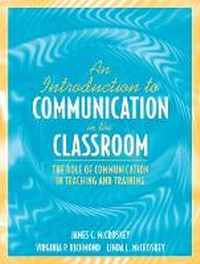
An Introduction to Communication in the Classroom
The Role of Communication in Teaching and Training
Published on 10. February 2006
Book
Paperback/Softback
192 pages
978-0-205-39615-3 (ISBN)
Description
An Introduction to Communication in the Classroom: The Role of Communication in Teaching and Training offers a brief and basic introduction to concepts and applications related to communication in the classroom. Because the book does not assume any prior knowledge of communication concepts, it is written to be very accessible, avoiding technical language and jargon and fully explaining communication concepts.
More details
Language
English
Place of publication
United States
Publishing group
Pearson Education (US)
Target group
Professional and scholarly
Dimensions
Height: 235 mm
Width: 178 mm
Weight
376 gr
ISBN-13
978-0-205-39615-3 (9780205396153)
Copyright in bibliographic data and cover images is held by Nielsen Book Services Limited or by the publishers or by their respective licensors: all rights reserved.
Schweitzer Classification
Content
Preface.
1. The Nature of Communication.
Defining Communication
Components of the Instructional Communication Process
Interpersonal Communication Process
Some Important Distinctions
2. Communication Conceptions and Misconceptions.
Words Have Meaning
Communication is a Verbal Process
Telling is Communicating
Communication Will Solve All Our Problems
Communication is a Good Thing
The More Communication, the Better
Communication Can Break Down
Communication Competence Equals Communication Effectiveness
3. Getting Started.
Communication Motivations
Choice of Communication Partners
The Acquaintance Process
Levels of Communication
4. Common Classroom Communication Problems.
Quietness
Class and Group Size
Rumor and Serial Communication
The Nature of Schema
Improving Listening and Retention
Feedback
Impact of Feedback
5. Communication and Learning Goals.
Communication Goals
Learning Objectives: A Communication Perspective
6. Selectivity and Communication.
Selective Exposure
Selective Attention
Selective Perception
Selective Retention
Selective Recall
7. Teacher Images.
Effects of Teacher Images
Source Credibility
Temperament
Homophily
Interpersonal Attraction
Negative Images
8. Power in the Classroom.
Bases of Power
Sources of Power
Levels of Influence
Balancing Costs and Benefits
Behavioral Alteration Techniques and Messages
9. Expectancies, Grouping, and Classroom Communication.
Self-Fulfilling Prophecies
Self-Esteem
Expectancies and Grouping
10. Willingness to Communicate.
The Willingness to Communicate Trait
Special Constraints
Correlates of Willingness to Communicate
Effects of Low Willingness to Communicate
11. Communication Apprehension and Other Personality Variables.
The Nature of Personality
Common Personality Variables
The Nature of Communication Apprehension
Clarifying Distinctions
Causes of Trait Communication Apprehension
Effects of Communication Apprehension
Preventing and Reducing CA Problems in the Classroom
12. Teacher Communication Traits and Student Perceptions.
Teacher Communication Traits
Student Perceptions and Student Realities
13. Teacher Behaviors: What Students Like and Dislike.
Teacher Misbehaviors
Student Perceptions in Intercultural Contexts
14. Nonverbal Communication in the Classroom.
Nonverbal/Verbal Distinctions
Nonverbal Message Categories
Appendix A: Teacher and Trainer Communication Orientations.
Appendix B: Student Perceptions of Teachers and Trainers.
1. The Nature of Communication.
Defining Communication
Components of the Instructional Communication Process
Interpersonal Communication Process
Some Important Distinctions
2. Communication Conceptions and Misconceptions.
Words Have Meaning
Communication is a Verbal Process
Telling is Communicating
Communication Will Solve All Our Problems
Communication is a Good Thing
The More Communication, the Better
Communication Can Break Down
Communication Competence Equals Communication Effectiveness
3. Getting Started.
Communication Motivations
Choice of Communication Partners
The Acquaintance Process
Levels of Communication
4. Common Classroom Communication Problems.
Quietness
Class and Group Size
Rumor and Serial Communication
The Nature of Schema
Improving Listening and Retention
Feedback
Impact of Feedback
5. Communication and Learning Goals.
Communication Goals
Learning Objectives: A Communication Perspective
6. Selectivity and Communication.
Selective Exposure
Selective Attention
Selective Perception
Selective Retention
Selective Recall
7. Teacher Images.
Effects of Teacher Images
Source Credibility
Temperament
Homophily
Interpersonal Attraction
Negative Images
8. Power in the Classroom.
Bases of Power
Sources of Power
Levels of Influence
Balancing Costs and Benefits
Behavioral Alteration Techniques and Messages
9. Expectancies, Grouping, and Classroom Communication.
Self-Fulfilling Prophecies
Self-Esteem
Expectancies and Grouping
10. Willingness to Communicate.
The Willingness to Communicate Trait
Special Constraints
Correlates of Willingness to Communicate
Effects of Low Willingness to Communicate
11. Communication Apprehension and Other Personality Variables.
The Nature of Personality
Common Personality Variables
The Nature of Communication Apprehension
Clarifying Distinctions
Causes of Trait Communication Apprehension
Effects of Communication Apprehension
Preventing and Reducing CA Problems in the Classroom
12. Teacher Communication Traits and Student Perceptions.
Teacher Communication Traits
Student Perceptions and Student Realities
13. Teacher Behaviors: What Students Like and Dislike.
Teacher Misbehaviors
Student Perceptions in Intercultural Contexts
14. Nonverbal Communication in the Classroom.
Nonverbal/Verbal Distinctions
Nonverbal Message Categories
Appendix A: Teacher and Trainer Communication Orientations.
Appendix B: Student Perceptions of Teachers and Trainers.