

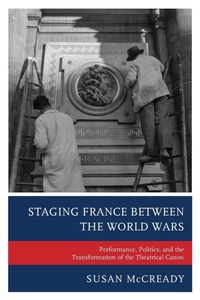
Staging France between the World Wars
Performance, Politics, and the Transformation of the Theatrical Canon
Published on 28. March 2018
Book
Paperback/Softback
176 pages
978-1-4985-2280-9 (ISBN)
Description
Staging Francebetween the World Wars aims to establish the nature and significance of the modernist transformation of French theater between the World Wars, and to elucidate the relationship between aesthetics and the cultural, economic, and political context of the period. Over the course of the 1920s and 30s, as the modernist directors elaborated a theatrical tradition redefined along new lines: more abstract, more fluid, and more open to interpretation, their work was often contested, especially when they addressed the classics of the French theatrical repertory. This study consists largely of the analysis of productions of classic plays staged during the interwar years, and focuses on the contributions of Jacques Copeau and the Cartel because of their prominence in the modernist movement and their outspoken promotion of the role of the theatrical director in general. Copeau and the Cartel began on the margins of theatrical activity, but over the course of the interwar period, their movement gained mainstream acceptance and official status within the theater world. Tracing their trajectory from fringe to center, from underdogs to elder statesmen, this study illuminates both the evolution of the modernist aesthetic and the rise of the metteur-en-scene, whose influence would reshape the French theatrical canon.
Reviews / Votes
Clearly conveying the basics of French theater's important interwar era, McCready (French, Univ. of Alabama; codirector, Center for the Study of War and Memory) offers insights that are original and impressive. She assesses the influence of Jacques Copeau and the so-called cartel directors (Charles Dullin, Louis Jouvet, Baston Baty, Georges Pitoeff) in terms of their modernist staging innovations applied to the "classics" of the drama (a canon they actually expanded) in counterpoint to the Comedie-Francaise's productions as bastion of tradition. McCready's marshaling of archival materials combined with her own thoughtful analysis shows how these independent directors of the 1920s-30s redefined "tradition"-ignoring stale conventions, returning to populist roots-in a process that also led audiences to embrace the modernist aesthetic. In chapters on productions of Moliere's plays, on the Racine/Shakespeare dichotomy, and on Alfred de Musset's elevation to preeminence among the Romantics, McCready anchors her premise that classic plays served as vehicles for validating the director's authority to interpret texts through performance elements beyond the verbal.... McCready authoritatively blends theater history, politics, and dramatic literature. Lucidly written and cogently argued, the book includes extensive notes as well as the standard apparatus. Summing Up: Highly recommended. Upper-division undergraduates through faculty and professionals. * Choice Reviews * For those wishing to make sense of a largely ignored period of French theatre, this study of the rise of the actor/director...is an absolute must.... [McCready's] survey of landmark productions is meticulously researched, and insights from their performance history (costumes, set design, rehearsal scripts,etc.) further strengthen the perceptive analysis of a wide range of reviews.... [T]he writing is concise, taut, and superbly signposted.... [T]he author's own translation of French quotations is excellent, frequently exploring the original nuances of the words to reinforce her argument. A delightfully accessible read. * Modern Language Review * Susan McCready approaches this subject in a novel and effective way. . . . McCready's insightful and highly readable study made me think about how classic repertory has continued-to the present-to be a site of contestation and creation in French theater; and how questions of tradition and national cultural identity dominate our own times, in theater and beyond. * The French Review * This is first-rate scholarship on the history of theater and performance that brings us to a new understanding of the French stage-and its radical transformation-during the interwar years (1918-1940). Susan McCready argues convincingly that the period's modernist directors revolutionized theatrical production, transformed the metteur-en-scene into an artiste in his own right, and re-envisioned the French dramatic canon. Perhaps most compellingly, she ties these aesthetic developments to the far-reaching cultural ferment of the interbellum, to the period's complicated political context, and to its deep and anxiety-ridden engagement with broader questions of French identity. Carefully researched and clearly written, Staging France has much to offer, both to theater specialists and to a more general readership in French Studies. -- Michael Garval, North Carolina State UniversityMore details
Language
English
Place of publication
United States
Publishing group
Bloomsbury Publishing Plc
Target group
Professional and scholarly
Dimensions
Height: 229 mm
Width: 152 mm
Thickness: 10 mm
Weight
265 gr
ISBN-13
978-1-4985-2280-9 (9781498522809)
Copyright in bibliographic data and cover images is held by Nielsen Book Services Limited or by the publishers or by their respective licensors: all rights reserved.
Schweitzer Classification
Other editions
Additional editions
Susan McCready
Staging France between the World Wars
Performance, Politics, and the Transformation of the Theatrical Canon
E-Book
09/2016
1st Edition
Bloomsbury eBooks US
€44.99
Available for download
Person
Susan McCready is professor of French and codirector of the Center for the Study of War and Memory at the University of South Alabama.
Content
Introduction
Chapter One: Subject to Interpretation
Chapter Two: Mobilizing the Canon
Chapter Three: Moliere
Chapter Four: Racine et Shakespeare
Chapter Five: The Romantics
Chapter Six: Hitting the Mainstream
Conclusion
Chapter One: Subject to Interpretation
Chapter Two: Mobilizing the Canon
Chapter Three: Moliere
Chapter Four: Racine et Shakespeare
Chapter Five: The Romantics
Chapter Six: Hitting the Mainstream
Conclusion