

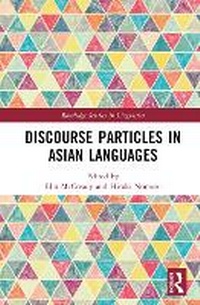
Discourse Particles in Asian Languages
1st Edition
Published on 19. December 2024
Book
484 pages
978-1-032-54760-2 (ISBN)
Description
Within linguistics, there has been a great deal of interest in discourse particles for some time now, especially within semantics and pragmatics. The term 'discourse particles' has been used to cover a broad range of phenomena, including such things as 'sentence final particles,' 'discourse adverbs' and other related phenomena. However, most research in the area (particularly within formal semantics and pragmatics) focuses on a restricted set of languages, and there is little consensus on the proper formal treatment of particles, partly due to the limited range of data available.
In recent years, there has been extensive development of the formal approach to discourse particles, which often treats these words as devices for marking information update. Also important is the extension of data to non-Western languages like Japanese, Korean or Chinese. These volumes are the first to give an exclusive focus on particles in non-European languages (in this case Asian languages), from the perspective of formal as well as non-formal semantics and pragmatics.
These volumes include papers on Japanese, Mandarin, Tagalog, Kimaragang Dusun, Malay, Singlish, Thai and Vietnamese. The papers are informed by recent theoretical work in formal semantics and pragmatics relating to the meaning of particles. The collection contributes to our theoretical understanding of the meaning of discourse particles and to empirical knowledge of discourse particles in the languages of Asia.
In recent years, there has been extensive development of the formal approach to discourse particles, which often treats these words as devices for marking information update. Also important is the extension of data to non-Western languages like Japanese, Korean or Chinese. These volumes are the first to give an exclusive focus on particles in non-European languages (in this case Asian languages), from the perspective of formal as well as non-formal semantics and pragmatics.
These volumes include papers on Japanese, Mandarin, Tagalog, Kimaragang Dusun, Malay, Singlish, Thai and Vietnamese. The papers are informed by recent theoretical work in formal semantics and pragmatics relating to the meaning of particles. The collection contributes to our theoretical understanding of the meaning of discourse particles and to empirical knowledge of discourse particles in the languages of Asia.
More details
Series
Language
English
Place of publication
London
United Kingdom
Publishing group
Taylor & Francis Ltd
Target group
College/higher education
Postgraduate
Illustrations
16 s/w Abbildungen, 16 s/w Zeichnungen, 25 s/w Tabellen
25 Tables, black and white; 16 Line drawings, black and white; 16 Illustrations, black and white
Dimensions
Height: 234 mm
Width: 156 mm
Weight
453 gr
ISBN-13
978-1-032-54760-2 (9781032547602)
Copyright in bibliographic data and cover images is held by Nielsen Book Services Limited or by the publishers or by their respective licensors: all rights reserved.
Schweitzer Classification
Other editions
Additional editions
Elin McCready | Hiroki Nomoto
Discourse Particles in Asian Languages
Book
08/2023
1st Edition
Routledge
€430.82
Shipment within 10-20 days
Persons
Elin McCready is Professor in the Department of English Language and Literature at Aoyama Gakuin University, Japan.
Hiroki Nomoto is Associate Professor of Malay Language and Linguistics at Tokyo University of Foreign Studies, Japan.
Hiroki Nomoto is Associate Professor of Malay Language and Linguistics at Tokyo University of Foreign Studies, Japan.
Content
Vol 1:
1 On the mirative use of the no (da) construction in Japanese 2 Evidentiality, inference, conclusion: Japanese no as a particle and complementizer 3 Mandarin Chinese sentence final de as a marker of private evidence 4 How are contrasts marked?-The case of ne in in Mandarin Chinese 5 Cantonese question particles 6 Softness, assertiveness and their expression via Cantonese sentence final particles 7 Formality weakening and the underspecified expressive yo in Korean
Vol 2:
1 Tagalog pala: An unsurprising case of mirativity 2 Discourse particles in Tagalog: The case of e 3 A Kimaragang status particle: Accessible information 4 A syntactic universal in a contact language: The story of Singlish already 5 On the discourse marker dah in Colloquial Malay (and sudah in Sabah Malay) 6 On the apparently non-additive use of Malay additive pun 7 A unified analysis of (some) discourse particles in Thai 8 Interpersonal uses of the pragmatic particle /k???/ in Thai conversation 9 A scalar semantics for the Vietnamese sentence-final particle co 10 Syntax-information structure interface in Vietnamese
1 On the mirative use of the no (da) construction in Japanese 2 Evidentiality, inference, conclusion: Japanese no as a particle and complementizer 3 Mandarin Chinese sentence final de as a marker of private evidence 4 How are contrasts marked?-The case of ne in in Mandarin Chinese 5 Cantonese question particles 6 Softness, assertiveness and their expression via Cantonese sentence final particles 7 Formality weakening and the underspecified expressive yo in Korean
Vol 2:
1 Tagalog pala: An unsurprising case of mirativity 2 Discourse particles in Tagalog: The case of e 3 A Kimaragang status particle: Accessible information 4 A syntactic universal in a contact language: The story of Singlish already 5 On the discourse marker dah in Colloquial Malay (and sudah in Sabah Malay) 6 On the apparently non-additive use of Malay additive pun 7 A unified analysis of (some) discourse particles in Thai 8 Interpersonal uses of the pragmatic particle /k???/ in Thai conversation 9 A scalar semantics for the Vietnamese sentence-final particle co 10 Syntax-information structure interface in Vietnamese