

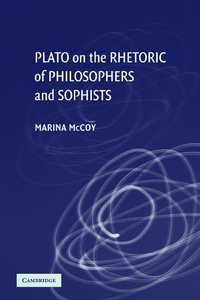
Plato on the Rhetoric of Philosophers and Sophists
Published on 3. March 2011
Book
Paperback/Softback
222 pages
978-0-521-17537-1 (ISBN)
Description
Marina McCoy explores Plato's treatment of the rhetoric of philosophers and sophists through a thematic treatment of six different Platonic dialogues, including Apology, Protagoras, Gorgias, Republic, Sophist, and Phaedras. She argues that Plato presents the philosopher and the sophist as difficult to distinguish, insofar as both use rhetoric as part of their arguments. Plato does not present philosophy as rhetoric-free, but rather shows that rhetoric is an integral part of philosophy. However, the philosopher and the sophist are distinguished by the philosopher's love of the forms as the ultimate objects of desire. It is this love of the forms that informs the philosopher's rhetoric, which he uses to lead his partner to better understand his deepest desires. McCoy's work is of interest to philosophers, classicists, and communications specialists alike in its careful yet comprehensive treatment of philosophy, sophistry, and rhetoric as portrayed through the drama of the dialogues.
More details
Language
English
Place of publication
Cambridge
United Kingdom
Target group
Professional and scholarly
Product notice
Paperback (trade)
Illustrations
Worked examples or Exercises
Dimensions
Height: 229 mm
Width: 152 mm
Thickness: 13 mm
Weight
368 gr
ISBN-13
978-0-521-17537-1 (9780521175371)
Copyright in bibliographic data and cover images is held by Nielsen Book Services Limited or by the publishers or by their respective licensors: all rights reserved.
Schweitzer Classification
Other editions
Additional editions
Marina McCoy
Plato on the Rhetoric of Philosophers and Sophists
E-Book
01/2008
1st Edition
Cambridge University Press
€38.49
Available for download
Marina McCoy
Plato on the Rhetoric of Philosophers and Sophists
Book
09/2007
Cambridge University Press
€129.10
Shipment within 15-20 days
Person
Content
1. Introduction; 2. Elements of Gorgianic rhetoric and the forensic genre in Plato's Apology; 3. The rhetoric of socratic questioning in the Protagoras; 4. The competition between philosophy and rhetoric in the Gorgias; 5. The dialectical development of the philosopher and sophist in the Republic; 6. Philosophers, sophists, and strangers in the Sophist; 7. Love and rhetoric in Plato's Phaedrus.