

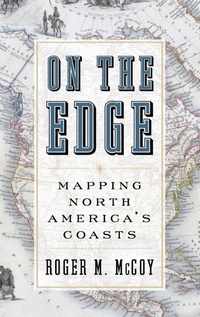
On the Edge
Mapping North America's Coasts
1st Edition
Published on 2. August 2012
Book
Hardback
264 pages
978-0-19-974404-6 (ISBN)
Description
With our access to Google Maps, Global Positioning Systems, and Atlases that cover all regions and terrains and tell us precisely how to get from one place to another, we tend to forget there was ever a time when the world was unknown and uncharted--a mystery waiting to be solved.
In On the Edge, Roger McCoy tells the captivating--and often harrowing--story of the 400 year effort to map North America's Coasts. Much of the book is based on the narratives of mariners who sought a passage through the continent to Asia and produced maps as a byproduct of their journeys. These courageous explorers had to rely on the most rudimentary mapping tools and to contend with unimaginably harsh conditions: ship-crushing ice floes; the threat of frostbite, scurvy, and starvation; gold fever and mutiny; ice that could lock them in for months on end; and, inevitably, the failure to find the elusive Northwest passage. Telling the story from the explorers' perspective, McCoy allows readers to see how maps of their voyages were made and why they were so full of errors, as well as how they gradually acquired greater accuracy, especially after the longitude problem was solved. On the Edge tracks the dramatic voyages of John Cabot, John Davis, Captain Cook, Henry Hudson, Martin Frobisher, John Franklin (who nearly starved to death and become known in England as "the man who ate his boots"), and others, concluding with Robert Peary, Otto Sverdrup, and Vihjalmur Steffanson in the early twentieth century.
Drawing upon diaries, journals, and other primary sources--and including a set of maps charting the progress of exploration over time--On the Edge shows exactly how we came to know the shape of our continent.
In On the Edge, Roger McCoy tells the captivating--and often harrowing--story of the 400 year effort to map North America's Coasts. Much of the book is based on the narratives of mariners who sought a passage through the continent to Asia and produced maps as a byproduct of their journeys. These courageous explorers had to rely on the most rudimentary mapping tools and to contend with unimaginably harsh conditions: ship-crushing ice floes; the threat of frostbite, scurvy, and starvation; gold fever and mutiny; ice that could lock them in for months on end; and, inevitably, the failure to find the elusive Northwest passage. Telling the story from the explorers' perspective, McCoy allows readers to see how maps of their voyages were made and why they were so full of errors, as well as how they gradually acquired greater accuracy, especially after the longitude problem was solved. On the Edge tracks the dramatic voyages of John Cabot, John Davis, Captain Cook, Henry Hudson, Martin Frobisher, John Franklin (who nearly starved to death and become known in England as "the man who ate his boots"), and others, concluding with Robert Peary, Otto Sverdrup, and Vihjalmur Steffanson in the early twentieth century.
Drawing upon diaries, journals, and other primary sources--and including a set of maps charting the progress of exploration over time--On the Edge shows exactly how we came to know the shape of our continent.
Reviews / Votes
This delightful and engaging historical geography is much more about exploring coasts than mapping them. What McCoy (emer., Utah) does well is to compile a chronology of several centuries of European mariners' exploits reproduced or imagined by cartographers, and to do so in a single coherent narrative and set of maps of consistent scale to illustrate the accumulation of cartographic knowledge of North American coasts up to the early 20th century. Always driving exploration was a desire to locate a Northwest Passage. The author's maps catalog the rate, extent, and accuracy of coastal exploration and mapping from the slow and awkward early years, when decades might pass before another explorer appeared, to the final intense and dramatic efforts to explore and map Arctic coastlines. The author's writing is crisp, and the book is an accessible, enjoyable read. Summing Up: Highly recommended. * Choice *More details
Language
English
Place of publication
New York
United States
Target group
College/higher education
Professional and scholarly
General readers interested in history, exploration, or science.
Illustrations
10 bw
Dimensions
Height: 240 mm
Width: 161 mm
Thickness: 20 mm
Weight
612 gr
ISBN-13
978-0-19-974404-6 (9780199744046)
Copyright in bibliographic data and cover images is held by Nielsen Book Services Limited or by the publishers or by their respective licensors: all rights reserved.
Schweitzer Classification
Other editions
Additional editions
E-Book
07/2012
1st Edition
OUP eBook
€23.99
Available for download
E-Book
07/2012
1st Edition
OUP eBook
€18.49
Available for download
Person
Roger M. McCoy is Professor Emeritus, University of Utah, and the author of Ending in Ice.
Content
1. The urge to discover lands and make maps ; Part I: THE PROJECT BEGINS ; 2. Earliest ventures to the Northwest Passage: John Cabot and others ; Part II: 1576-1632 ; 3. Sailors and sailing in the sixteenth century. ; 4. Martin Frobisher succumbs to gold fever ; 5. John Davis makes a near miss ; 6. Henry Hudson has a very bad day ; 7. Further efforts probe the east coasts ; Part III: 1719-1789 ; 8. From the Pacific and through the tundra ; Part IV: 1822-1878 ; 9. John Franklin's expedition fails, but opens the door to success ; 10. The Franklin searchers almost finish the map ; 11. Finding the North Pole ; Part V: FINISHING THE PROJECT ; 12. Amundsen sails through ; Endnotes ; Bibliography ; Index