

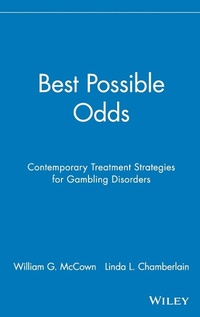
Best Possible Odds
Contemporary Treatment Strategies for Gambling Disorders
1st Edition
Published on 20. March 2000
Book
Hardback
272 pages
978-0-471-18969-5 (ISBN)
Description
An estimated 3-5% of all individuals who gamble will become compulsive gamblers. This "invisible addiction" can be financially and emotionally devastating to both the gambler and his/her family. This timely clinical manual explains why gambling is on the rise and the factors which distinguish recreational and compulsive gamblers. Mental health professionals will learn how to assess and treat compulsive gamblers using a variety of interventions: behavior therapy, inpatient treatment, family therapy, and 12-step programs.
More details
Language
English
Place of publication
New York
United States
Target group
Professional and scholarly
Product notice
sewn/stitched
Cloth over boards
Dimensions
Height: 240 mm
Width: 161 mm
Thickness: 19 mm
Weight
583 gr
ISBN-13
978-0-471-18969-5 (9780471189695)
Copyright in bibliographic data and cover images is held by Nielsen Book Services Limited or by the publishers or by their respective licensors: all rights reserved.
Schweitzer Classification
Persons
William G. McCown and Linda L. Chamberlain are the authors of Best Possible Odds: Contemporary Treatment Strategies for Gambling Disorders, published by Wiley.
Content
An Introduction to Gambling and Gambling Disorders.
Paradigms of Problem Gambling Behavior.
The Phenomenology of Gambling.
Etiologies and Maintenance of Gambling Disorders: A BriefReview.
Treatment for Pathological Gambling: Inpatient Programs andGamblers Anonymous.
A Multiphasic Model of Outpatient Treatment.
Working Strategies for Treatment Success: The Pragmatics of Therapyfor Abusive and Addicted Gamblers.
Assessment of Gambling and Gambling-Related PsychologicalDisturbances.
Chaos Theory, Gambling, and Addictions: Speculations on New Methodsof Nonlinear Treatment.
Family Systems Therapy: Treating the Patient and the System.
Epilogue: Considerations for Future Research andInterventions.
References.
Indexes.
Paradigms of Problem Gambling Behavior.
The Phenomenology of Gambling.
Etiologies and Maintenance of Gambling Disorders: A BriefReview.
Treatment for Pathological Gambling: Inpatient Programs andGamblers Anonymous.
A Multiphasic Model of Outpatient Treatment.
Working Strategies for Treatment Success: The Pragmatics of Therapyfor Abusive and Addicted Gamblers.
Assessment of Gambling and Gambling-Related PsychologicalDisturbances.
Chaos Theory, Gambling, and Addictions: Speculations on New Methodsof Nonlinear Treatment.
Family Systems Therapy: Treating the Patient and the System.
Epilogue: Considerations for Future Research andInterventions.
References.
Indexes.