

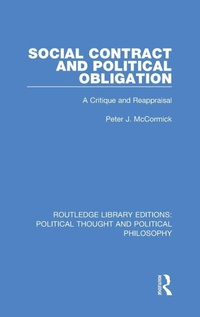
Social Contract and Political Obligation
A Critique and Reappraisal
1st Edition
Published on 4. December 2019
Book
Hardback
332 pages
978-0-367-23420-1 (ISBN)
Description
First published in 1987. This study is concerned with the problem of political obligation, the normative question of why one should obey the law, and with social contract thought as an answer to this question. It is entitled a critique, but the critique is not of social contract theory as such, but rather of the "orthodox" treatment of contract that yields so readily to the rough handling and easy rejection that is the normal lot of contractarianism in contemporary treatments. In its place will be suggested a reinterpretation of contract that sees it as making different assumptions and requiring different premises, and that is proof against many of the orthodox refutations of social contract theory; the reinterpretation is thus in the nature of a vindication.
First, from an examination of the most commonly cited champions of contractarianism (namely Hobbes, Locke and Rousseau) will be derive a reinterpretation of contract in the form of a new model or syllogism, the features of which will be brought out by contrasting it first with the contemporary ideas of John Rawls and then with the orthodox model itself. Democratic consent theory, as the heir to the remnants of the orthodox model, will be examined, and the ideas of T. H. Green will be considered as embodying an important feature of contractarianism omitted or ignored by the orthodox model (and hence by democratic theory.) Finally, the new model of contract will be suggested as a potentially useful approach to the problem of political obligation in the modern context.
This title will be of interest to student of politics and philosophy.
First, from an examination of the most commonly cited champions of contractarianism (namely Hobbes, Locke and Rousseau) will be derive a reinterpretation of contract in the form of a new model or syllogism, the features of which will be brought out by contrasting it first with the contemporary ideas of John Rawls and then with the orthodox model itself. Democratic consent theory, as the heir to the remnants of the orthodox model, will be examined, and the ideas of T. H. Green will be considered as embodying an important feature of contractarianism omitted or ignored by the orthodox model (and hence by democratic theory.) Finally, the new model of contract will be suggested as a potentially useful approach to the problem of political obligation in the modern context.
This title will be of interest to student of politics and philosophy.
More details
Series
Language
English
Place of publication
London
United Kingdom
Publishing group
Taylor & Francis Ltd
Target group
College/higher education
Dimensions
Height: 240 mm
Width: 161 mm
Thickness: 23 mm
Weight
666 gr
ISBN-13
978-0-367-23420-1 (9780367234201)
Copyright in bibliographic data and cover images is held by Nielsen Book Services Limited or by the publishers or by their respective licensors: all rights reserved.
Schweitzer Classification
Other editions
Additional editions

Book
12/2021
1st Edition
Routledge
€58.90
Shipment within 15-20 days

E-Book
11/2019
1st Edition
Routledge
€48.49
Available for download
Content
1. Introduction 2. The Theme Introduced: Grotius 3. The Theme Developed: Hobbes 4. The Theme Developed: Locke 5. The Theme Developed: Rousseau 6. The Theme Clarified: The Imputed Contract and John Rawls 7. The Theme Clarified: The Orthodox Model and Imputed Contract 8. The Theme divided: Democracy, Consent and Obligation 9. The Theme Divided: T. H. Green 10. Conclusion; Appendices