

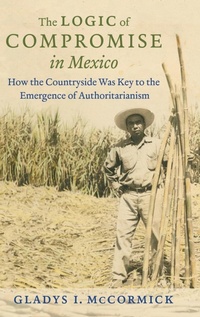
The Logic of Compromise in Mexico
How the Countryside Was Key to the Emergence of Authoritarianism
Published on 11. April 2016
Book
Hardback
288 pages
978-1-4696-2894-3 (ISBN)
Description
In this political history of twentieth-century Mexico, Gladys McCormick argues that the key to understanding the immense power of the long-ruling Partido Revolucionario Institucional (PRI) is to be found in the countryside. Using newly available sources, including declassified secret police files and oral histories, McCormick looks at large-scale sugar cooperatives in Morelos and Puebla, two major agricultural regions that serve as microcosms of events across the nation. She argues that Mexico's rural peoples, despite shouldering much of the financial burden of modernization policies, formed the PRI regime's most fervent base of support.
McCormick demonstrates how the PRI exploited this support, using key parts of the countryside to test and refine instruments of control-including the regulation of protest, manipulation of collective memories of rural communities, and selective application of violence against critics-that it later employed in other areas, both rural and urban. With three peasant leaders, brothers named Ruben, Porfirio, and Antonio Jaramillo, at the heart of her story, McCormick draws a capacious picture of peasant activism, disillusion, and compromise in state formation, revealing the basis for an enduring political culture dominated by the PRI. On a broader level, McCormick demonstrates the connections among modern state building in Latin America, the consolidation of new forms of authoritarian rule, and the deployment of violence on all sides.
McCormick demonstrates how the PRI exploited this support, using key parts of the countryside to test and refine instruments of control-including the regulation of protest, manipulation of collective memories of rural communities, and selective application of violence against critics-that it later employed in other areas, both rural and urban. With three peasant leaders, brothers named Ruben, Porfirio, and Antonio Jaramillo, at the heart of her story, McCormick draws a capacious picture of peasant activism, disillusion, and compromise in state formation, revealing the basis for an enduring political culture dominated by the PRI. On a broader level, McCormick demonstrates the connections among modern state building in Latin America, the consolidation of new forms of authoritarian rule, and the deployment of violence on all sides.
More details
Language
English
Place of publication
Chapel Hill
United States
Target group
Professional and scholarly
Dimensions
Height: 240 mm
Width: 161 mm
Thickness: 22 mm
Weight
675 gr
ISBN-13
978-1-4696-2894-3 (9781469628943)
Copyright in bibliographic data and cover images is held by Nielsen Book Services Limited or by the publishers or by their respective licensors: all rights reserved.
Schweitzer Classification
Other editions
Additional editions
Gladys I. Mccormick
The Logic of Compromise in Mexico
How the Countryside Was Key to the Emergence of Authoritarianism
E-Book
02/2016
The University of North Carolina Press
€19.49
Available for download
Person
Gladys I. McCormick is assistant professor of history at Syracuse University, USA.