

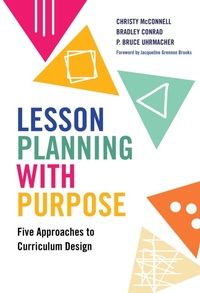
Lesson Planning with Purpose
Five Approaches to Curriculum Design
Published on 19. June 2020
Book
Hardback
208 pages
978-0-8077-6399-5 (ISBN)
Description
When teachers and students are both engaged in the educational enterprise, every day has the potential to be transformative. Lesson Planning with Purpose takes readers on a journey through many pathways to engaging and meaningful educational experiences. The text first discusses Perceptive Teaching: the belief that teachers must know themselves and their students while cultivating culturally sensitive, safe, and inviting spaces for learning for all students. Next, five unique approaches to lesson planning are explored: behaviorist, constructivist, aesthetic, ecological, and integrated social-emotional learning. Each chapter provides the rationale for the approach, its theoretical background, practical applications, and critiques and considerations. Chapters end with a sample lesson that can be compared across approaches. Winner of the 2021 American Association for Teaching and Curriculum (AATC) O.L. Davis Outstanding Book Award. Book Features:
A comprehensive examination of multiple approaches to lesson planning.
Guidance for teachers on when to choose various approaches, as well as how they might mix and match and blend ideas.
User-friendly lesson plan templates, sample lessons, and discussion questions.
An appendix with lesson plan examples written by practicing teachers across content areas and age groups.
A comprehensive examination of multiple approaches to lesson planning.
Guidance for teachers on when to choose various approaches, as well as how they might mix and match and blend ideas.
User-friendly lesson plan templates, sample lessons, and discussion questions.
An appendix with lesson plan examples written by practicing teachers across content areas and age groups.
More details
Language
English
Place of publication
New York
United States
Target group
Professional and scholarly
Product notice
sewn/stitched
Cloth over boards
Dimensions
Height: 231 mm
Width: 160 mm
Thickness: 15 mm
Weight
417 gr
ISBN-13
978-0-8077-6399-5 (9780807763995)
Copyright in bibliographic data and cover images is held by Nielsen Book Services Limited or by the publishers or by their respective licensors: all rights reserved.
Schweitzer Classification
Persons
Christy McConnell is professor of foundations and curriculum studies at the University of Northern Colorado. Bradley Conrad is associate professor of education at Capital University, Columbus, Ohio. P. Bruce Uhrmacher is professor of research methods and statistics and curriculum and instruction in the Morgridge College of Education at the University of Denver.
Content
Foreword
Jacqueline Grennon Brooks
Preface
Acknowledgments
1.?Planning with Purpose
Curriculum Lens
Overview of the Five Approaches to Lesson Planning
General Tips to Make Each Approach Successful
Teachers as Artists
What Does It Mean to Plan with Purpose?
How to Use This Book
About Us
2.?Perceptive Teaching: Who I Am and What I Do
Teaching is Never a Neutral Act
What is Culture? What is Multicultural Education?
What is Culturally Responsive Pedagogy?
Educational Psychologists' Contributions to Multiculturalism
Qualities of Perceptive Teaching
Who I Am: Open-Minded, Aware, Caring, Authentic
What I Do: Personalize the Experience, Teach the Whole Person, Teach with Intention, Develop Autonomy
Discussion
Discussion Questions
3.?The Behaviorist Approach to Lesson Planning:-Skill Development
Rationale
Theoretical Background
Practical Application: Lesson Plan Formats
Learning Aims: Behavioral Objectives with ABCD Format
Assessment and Evaluation
Classroom Interactions and Roles
Lesson Plan Comparison: The Behaviorist Approach to Teaching Metaphor
Critiques and Considerations
Discussion Questions
4.?The Constructivist Approach to Lesson Planning:-Individualized Meaning Making
Rationale
Theoretical Background
Practical Application: Lesson Plan Formats
Learning Aims: Emergent Understandings
Assessment and Evaluation
Classroom Interactions and Roles
Lesson Plan Comparison: The Constructivist Approach to Teaching Metaphor
Critiques and Considerations
Discussion Questions
5.?The Aesthetic Approach to Lesson Planning:-Sensory Rich, Memorable Experiences
Rationale
Theoretical Background
Practical Application: Lesson Plan Formats
Learning Aims: Expressive Objectives
Assessment and Evaluation: Critique: Evaluate, Assess, Reflect
Classroom Interactions and Roles
Lesson Plan Comparison: The Aesthetic Approach to Teaching Metaphor
Critiques and Considerations
Discussion Questions
6.?The Ecological Approach to Lesson Planning:-Real World Relevance and Connections
Rationale
Theoretical Background
Ecomindedness and Place-based Curriculum Together
Practical Application: Lesson Plan Formats
Learning Aims: Experience-Based Objectives (EBOs)
Lesson Plan Examples
Assessment and Evaluation
Classroom Interactions and Roles
Lesson Plan Comparison: The Ecological Approach to Teaching Metaphor
Critiques and Considerations
Discussion Questions
7.?The Integrated Social Emotional Learning Approach to Lesson Planning:- Relationship Building and Holistic Development
Rationale
Theoretical Background
Practical Application: Lesson Plan Formats
Learning Aims: Integrated Social Emotional & Individual SEL Objectives
Assessment and Evaluation
Classroom Interactions and Roles
Lesson Plan Comparison: The Integrated Social Emotional Learning Approach to Teaching Metaphor
Critiques and Considerations
Discussion Questions
8.?Planning with Purpose Summary and Extensions
The Five Approaches to Lesson Planning
Paying Attention to Context: Perceptive Teaching
Blending Approaches
Another Word on Lesson Planning
Unit Planning
Unit Plans Using a Single Approach
Bringing it all Together Separately
Appendix A: Behaviorist Lesson Plan Template and Examples
Appendix B: Constructivist Lesson Plan Template and Examples
Appendix C: Aesthetic Lesson Plan Template and Examples
Appendix D: Ecological Lesson Plan Templates (Ecomindedness and Place-Based) and Examples
Appendix E: Integrated Social Emotional Learning (ISEL) Lesson Plan Template and Examples
Appendix F: Biographical Statements for Lesson Plan Examples
References
Index
About the Authors
Jacqueline Grennon Brooks
Preface
Acknowledgments
1.?Planning with Purpose
Curriculum Lens
Overview of the Five Approaches to Lesson Planning
General Tips to Make Each Approach Successful
Teachers as Artists
What Does It Mean to Plan with Purpose?
How to Use This Book
About Us
2.?Perceptive Teaching: Who I Am and What I Do
Teaching is Never a Neutral Act
What is Culture? What is Multicultural Education?
What is Culturally Responsive Pedagogy?
Educational Psychologists' Contributions to Multiculturalism
Qualities of Perceptive Teaching
Who I Am: Open-Minded, Aware, Caring, Authentic
What I Do: Personalize the Experience, Teach the Whole Person, Teach with Intention, Develop Autonomy
Discussion
Discussion Questions
3.?The Behaviorist Approach to Lesson Planning:-Skill Development
Rationale
Theoretical Background
Practical Application: Lesson Plan Formats
Learning Aims: Behavioral Objectives with ABCD Format
Assessment and Evaluation
Classroom Interactions and Roles
Lesson Plan Comparison: The Behaviorist Approach to Teaching Metaphor
Critiques and Considerations
Discussion Questions
4.?The Constructivist Approach to Lesson Planning:-Individualized Meaning Making
Rationale
Theoretical Background
Practical Application: Lesson Plan Formats
Learning Aims: Emergent Understandings
Assessment and Evaluation
Classroom Interactions and Roles
Lesson Plan Comparison: The Constructivist Approach to Teaching Metaphor
Critiques and Considerations
Discussion Questions
5.?The Aesthetic Approach to Lesson Planning:-Sensory Rich, Memorable Experiences
Rationale
Theoretical Background
Practical Application: Lesson Plan Formats
Learning Aims: Expressive Objectives
Assessment and Evaluation: Critique: Evaluate, Assess, Reflect
Classroom Interactions and Roles
Lesson Plan Comparison: The Aesthetic Approach to Teaching Metaphor
Critiques and Considerations
Discussion Questions
6.?The Ecological Approach to Lesson Planning:-Real World Relevance and Connections
Rationale
Theoretical Background
Ecomindedness and Place-based Curriculum Together
Practical Application: Lesson Plan Formats
Learning Aims: Experience-Based Objectives (EBOs)
Lesson Plan Examples
Assessment and Evaluation
Classroom Interactions and Roles
Lesson Plan Comparison: The Ecological Approach to Teaching Metaphor
Critiques and Considerations
Discussion Questions
7.?The Integrated Social Emotional Learning Approach to Lesson Planning:- Relationship Building and Holistic Development
Rationale
Theoretical Background
Practical Application: Lesson Plan Formats
Learning Aims: Integrated Social Emotional & Individual SEL Objectives
Assessment and Evaluation
Classroom Interactions and Roles
Lesson Plan Comparison: The Integrated Social Emotional Learning Approach to Teaching Metaphor
Critiques and Considerations
Discussion Questions
8.?Planning with Purpose Summary and Extensions
The Five Approaches to Lesson Planning
Paying Attention to Context: Perceptive Teaching
Blending Approaches
Another Word on Lesson Planning
Unit Planning
Unit Plans Using a Single Approach
Bringing it all Together Separately
Appendix A: Behaviorist Lesson Plan Template and Examples
Appendix B: Constructivist Lesson Plan Template and Examples
Appendix C: Aesthetic Lesson Plan Template and Examples
Appendix D: Ecological Lesson Plan Templates (Ecomindedness and Place-Based) and Examples
Appendix E: Integrated Social Emotional Learning (ISEL) Lesson Plan Template and Examples
Appendix F: Biographical Statements for Lesson Plan Examples
References
Index
About the Authors