

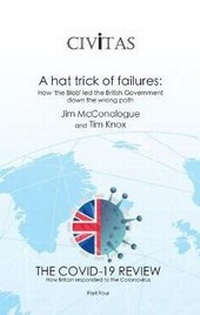
A hat trick of failures
How 'the Blob' led the British Government down the wrong path
Published on 25. June 2020
Book
Paperback/Softback
72 pages
978-1-912581-10-8 (ISBN)
Description
Britain has achieved an undesirable hat trick of failures in its Covid-19 pandemic response.
Jim McConalogue and Tim Knox argue in this report that:
* Along with Spain, Britain has the highest excess death rate per capita in the world for the first half
of 2020.
* The government's reaction to the Covid-19 pandemic has also been one of the most financially
expensive of any country in the OECD both in terms of the cost of the measures that the government
has taken and the overall damage to the economy.
* Only three countries in the world are less prepared to ease lockdown restrictions than the UK:
Algeria, Nicaragua and Iran.
McConalogue and Knox put the blame for this poor response on what they call 'The Blob' - the
scientific clique entrenched within a managerialist Whitehall culture which the politicians chose not
to confront or question. They show how the advisory groups to the government appear to have been
granted 'a representational monopoly' with the advice coming from scientific committees being
rarely challenged either by government or by those outside the inner circle of advisers.
They argue that ministerial deference to 'the science' was frequently not justified. 'The science'
made many mistakes. Other considerations - including the impact of sending of elderly infected
patients from NHS hospitals to care homes and the wider economic costs - were never given the
attention they deserved.?
The authors recommend that parliament and future inquiries should question whether the
government might have drawn upon a far wider pool of expertise than that offered by existing
advisory bodies. Should there now be a re-evaluation of the purposes, composition and objectives of
the government's scientific advisory groups? Should the circular and self-reinforcing way in which the
Cabinet Office Briefing Rooms (COBR) authorises the Scientific Advisory Group for Emergencies
(SAGE) but then almost solely and unquestionably relies upon its advice in return be dismantled?
And why did other European countries - including Germany, Sweden and the Netherlands - fare so
much better in terms of their rates of excess deaths, the economic impact of the measures taken in
response to the pandemic and their readiness to ease lockdown?
Jim McConalogue and Tim Knox argue in this report that:
* Along with Spain, Britain has the highest excess death rate per capita in the world for the first half
of 2020.
* The government's reaction to the Covid-19 pandemic has also been one of the most financially
expensive of any country in the OECD both in terms of the cost of the measures that the government
has taken and the overall damage to the economy.
* Only three countries in the world are less prepared to ease lockdown restrictions than the UK:
Algeria, Nicaragua and Iran.
McConalogue and Knox put the blame for this poor response on what they call 'The Blob' - the
scientific clique entrenched within a managerialist Whitehall culture which the politicians chose not
to confront or question. They show how the advisory groups to the government appear to have been
granted 'a representational monopoly' with the advice coming from scientific committees being
rarely challenged either by government or by those outside the inner circle of advisers.
They argue that ministerial deference to 'the science' was frequently not justified. 'The science'
made many mistakes. Other considerations - including the impact of sending of elderly infected
patients from NHS hospitals to care homes and the wider economic costs - were never given the
attention they deserved.?
The authors recommend that parliament and future inquiries should question whether the
government might have drawn upon a far wider pool of expertise than that offered by existing
advisory bodies. Should there now be a re-evaluation of the purposes, composition and objectives of
the government's scientific advisory groups? Should the circular and self-reinforcing way in which the
Cabinet Office Briefing Rooms (COBR) authorises the Scientific Advisory Group for Emergencies
(SAGE) but then almost solely and unquestionably relies upon its advice in return be dismantled?
And why did other European countries - including Germany, Sweden and the Netherlands - fare so
much better in terms of their rates of excess deaths, the economic impact of the measures taken in
response to the pandemic and their readiness to ease lockdown?
More details
Language
English
Place of publication
London
United Kingdom
Dimensions
Height: 216 mm
Width: 138 mm
Thickness: 5 mm
ISBN-13
978-1-912581-10-8 (9781912581108)
Copyright in bibliographic data and cover images is held by Nielsen Book Services Limited or by the publishers or by their respective licensors: all rights reserved.
Schweitzer Classification