

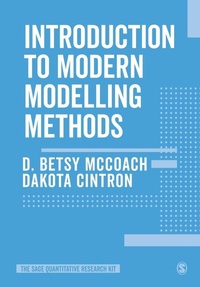
Introduction to Modern Modelling Methods
1st Edition
Published on 21. March 2022
Book
Paperback/Softback
304 pages
978-1-5264-2403-7 (ISBN)
Description
Using simple and direct language, this concise text provides practical guidance on a wide range of modeling methods and techniques for use with quantitative data. It covers:
? 2-level Multilevel Models
? Structural Equation Modeling (SEM)
? Longitudinal Modeling using multilevel and SEM techniques
? Combining organizational and longitudinal models
Part of The SAGE Quantitative Research Kit, this book will give you the know-how and confidence needed to succeed on your quantitative research journey.
? 2-level Multilevel Models
? Structural Equation Modeling (SEM)
? Longitudinal Modeling using multilevel and SEM techniques
? Combining organizational and longitudinal models
Part of The SAGE Quantitative Research Kit, this book will give you the know-how and confidence needed to succeed on your quantitative research journey.
More details
Series
Language
English
Place of publication
London
United Kingdom
Target group
College/higher education
Dimensions
Height: 244 mm
Width: 170 mm
Thickness: 17 mm
Weight
528 gr
ISBN-13
978-1-5264-2403-7 (9781526424037)
Copyright in bibliographic data and cover images is held by Nielsen Book Services Limited or by the publishers or by their respective licensors: all rights reserved.
Schweitzer Classification
Other editions
Additional editions
D. Betsy McCoach | Dakota Cintron
Introduction to Modern Modelling Methods
E-Book
03/2022
1st Edition
SAGE Publications Ltd
€61.49
Available for download
D. Betsy McCoach | Dakota Cintron
Introduction to Modern Modelling Methods
E-Book
03/2022
1st Edition
SAGE Publications Ltd
€61.49
Available for download
Persons
D. Betsy McCoach, Ph.D., is professor of Research Methods, Measurement, and Evaluation in the Educational Psychology department at the University of Connecticut, where she teaches graduate courses in Structural Equation Modeling, Multilevel Modeling, Advances in Latent Variable Modeling, and Instrument Design. Dr. McCoach has co-authored over 100 peer-reviewed journal articles, book chapters, and books, including Instrument Design in the Affective Domain and Multilevel Modeling of Educational Data. In 2011, Dr. McCoach founded the Modern Modeling Methods conference.
Dr. McCoach is co-Principal Investigator for the National Center for Research on Gifted Education and has served as Principal Investigator, co-Principal Investigator, and/or research methodologist for several other federally-funded research projects/grants.
Dr. McCoach's research interests include latent variable modeling, multilevel modeling, longitudinal modeling, instrument design, and gifted education.
Dr. Dakota Cintron, Ph.D., is a postdoctoral scholar for the Evidence for Action (E4A) Methods Laboratory. Dr. Cintron's research focuses on the application, development, and assessment of quantitative methods in the social and behavioral sciences. His areas of research interest include topics such as item response theory, latent variable and structural equation modeling, longitudinal data analysis, hierarchical linear modeling, and causal inference. Dr. Cintron earned his Ph.D. in Educational Psychology from the University of Connecticut. He has previously held research positions at the Institute for Health, Health Care Policy and Aging Research, the National Institute for Early Education Research, and New Visions for Public Schools.
Dr. McCoach is co-Principal Investigator for the National Center for Research on Gifted Education and has served as Principal Investigator, co-Principal Investigator, and/or research methodologist for several other federally-funded research projects/grants.
Dr. McCoach's research interests include latent variable modeling, multilevel modeling, longitudinal modeling, instrument design, and gifted education.
Dr. Dakota Cintron, Ph.D., is a postdoctoral scholar for the Evidence for Action (E4A) Methods Laboratory. Dr. Cintron's research focuses on the application, development, and assessment of quantitative methods in the social and behavioral sciences. His areas of research interest include topics such as item response theory, latent variable and structural equation modeling, longitudinal data analysis, hierarchical linear modeling, and causal inference. Dr. Cintron earned his Ph.D. in Educational Psychology from the University of Connecticut. He has previously held research positions at the Institute for Health, Health Care Policy and Aging Research, the National Institute for Early Education Research, and New Visions for Public Schools.
Content
Clustering and Dependence: Our Entry into Multilevel Modeling
Multilevel Modeling: A Conceptual Introduction
Multilevel Model Building Steps and Example
Introduction to Structural Equation Modeling
Specification and Identification of Structural Equation Models
Building Structural Equation Models
Longitudinal Growth Curve Models in MLM and SEM
An Applied Example of Growth Curve Modeling in MLM and SEM
Multilevel Modeling: A Conceptual Introduction
Multilevel Model Building Steps and Example
Introduction to Structural Equation Modeling
Specification and Identification of Structural Equation Models
Building Structural Equation Models
Longitudinal Growth Curve Models in MLM and SEM
An Applied Example of Growth Curve Modeling in MLM and SEM