

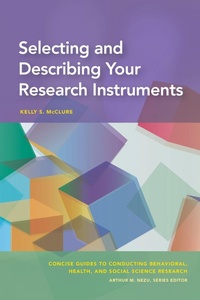
Selecting and Describing Your Research Instruments
Published on 23. June 2020
Book
Paperback/Softback
125 pages
978-1-4338-3222-2 (ISBN)
Description
Emerging researchers are often surprised to learn that instrument selection is a complex and important step in the process of research design. The first of its kind, this concise guide explains how to identify appropriate instruments, select the best ones for the job, and properly describe the instruments so that others will know how and why they were chosen. Each chapter in the book focuses on a specific aspect of instrument selection, with illuminating examples and helpful worksheets to fill out along the way. Topics include pinpointing what to measure, types of instruments, resources for identifying instruments, organizing information and taking notes, describing instruments for different audiences, ethical issues, considerations around individual differences and diversity, consulting with advisors, and troubleshooting. This book is part of APA's Concise Guides to Conducting Behavioral, Health, and Social Science Research series. Aimed at undergraduate students in research methods courses or others with a lab or research project, each book describes a key stage in the research process. Collectively, these books provide a solid grounding in research from start to finish.
More details
Series
Language
English
Place of publication
Washington DC
United States
Target group
Professional and scholarly
Product notice
Paperback (trade)
Dimensions
Height: 226 mm
Width: 150 mm
Thickness: 10 mm
Weight
181 gr
ISBN-13
978-1-4338-3222-2 (9781433832222)
Copyright in bibliographic data and cover images is held by Nielsen Book Services Limited or by the publishers or by their respective licensors: all rights reserved.
Schweitzer Classification
Person
Kelly McClure, PhD, is associate professor and chair of psychology at La Salle University in Philadelphia, Pennsylvania. She received her doctorate from Drexel University in 2 2. She was a co-editor of Practitioners Guide to Empirically Based Measures of Depression and is currently an associate editor of Clinical Psychology: Science and Practice. Her main research interests are in social problem solving and coping with cancer.
Content
Dedication
Series Foreword
Acknowledgements
Introduction
Chapter . Identifying and Defining the Constructs and Variables to Measure
Chapter 2. Types of Instruments and Their Properties: Methods to Measure Variables and Constructs
Chapter 3. Identifying Available Instruments
Chapter 4. Gathering and Organizing Information About Instruments
Chapter 5. Permissions and Feasibility
Chapter . Using the Evidence to Guide Your Instrument Selection
Chapter 7. Following Ethical Principles and Guidelines
Chapter 8. Describing the Instruments Effectively for Different Audiences
Chapter 9. Troubleshooting
Conclusion
Glossary
References
Index
About the Author
About the Series Editor
Series Foreword
Acknowledgements
Introduction
Chapter . Identifying and Defining the Constructs and Variables to Measure
Chapter 2. Types of Instruments and Their Properties: Methods to Measure Variables and Constructs
Chapter 3. Identifying Available Instruments
Chapter 4. Gathering and Organizing Information About Instruments
Chapter 5. Permissions and Feasibility
Chapter . Using the Evidence to Guide Your Instrument Selection
Chapter 7. Following Ethical Principles and Guidelines
Chapter 8. Describing the Instruments Effectively for Different Audiences
Chapter 9. Troubleshooting
Conclusion
Glossary
References
Index
About the Author
About the Series Editor