

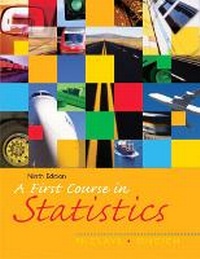
A First Course in Statistics
9th Edition
Published on 23. June 2005
Book
Hardback
640 pages
978-0-13-149979-9 (ISBN)
Description
For algebra-based Introductory Statistics courses.
The Ninth Edition of this best selling introductory text features a stronger emphasis on critical thinking and sound decision making through its extensive coverage of data collection and analysis. In addition, it features a balanced approach to both the theory and application of statistics. Incorporating more pedagogy than ever before, the text helps students develop statistical thinking and teaches students to properly assess the credibility of inferences - from the vantage point of both the consumer and the producer.
The Ninth Edition of this best selling introductory text features a stronger emphasis on critical thinking and sound decision making through its extensive coverage of data collection and analysis. In addition, it features a balanced approach to both the theory and application of statistics. Incorporating more pedagogy than ever before, the text helps students develop statistical thinking and teaches students to properly assess the credibility of inferences - from the vantage point of both the consumer and the producer.
More details
Edition
9th edition
Language
English
Place of publication
United States
Publishing group
Pearson Education (US)
Target group
Professional and scholarly
Dimensions
Height: 253 mm
Width: 201 mm
Thickness: 21 mm
Weight
1126 gr
ISBN-13
978-0-13-149979-9 (9780131499799)
Copyright in bibliographic data and cover images is held by Nielsen Book Services Limited or by the publishers or by their respective licensors: all rights reserved.
Schweitzer Classification
Other editions
New editions
Book
02/2008
10th Edition
Pearson
€77.66
Article exhausted; check for reprint
Previous edition
Book
06/2002
8th Edition
Pearson
€49.51
Article exhausted; check for reprint
Content
Chapter 1 Statistics, Data, and Statistical Thinking 1.1 The Science of Statistics
1.2 Types of Statistical Applications
1.3 Fundamental Elements of Statistics
1.4 Types of Data
1.5 Collecting Data
1.6 The Role of Statistics in Critical Thinking
Statistics in Action: USA Weekend Teen Surveys - Are Boys Really from Mars and Girls from Venus?
Using Technology: Creating and Listing Data in MINITAB
Chapter 2 Methods for Describing Sets of Data
2.1 Describing Qualitative Data
2.2 Graphical Methods for Describing Quantitative Data
2.3 Summation Notation
2.4 Numerical Measures of Central Tendency
2.5 Numerical Measures of Variability
2.6 Interpreting the Standard Deviation
2.7 Numerical Measures of Relative Standing
2.8 Methods for Detecting Outliers (Optional)
2.9 Graphing Bivariate Relationships (Optional)
2.10 Distorting the Truth with Descriptive Techniques
Statistics In Action: The "Eye Cue" Test: Does Experience Improve Performance?
Using Technology: Describing Data in MINITAB
Chapter 3 Probability
3.1 Events, Sample Spaces, and Probability
3.2 Unions and Intersections
3.3 Complementary Events
3.4 The Additive Rule and Mutually Exclusive Events
3.5 Conditional Probability
3.6 The Multiplicative Rule and Independent Events
3.7 Random Sampling
Statistics In Action: Lotto Buster!
Using Technology: Generating a Random Sample in MINITAB
Chapter 4 Random Variables and Probability Distributions
4.1 Two Types of Random Variables
4.2 Probability Distributions for Discrete Random Variables
4.3 The Binomial Random Distribution
4.4 Probability Distributions for Continuous Random Variables
4.5 The Normal Distribution
4.6 Descriptive Methods for Assessing Normality
4.7 Approximating a Binomial Distribution with a Normal Distribution (Optional)
4.8 Sampling Distributions
4.9 The Central Limit Theorem
Statistics in Action: Super Weapons Development - Optimizing the Hit Ratio
Using Technology: Binomial Probabilities, Normal Probabilities, and Normal Probability Plots in MINITAB
Chapter 5 Inferences Based on a Single Sample: Estimation with Confidence Intervals
5.1 Large-Sample Confidence Interval for a Population Mean
5.2 Small-Sample Confidence Interval for a Population Mean
5.3 Large-Sample Confidence Interval for a Population Proportion
5.4 Determining the Sample Size
5.5 Identifying the Parameter to be Estimated
Statistics in Action:Speed - Improving the Sprint Times of High School Football Players
Using Technology: Confidence Intervals in MINITAB
Chapter 6 Inferences Based on a Single Sample: Tests of Hypothesis
6.1 The Elements of a Test of Hypothesis
6.2 Large-Sample Test of Hypothesis About a Population Mean
6.3 Observed Significance Levels: p-Values
6.4 Small-Sample Test of Hypothesis About a Population Mean
6.5 Large-Sample Test of Hypothesis About a Population Proportion
6.6 A Nonparametric Test about a Population Median (Optional)
Statistics in Action: Diary of a Kleenex User
Using Technology: Tests of Hypothesis in MINITAB
Chapter 7 Comparing Population Means
7.1 Comparing Two Population Means: Independent Sampling
7.2 Comparing Two Population Means: Paired Difference Experiments
7.3 Determining the Sample Size
7.4 A Nonparametric Test for Comparing Two Population: Independent Sampling (Optional)
7.5 A Nonparametric Test for Comparing Two Populations: Paired Difference Experiments (Optional)
7.6 Comparing Three or More Population Means: Analysis of Variance (Optional)
Statistics in Action: On the Trail of the Cockroach
Using Technology: Comparing Means in MINITAB
Chapter 8 Comparing Population Proportions
8.1 Comparing Two Population Proportions: Independent Sampling
8.2 Determining the Sample Size
8.3 Testing Categorical Probabilities: Multinomial Experiment
8.4 Testing Categorical Probabilities: Two-Way (Contingency) Table
Statistics in Action: A Study of Coupon Users--Mail Versus the Internet
Using Technology: Categorical Data Analyses Using MINITAB
Chapter 9 Simple Linear Regression
9.1 Probabilistic Models
9.2 Fitting the Model: The Least Squares Approach
9.3 Model Assumptions
9.4 An Estimator of ?2
9.5 Assessing the Utility of the Model: Making Inferences About the Slope ?1
9.6 The Coefficient of Correlation
9.7 The Coefficient of Determination
9.8 Using the Model for Estimation and Prediction
9.9 A Complete Example
9.10 A Nonparametric Test for Correlation (Optional)
Statistics in Action: Can "Dowsers" Really Detect Water?
Using Technology: Simple Linear Regression in MINITAB
Appendix A: Tables
Table I Random Numbers
Table II Binomial Probabilities
Table III Normal Curve Areas
Table IV Critical Values of t
Table V Critical Values of TL and TU for the Wilcoxon Rank Sum Test: Independent Samples
Table VI Critical Values of T0 in the Wilcoxon Paired Difference Signed Rank Test
Table VII Percentage Points of the F Distribution, ?=.10
Table VIII Percentage Points of the F Distribution, ?=.05
Table IX Percentage Points of the F Distribution, ?=.025
Table X Percentage Points of the F Distribution, ?=.01
Table XI Critical Values of ?2
Table XII Critical Values of Spearman's Rank Correlation Coefficient
Appendix B: Calculation Formulas for Analysis of Variance (Independent Sampling)
Short Answers to Selected Odd-Numbered Exercises
Index
1.2 Types of Statistical Applications
1.3 Fundamental Elements of Statistics
1.4 Types of Data
1.5 Collecting Data
1.6 The Role of Statistics in Critical Thinking
Statistics in Action: USA Weekend Teen Surveys - Are Boys Really from Mars and Girls from Venus?
Using Technology: Creating and Listing Data in MINITAB
Chapter 2 Methods for Describing Sets of Data
2.1 Describing Qualitative Data
2.2 Graphical Methods for Describing Quantitative Data
2.3 Summation Notation
2.4 Numerical Measures of Central Tendency
2.5 Numerical Measures of Variability
2.6 Interpreting the Standard Deviation
2.7 Numerical Measures of Relative Standing
2.8 Methods for Detecting Outliers (Optional)
2.9 Graphing Bivariate Relationships (Optional)
2.10 Distorting the Truth with Descriptive Techniques
Statistics In Action: The "Eye Cue" Test: Does Experience Improve Performance?
Using Technology: Describing Data in MINITAB
Chapter 3 Probability
3.1 Events, Sample Spaces, and Probability
3.2 Unions and Intersections
3.3 Complementary Events
3.4 The Additive Rule and Mutually Exclusive Events
3.5 Conditional Probability
3.6 The Multiplicative Rule and Independent Events
3.7 Random Sampling
Statistics In Action: Lotto Buster!
Using Technology: Generating a Random Sample in MINITAB
Chapter 4 Random Variables and Probability Distributions
4.1 Two Types of Random Variables
4.2 Probability Distributions for Discrete Random Variables
4.3 The Binomial Random Distribution
4.4 Probability Distributions for Continuous Random Variables
4.5 The Normal Distribution
4.6 Descriptive Methods for Assessing Normality
4.7 Approximating a Binomial Distribution with a Normal Distribution (Optional)
4.8 Sampling Distributions
4.9 The Central Limit Theorem
Statistics in Action: Super Weapons Development - Optimizing the Hit Ratio
Using Technology: Binomial Probabilities, Normal Probabilities, and Normal Probability Plots in MINITAB
Chapter 5 Inferences Based on a Single Sample: Estimation with Confidence Intervals
5.1 Large-Sample Confidence Interval for a Population Mean
5.2 Small-Sample Confidence Interval for a Population Mean
5.3 Large-Sample Confidence Interval for a Population Proportion
5.4 Determining the Sample Size
5.5 Identifying the Parameter to be Estimated
Statistics in Action:Speed - Improving the Sprint Times of High School Football Players
Using Technology: Confidence Intervals in MINITAB
Chapter 6 Inferences Based on a Single Sample: Tests of Hypothesis
6.1 The Elements of a Test of Hypothesis
6.2 Large-Sample Test of Hypothesis About a Population Mean
6.3 Observed Significance Levels: p-Values
6.4 Small-Sample Test of Hypothesis About a Population Mean
6.5 Large-Sample Test of Hypothesis About a Population Proportion
6.6 A Nonparametric Test about a Population Median (Optional)
Statistics in Action: Diary of a Kleenex User
Using Technology: Tests of Hypothesis in MINITAB
Chapter 7 Comparing Population Means
7.1 Comparing Two Population Means: Independent Sampling
7.2 Comparing Two Population Means: Paired Difference Experiments
7.3 Determining the Sample Size
7.4 A Nonparametric Test for Comparing Two Population: Independent Sampling (Optional)
7.5 A Nonparametric Test for Comparing Two Populations: Paired Difference Experiments (Optional)
7.6 Comparing Three or More Population Means: Analysis of Variance (Optional)
Statistics in Action: On the Trail of the Cockroach
Using Technology: Comparing Means in MINITAB
Chapter 8 Comparing Population Proportions
8.1 Comparing Two Population Proportions: Independent Sampling
8.2 Determining the Sample Size
8.3 Testing Categorical Probabilities: Multinomial Experiment
8.4 Testing Categorical Probabilities: Two-Way (Contingency) Table
Statistics in Action: A Study of Coupon Users--Mail Versus the Internet
Using Technology: Categorical Data Analyses Using MINITAB
Chapter 9 Simple Linear Regression
9.1 Probabilistic Models
9.2 Fitting the Model: The Least Squares Approach
9.3 Model Assumptions
9.4 An Estimator of ?2
9.5 Assessing the Utility of the Model: Making Inferences About the Slope ?1
9.6 The Coefficient of Correlation
9.7 The Coefficient of Determination
9.8 Using the Model for Estimation and Prediction
9.9 A Complete Example
9.10 A Nonparametric Test for Correlation (Optional)
Statistics in Action: Can "Dowsers" Really Detect Water?
Using Technology: Simple Linear Regression in MINITAB
Appendix A: Tables
Table I Random Numbers
Table II Binomial Probabilities
Table III Normal Curve Areas
Table IV Critical Values of t
Table V Critical Values of TL and TU for the Wilcoxon Rank Sum Test: Independent Samples
Table VI Critical Values of T0 in the Wilcoxon Paired Difference Signed Rank Test
Table VII Percentage Points of the F Distribution, ?=.10
Table VIII Percentage Points of the F Distribution, ?=.05
Table IX Percentage Points of the F Distribution, ?=.025
Table X Percentage Points of the F Distribution, ?=.01
Table XI Critical Values of ?2
Table XII Critical Values of Spearman's Rank Correlation Coefficient
Appendix B: Calculation Formulas for Analysis of Variance (Independent Sampling)
Short Answers to Selected Odd-Numbered Exercises
Index